
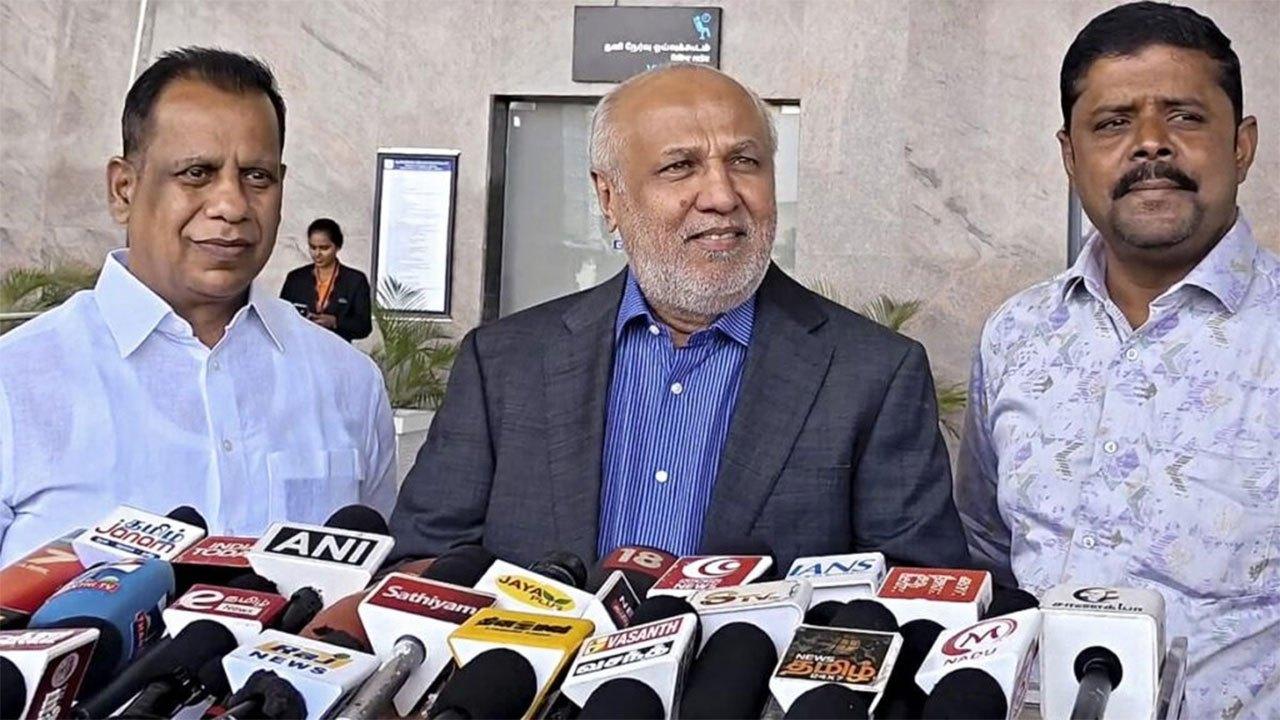
Sri Lanka Muslim Congress (SLMC) leader and Member of Parliament Rauff Hakeem has said that the sovereignty of Katchatheevu is already settled under international law and bilateral agreements, warning that attempts to reopen the issue are not a practical solution to the long-running dispute between fishermen on both sides of the Palk Strait.
Speaking at a press conference in Tamil Nadu on Friday during a visit to India, Hakeem said making Katchatheevu the focus whenever tensions arise between fishermen was not a prudent approach.
Responding to questions on whether Sri Lanka would consider handing the island back to India to ease the frequent detention of Tamil Nadu fishermen, Hakeem said India had already recognised Sri Lanka’s sovereignty over Katchatheevu through international legal frameworks.
He said any attempt to reconsider the island’s status would require engagement through the United Nations, as neither country could independently alter the internationally recognised maritime boundary.
“To change this outside international law would require military action to seize the island, which the Indian central government would never pursue,” Hakeem said.
Hakeem’s comments come amid continued pressure from Tamil Nadu over the detention of fishermen by the Sri Lankan Navy, with Katchatheevu repeatedly returning to the centre of political debate in India.
The 285-acre uninhabited island, situated between Tamil Nadu and Tamil Eelam in the Palk Strait, was placed on the Sri Lankan side of the maritime boundary under the 1974 agreement signed by Indian Prime Minister Indira Gandhi and Sri Lankan Prime Minister Sirimavo Bandaranaike. A subsequent 1976 agreement further restricted fishermen from both countries from fishing in each other’s waters, including around Katchatheevu.
India’s Ministry of External Affairs has previously stated that Indian fishermen are permitted access to Katchatheevu for rest, drying nets and the annual St Anthony’s Church festival, but that this access does not amount to fishing rights around the island.
Katchatheevu remains a flashpoint in Indo-Lanka relations, with political parties in Tamil Nadu repeatedly calling for the island’s return to India as Sri Lankan naval arrests continue. The issue has also been raised by Indian politicians including Prime Minister Narendra Modi, who criticised the 1974 agreement during election campaigning in Tamil Nadu, accusing the Congress party of “callously” giving away the island.
For Tamil Nadu fishing communities, the dispute is not only territorial but tied to repeated arrests, vessel seizures and allegations of mistreatment by the Sri Lankan Navy. For Eelam Tamil fishermen in the North-East, the issue is also linked to illegal bottom trawling and destructive fishing practices by Indian trawlers, which they say have damaged marine resources and devastated their livelihoods.
Addressing the arrest of Tamil Nadu fishermen by the Sri Lankan Navy, Hakeem described the issue as a humanitarian and livelihood crisis rather than a purely legal dispute.
He proposed establishing a joint cooperative framework involving fishermen from both sides of the Palk Strait to encourage dialogue and identify practical solutions. Hakeem said several bilateral discussions and diplomatic committees had already addressed the matter, but acknowledged that implementation of agreed solutions had remained limited. He also stressed the need to protect marine resources, noting that concerns over banned fishing gear and destructive fishing practices continue to influence Sri Lanka’s enforcement actions.
As a long-term measure, Hakeem suggested that the Indian government provide financial support to help Tamil Nadu fishermen transition from traditional coastal fishing methods to deep-sea fishing operations.
Hakeem further announced that a joint delegation representing Tamil-speaking political parties in the Sri Lankan Parliament would soon visit Chennai to meet Tamil Nadu Chief Minister C. Joseph Vijay and discuss coordinated efforts to address the long-standing fishermen issue.
He said the delegation had decided against holding separate meetings and would instead pursue a united approach in discussions with Tamil Nadu authorities.
The fishermen dispute remains one of the most persistent tensions between Sri Lanka and India, sitting at the intersection of maritime boundaries, Tamil Nadu politics, Eelam Tamil livelihoods and Sri Lanka’s militarised control of the northern seas.