
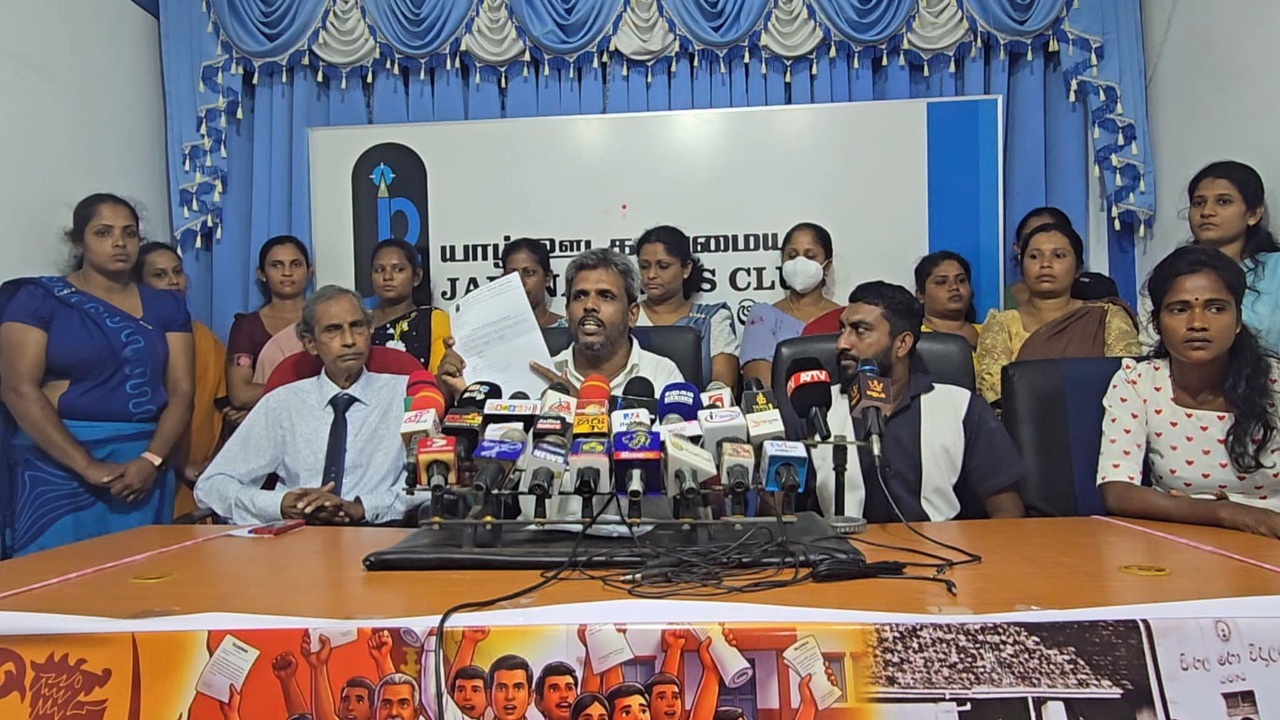
Sinhala organisations have called on the Sri Lankan government to resettle Sinhalese in the Northern Province and allocate land to those they say were displaced from the region, warning that they will mount larger protests if their demands are not met.
Addressing a press conference at the Jaffna Press Club, the representatives urged the government to halt any new land allocation programmes in the Jaffna peninsula until what they described as the land rights of displaced Sinhalese had been addressed. Citing the 1981 census, they claimed that around 6,500 Sinhalese had lived in the peninsula before the war, but that fewer than 150 had since been able to return. They put the peninsula's current population at roughly 700,000 Tamils and 12,000 Muslims, and argued that while others had regained access to their land, only a small number of Sinhalese had been resettled.
The organisations claimed to have learned that discussions on land allocation for other ethnic groups had recently taken place at the Jaffna District Secretariat, and called for such initiatives to be suspended until the claims of Sinhalese were resolved. They said they had campaigned on the issue for the past 17 years and had established a global Sinhala organisation, Sasuna Rekumada, around a decade ago to pursue it, but that repeated representations to successive governments and officials had produced no action. Memoranda setting out their demands, they said, had been submitted to all district secretaries and to the Northern Province governor in March, without response.
The representatives also called for the preservation of what they said were more than 200 historically significant archaeological sites of various religions in the Northern Province, urging the government to "protect and restore" them. They further demanded the appointment of Sinhala-speaking officials, in every Divisional Secretariat in the province.
The groups raised parallel demands over Mannar District, claiming that 8,668 Sinhalese had lived there before the war but that only around a tenth had since been resettled. They alleged that Sinhalese seeking to return had been denied the chance to settle in the Nanattan, Madhu and Musali Divisional Secretariat divisions, and that the authorities had refused to register new settlers.
The implications behind a seemingly reasonable demand
Framed in the language of equal rights, the demands nonetheless sit uneasily against the reality of land disputes in the North-East. Where Tamils and Muslims have been resettled, it has been on the basis of existing deeds and documented ownership. Yet tens of thousands of Tamil landowners, many holding clear documentary proof of title, remain barred from their own properties, above all in areas still under military occupation such as the Valikamam North High Security Zone, Thaiyiddy and Keppapulavu. Far from being offered alternative state land, displaced Tamils have spent years protesting simply for the return of what is already legally theirs.
That contrast is what gives the Sinhala organisations' appeal its edge. If the demand is for the restoration of hereditary, privately owned property held under valid deeds, it is a matter for the landowners and the courts. If, however, it is a call for the state to grant new land and fresh registrations, it would amount to state-facilitated demographic change in the Northern Province, precisely the concern that has long attached to Sinhala settlement schemes across the Tamil homeland, which Tamil parties have repeatedly argued were designed to alter its ethnic composition.
No equivalent for displaced Tamils
The imbalance is sharpened by the absence of any comparable, state-backed resettlement of Eelam Tamils in the south or elsewhere on the island. While successive governments have promoted Sinhala settlement in parts of the North and East, notably through the Mahaweli development zone, Tamils displaced by the war have been offered no equivalent state initiative. Schemes such as Weli Oya, the area formerly known as Manal Aru, remain among the most frequently cited examples of state-engineered demographic transformation, alongside settlement projects in parts of Trincomalee and Ampara.
The selective use of the census
The organisations' reliance on the 1981 census invites scrutiny of its own. The same census that records pre-war Sinhala populations in Jaffna and Mannar also records substantial Sri Lankan Tamil populations elsewhere on the island: more than 170,000 in Colombo District, around 37,000 in Badulla, some 15,000 in Kegalle, over 14,000 in Kurunegala, more than 8,000 in Anuradhapura, over 7,000 in Galle and more than 5,000 in Polonnaruwa. It also distinguishes Sri Lankan Tamils from Indian Tamils in the Central Province, logging over 52,000 Tamils of Sri Lankan origin in Kandy and more than 76,000 in Nuwara Eliya, figures that complicate the common assumption that the hill country's Tamils are all of Indian origin. Yet no comparable programme has been proposed to restore those pre-war patterns. Historical census data is readily invoked to justify Sinhala resettlement in the North and East, while the displacement of Tamils from outside the Tamil-majority regions attracts little attention.
Language, heritage and history
The call for more Sinhala-speaking officials in the North is similarly double-edged. Sri Lanka's public administration already requires officers to meet language-proficiency standards under the Official Languages framework, with trilingual capacity meant to serve the public, even as Tamil activists point to the persistent absence of meaningful Tamil-language services across government institutions in the Sinhala-majority parts of the island.
The demand to protect more than 200 archaeological sites is likely to be read through the same lens. Tamil groups have long accused successive governments of privileging Buddhist archaeological claims in the North-East while neglecting Tamil heritage, pointing to the deteriorating condition of sites such as Manthiri Manai in Jaffna, the archaeological remains on Delft, and centuries-old Hindu temples in areas including Polonnaruwa as evidence of unequal treatment.