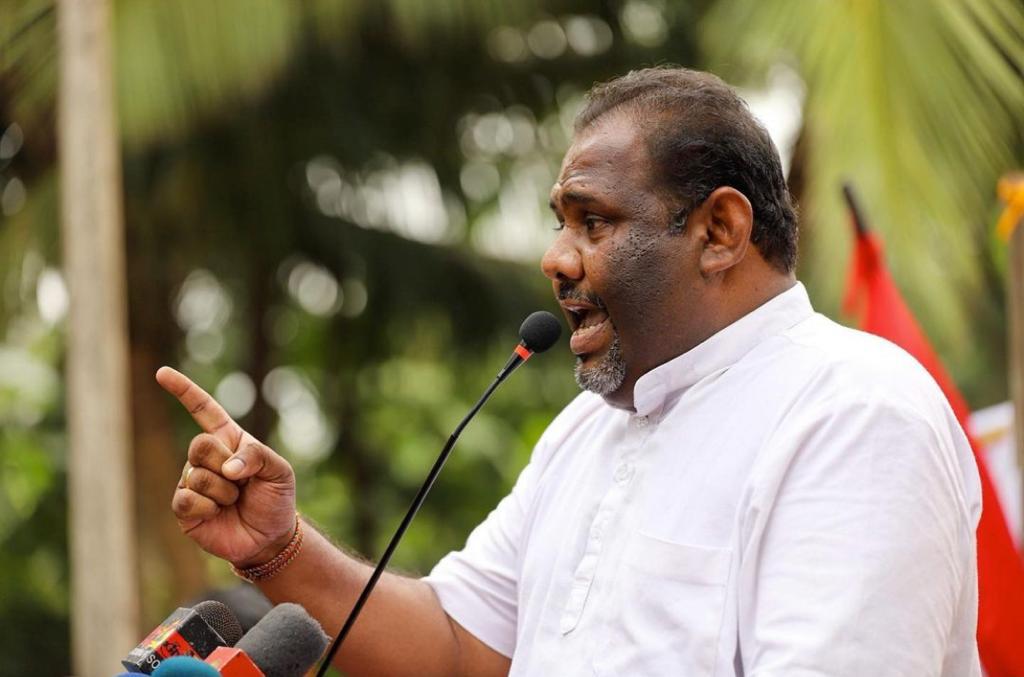
Tamil National People’s Front (TNPF) leader and parliamentarian Gajendrakumar Ponnambalam has sharply criticised the continued extension and application of Sri Lanka’s emergency regulations, arguing that such laws are being used as instruments of political control.
Speaking on the issue, Ponnambalam said emergency powers were routinely justified by the state as necessary to manage crises, but had failed to function effectively when Tamil civilians faced real emergencies.
He argued that in the Tamil homeland, such laws and security structures are instead deployed selectively to monitor, intimidate and suppress Tamils.
Ponnambalam pointed to a recent incident on 26 May, when two fishing boats operating between Karkovalam and Munai, under the Point Pedro Divisional Secretariat area, went to sea at around 11pm and failed to return the following day. According to the TNPF leader, the Divisional Secretariat, the Disaster Management Centre and the Sri Lankan Navy were informed immediately.
Ponnambalam said he personally visited the area and attempted to contact Sri Lanka’s Fisheries Minister Ramalingam Chandrasekar, but claimed there was no effective response or coordination from the authorities. He said naval officials told those seeking assistance that rough sea conditions made search operations impossible. When the Sri Lankan Air Force was contacted, helicopter deployment was also refused due to bad weather conditions.
For Ponnambalam, the incident exposed what he described as the hollowness of the state’s claims that militarisation and emergency powers are designed to protect civilians.
“I question the purpose of establishing camps by acquiring private lands within one kilometre in the Northern and Eastern regions. What benefit does this truly serve? Our lands are taken away, and under the claim of providing security, the authorities are only protecting themselves. So I ask—what is the purpose of this law, and for whom is it really intended?”
The TNPF leader said the continued presence of military camps across the North-East, many on private Tamil land, had not translated into meaningful protection for the people of the Tamil homeland.
Instead, he argued, the state uses emergency laws and security structures to safeguard its own political and military interests.
Ponnambalam further said that despite being in power for nearly two years, the Sri Lankan government had failed to implement key promises, particularly in Tamil areas.
He claimed that emergency legislation continues to function as a tool of suppression rather than a mechanism for public safety.
His remarks come as the government continues to face criticism over the extension of emergency regulations, which were first declared after Cyclone Ditwah and later extended.
Tamil political representatives have warned that such powers, historically used to intensify military control in the North-East, further entrench state surveillance and repression in the Tamil homeland.
Ponnambalam also linked his criticism to the arrest of Tamil rapper Ganeshkumar Sangeethsan, who was detained under the Prevention of Terrorism Act over allegations connected to songs he performed and shared online.
The arrest has sparked protests across the North-East and renewed calls for the repeal of the PTA, a law long condemned by Tamil political parties and human rights organisations for its disproportionate use against Tamils.
Ponnambalam said a person could not be arrested merely for holding or expressing an opinion. He argued that praising LTTE leader Velupillai Prabhakaran or speaking positively about the Liberation Tigers of Tamil Eelam (LTTE) did not amount to terrorism, but was instead an expression of political opinion.
He said the attempt to bring such expression under counter-terrorism law reflected irrational thinking.
According to Ponnambalam, if the state regards political opinion itself as dangerous, then it will continue to rely on security laws to suppress speech. But he insisted that speaking about a leader in a post-war context does not constitute terrorism.
He described the application of emergency-style powers and counter-terror laws in such contexts as an act of intellectual absurdity.
Ponnambalam also criticised those who argue that the PTA need not be repealed or that no alternative framework is required, calling them a “government lacking backbone” and unwilling to make even basic commitments.
He warned that while the Sri Lankan state may attempt to suppress Tamil political views, it cannot erase the underlying sentiments that continue to exist in the Tamil homeland.
He said that even if the LTTE was militarily defeated and silenced through mass violence, if the Tamil people of the North-East were asked today, even seventeen years later, many would still say that such an organisation should exist.
Ponnambalam added that this was why Sri Lanka’s Fisheries Minister Ramalingam Chandrasekar attended the remembrance of Thileepan, the LTTE political wing leader who died on hunger strike in 1987.
His comments come as the arrest of Sangeethsan, known as Hip Hop Sangeeth, continues to draw condemnation from Tamil political parties, lawyers, civil society groups, artists and international human rights organisations.
Protests demanding the rapper’s release have been held in Kilinochchi, Valvettithurai and Vavuniya, with demonstrators condemning the criminalisation of Tamil artistic expression.
For the TNPF leader, the continued use of emergency laws, military occupation and counter-terror legislation reflects a broader pattern of state repression in the North-East.
He said the Sri Lankan government may attempt to conceal its political failures through emergency powers, but warned that such efforts were only an illusion and would not succeed in the long term.