
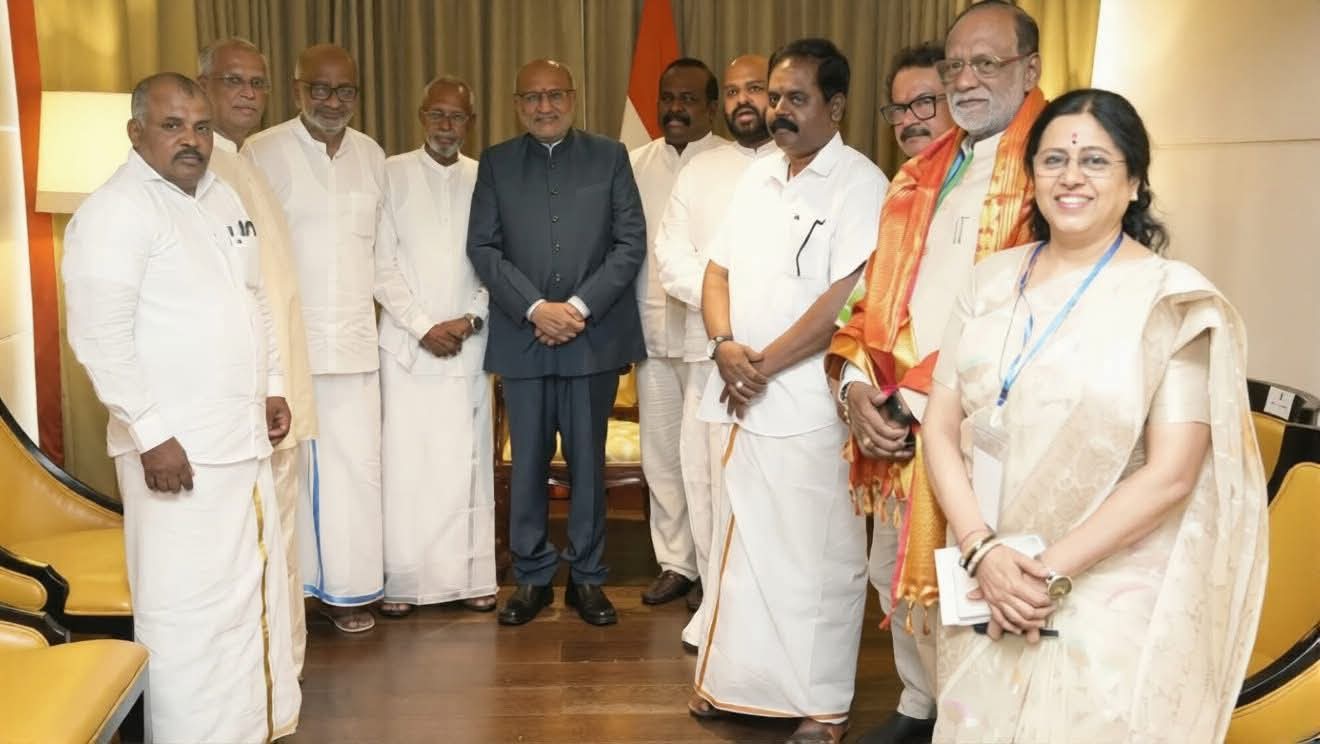
Indian Vice President C. P. Radhakrishnan’s two-day visit to Sri Lanka (19–20 April) was met with coordinated demands from Tamil political actors for a federal political settlement and meaningful justice, while representatives of the Malayaga Tamil community prioritised urgent socioeconomic and citizenship reforms.
While New Delhi framed the visit as part of deepening bilateral engagement, Tamil representatives used the opportunity to underscore the structural failures of the 13th Amendment to the Constitution of Sri Lanka and warn of the continued consolidation of Sinhala-Buddhist state control over the Tamil homeland.
Representatives from the Tamil National Council (TNC) and Ilankai Tamil Arasu Kachchi (ITAK) were unequivocal in their assessment that the provincial council framework has failed to deliver meaningful autonomy.
TNC member and Tamil National People's Front (TNPF) MP Selvarasa Kajendran submitted a memorandum asserting that the Indo-Lanka Accord envisaged a merged North-East functioning as a single, semi-autonomous unit. The memorandum argued that power remains firmly centralised in Colombo, facilitating what it described as decades of structural oppression against Eelam Tamils.
It further accused state institutions, including the Department of Archaeology, of being weaponised to appropriate and reframe Tamil Hindu heritage sites. Kajendran urged India to move beyond the limitations of the 13th Amendment and support a federal arrangement, including the recognition of Tamil nationhood.
Demands for a federal political solution, rather than limited devolution, emerged as a consistent theme across engagements.
ITAK’s C. V. K. Sivagnanam invoked Indian Prime Minister Narendra Modi’s 2015 remarks on meaningful devolution, reiterating that federalism remains the only viable pathway to a durable political settlement.
Meanwhile, M. A. Sumanthiran raised concerns over the continued postponement of provincial council elections, describing it as a deliberate strategy to undermine even the limited powers available under the existing framework. Radhakrishnan reportedly responded that President Anura Kumara Dissanayake had offered a “positive response” on elections, assurances Tamil leaders note have historically gone unfulfilled.
Concerns over demographic engineering and centralisation were also raised prominently.
Sivagnanam Shritharan warned of an escalating “emigration crisis” in the North-East, driven by economic marginalisation and the erosion of regional autonomy. He highlighted the central takeover of provincial schools and cited multiple court rulings that have weakened devolved governance structures.
Selvam Adaikkalanathan pointed to an increase in state-backed Sinhala settlements in Tamil areas, while Dharmalingam Siddharthan criticised Colombo’s continued failure to hold provincial elections, calling on India to adopt a firmer stance.
Senthil Thondaman of the Ceylon Workers’ Congress (CWC) focused on immediate socioeconomic concerns facing Malayaga Tamils.
His 12-point memorandum called for expanded access to Indian Overseas Citizenship (OCI), pathways to permanent residency for Tamil refugees in India, particularly those with children born there, and increased housing and land allocation schemes.