• US pledges $31 million assistance in governance, reconciliation and economic reform

    The US government will look to provide $31 million of assistance in strengthening governance, democratic reform, civil society and reconciliation efforts said the US Secretary of State John Kerry.

    Speaking during the State Department's budget proposals for the next fiscal year, Mr Kerry said,
  • UN Rights Chief must insist fulfilment of UNHRC resolution in Sri Lanka says Monitoring Accountability Panel
    The Sri Lanka Monitoring Accountability Panel, expressing concern at recent rejections by Sri Lanka’s president on the need for an international component to the accountability process, called on the UN Rights Chief to insist that Sri Lanka implements the UNHRC resolution.

    Noting President Sirisena’s rejection of international involvement, the monitoring panel said,
  • Sri Lanka PM appoints committee to oversee foreign affairs ministry
    Sri Lanka’s prime minister has set up a Global Affairs Committee to oversee the workings of the Foreign Affairs Ministry.
  • Coalition of pro-Rajapaksa parliamentarians to protest in parliament unless recognised as separate entity
    Sri Lanka’s ‘joint opposition’ which consist of a group of parliamentarians loyal to former president Mahinda Rajapaksa threatened to disrupt parliamentary proceedings unless they were recognised as a separate entity, reports Colombo Page.
  • Tamil UNP state minister refuses to host Sri Lankan flag

    The UNP's Vijayakala Maheswaran, the state minister for child affairs has refused to hoist the Sri Lankan flag at a function in Jaffna on Monday night.

    Ms Maheswaran, who is Tamil, was the chief guest at the opening of a science lab in the Meesalai Veerasingam College in Thenmaratchi, in the Jaffna district.

  • Zeid's comments on Tamil political prisoners 'misconstrued'

    UNHRC spokesperson Rupert Colville says the media had 'slightly misconstrued' the high commissioner's comments on Tamil political prisoners.

  • UN Rights Chief stresses importance of international participation in accountability and de-militarisation

    International participation in Sri Lanka’s accountability process is an important aspect in ensuring genuine accountability amidst war crimes allegations and widespread sexual violence, said the United Nations Human Rights Chief Zeid Al Hussein, at the end of his visit to the island this week.

    Stressing the importance of international participation, the Human Rights Chief said Sri Lanka's justice system over the years 
    "became highly politicised, unbalanced, unreliable".

    "The country’s history over the past few decades is littered with judicial failures," he added, noting “virtually every week provides a new story of a failed investigation, a mob storming a court room or another example of a crime going unpunished". 

    Stating that a recently passed UN resolution, which calls for international participation in an accountability mechanism, had "laid out an eminently sensible pathway for the country to follow", Mr Hussein stressed that his office would be "
    reporting back to the Council on progress — or lack of it — next June, and again in March 2017".

    He also highlighted ongoing human rights violations and the lack of accountability for them in his statement. “Sexual violence and harassment against women and girls is particularly poorly handled by the relevant State institutions — especially when the alleged perpetrators are members of the military or security services — and, as a result it remains all too widespread,” noted the High Commssioner.

    Mr Hussein said torture and sexual violence by Sri Lanka's security forces was ongoing, acknowledging reports detailing cases that took place last year, after the current government came into power.

    Highlighting the heavy military presence in the North-East, Mr Hussein said,

    In parallel, the size of the military force in the North and the East can be reduced to a level that is less intrusive and intimidating, as a first step in security sector reform".

    The Human Rights Chief further called on Sri Lanka’s military return land that it is occupying in the Tamil North-East. "The military needs to accelerate the return of land it has seized and is still holding to its rightful owners," he said. "While some land has been returned in the Jaffna and Trincomalee areas, there are still large tracts which can and should be swiftly given back. Once the land has been given back, the remaining communities of displaced people can — if given the necessary assistance — return home, and a lingering sore will have been cured once and for all."

    Drawing on Sri Lanka’s prime minister’s recent remarks that all disappeared persons could be presumed dead, Mr Hussein said it had caused "great distress among their families" and "this statement must be followed by rapid action to identify precisely who is still alive and who has died or been killed, properly account for their deaths – including whether or not they were unlawful – identify the location of their remains, and provide redress”.

    Commenting on his visits to the North-East Mr Hussein said,

    “When you visit Colombo, you see a bustling city… When you visit the North and the East, you see, in patches at least, damaged and depressed areas, poverty and continued displacement."

  • Zeid meets with Sri Lanka’s leaders to reaffirm human rights commitments

    UN High Commissioner for Human Rights Zeid Ra’ad Al Hussein met with Sri Lanka’s prime minister and president earlier today, to discuss the Sri Lankan governments commitment towards human rights.

    Speaking shortly after his meetings, Mr Hussein noted fears from Tamils in the North-East that the government “may be wavering on its human rights commitments.

    “I was therefore reassured this morning to hear both the President and the Prime Minister state their firm conviction in this regard,” said the High Commissioner.

  • Tamils call for re-merger of North and East and fully devolved powers in Kilinochchi constitution consultation sitting
    Tamil civil society submitted proposals to the government consultation Committee for Constitutional reforms in Killinochchi on Wednesday.
  • Human Rights Chief raises hopes of resettlement at IDP camp in Jaffna

    Updated 0200 GMT

    The United Nations Human Rights Commissioner Zeid Ra’ad Al Hussein visited Chunnakam IDP camp on Saturday, stating that he hoped the displaced Tamil villagers would be returned to their original homes the next time he visited Jaffna.

    Speaking to families living at the camp, the Human Rights Chief said, “I hope that next time I come I will not be visiting a welfare centre, but I will come to visit you in your homes”.

    The camp has previously been
    visited by foreign officials, and despite promises of resettlement by the Sri Lankan government, many remain trapped, a fact acknowledged by the High Commissioner.

    "You must be tired when you see people like me year after year and you tell your stories and nothing seems to happen," he said. "But I assure you, I assure you, in the end there will be change and you will find your way home."

    The camp residents applauded and cheered as the High Commissioner finished his address, with many lining up to thank him for his words.

    Many of the residents have been displaced from their homes for decades, and remain unable to return due to Sri Lankan military occupation of their land. "It's very clear that people of the North have problems and are frustrated," said the High Commissioner, after meeting residents at the camp. 


    The desperation felt was highlighted when elderly residents of the camp, pleaded with UN officials to be resettled in their land, as the High Commissioner's convoy was leaving.
  • Sri Lankan government appoints ‘Special Task Force’ to gauge public opinion on UN resolution
    The Sri Lankan government announced it will be appointing a ‘Special Task Force’ to examine public opinion on the implementation of a UN Human Rights Council resolution calling for accountability for violations of international humanitarian law.
  • Zeid meets with Sri Lankan defence officials

    The UN High Commissioner for Human Rights, Zeid Ra'ad Al Hussein met with secretary of the ministry of defence, Karunasena Hettiarachchi, and commanders of the army, air force and navy on Monday as he continued his four day visit of Sri Lanka.

  • Zeid meets with Sri Lanka's Buddhist clergy

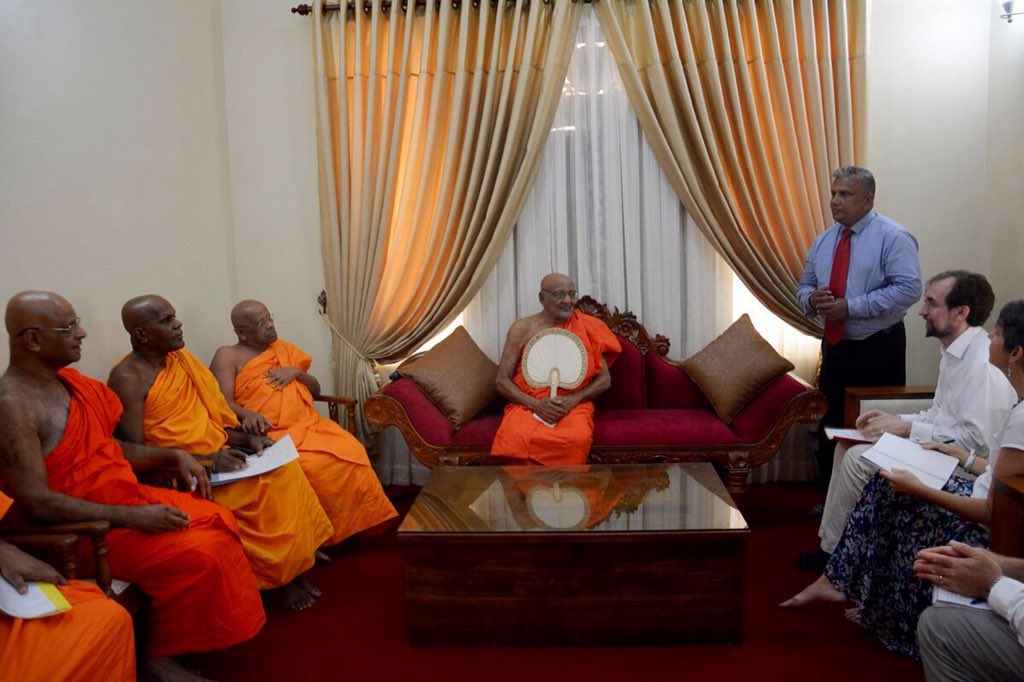
    The UN High Commissioner for Human Rights, Zeid Ra'ad Al Hussein met with the Buddhist clergy on Monday, as part of his four day tour of Sri Lanka.

    Mr Hussein met with the Mahanayake Thera as well other members of the clergy, who told the UN human rights chief that the present government was "striving hard to establish peace and reconciliation among all communities".

    "Our President had even gone to the extent of pardoning the very person who planned to assassinate him," the Buddhist monk was quoted by the Daily Mirror as saying.

Subscribe to Tamil Affairs