• Former Sri Lankan army head denied US visa again

    The former head of Sri Lanka’s army Sarath Fonseka has been denied a visa to enter the United States, reports the Daily Mirror.

    Diplomatic sources were quoted as stating “incidents that happened when he held the post of Army Commander might have resulted in the rejection process,” though this has been denied by his media secretary.

    Mr Fonseka, who oversaw the final phase of the armed conflict on the island where tens of thousands of Tamil civilians were massacred, was promoted to become Sri Lanka’s only five star general and the by Regional Development Minister by the current Sri Lankan government.

    In December 2015 the former army general was previously denied entry to the US, reportedly over his role in overseeing war crimes.
  • EU lifts Sri Lanka's fishing export ban
    Sri Lanka handed over its first set of fishing exports to the Ambassador to the Delegation of the European Union in Sri Lanka David Daly, in a ceremony that marked the first export since the lifting of the ban on fishing exports last week.

    Participating in a press conference at the Dikowita Fisheries harbour, Ambassador Daly officially announced the lifting of the Sri Lanka’s fishing exports ban to the EU.
     
  • Tamils call for justice at Geneva rally

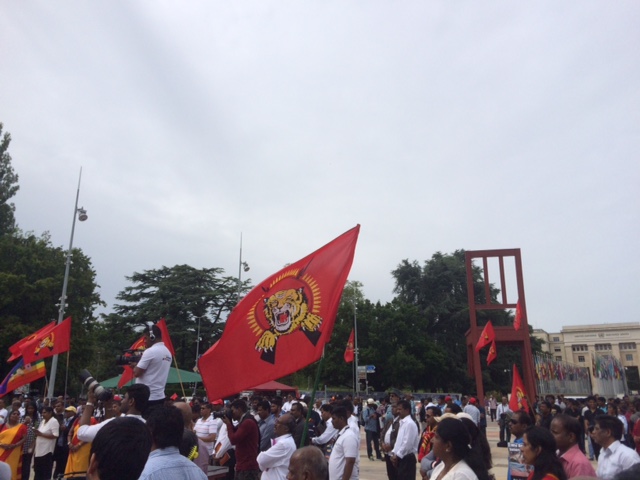
    Swiss Tamils were joined by Tamils from France, Germany and the UK at a rally outside the UN Human Rights Council today, calling for justice to be served through an international accountability mechanism.

  • Demographic, political and institutional barriers to accountability remain in Sri Lanka say panellists at UNHRC
     

    Voices from the North (Uncut) from Together Against Genocide on Vimeo.


    Together against Genocide, launched its report “No Justice, No Truth: Unfulfilled Promises of UN resolution 30-1 (Promoting reconciliation, accountability and human rights)” at the 32nd session of the United Nations Human Rights Council last week.

    The event saw diplomats addressed by a panel including the director of Together Against Genocide (TAG) Jan Jananayagam, Barrister at Mansfield Chambers Shivani Jegarajah, and Fellow at Stanford’s Center for International Security and Cooperation and Washington Post columnist Dr Kate Cronin-Furman.

    Introducing the event, the director of Together Against Genocide (TAG) said that the report, to be released later this week, found that minimal progress had been made by Sri Lanka on the recommendations of the High Commissioner for Human Rights which were referenced in the United Nations Human Rights Council Resolution 30-1.

    After outlining the methodology behind the progress report, Ms Jananayagam said,

     “On looking at the recommendations of the resolution, and mapping them to which of the 33 recommendations of the Office of the High Commissioner for Human Rights Investigation into Sri Lanka’s (OISL) report they refer to, our conclusion is that very little has been implemented.”

    Speaking on institutional reform Ms Jananayagam further noted the “Sri Lanka simply doesn’t have the legal framework to deal with the systemic crimes against humanity outlined in the OISL report. On security sector reform, she added that the intense militarisation of the Tamil North-East remained and raised concern at Sri Lanka’s selective attempts to vet military soldiers, stating,

    “The North-East is the most highly militarised regions in the world. If Sri Lanka vets the troops it sends out on peacekeeping missions without betting those remaining on the island, it actually means that you have a higher concentration of mass atrocities perpetrators on the streets of the Tamil North-East.  So partial implementation of security can be counter productive. “

    Dr Kate Cronin Furman went on to highlight underlying political barriers in progressing on accountability and transitional justice in Sri Lanka.

    Noting demographical challenges in Sri Lanka, Dr Furman said,

    “In practice accountability and justice in places were mass atrocities occurred also depends on politics. Transitional justice is a very hard sell when either of two things are true. One is that Perpetrators remain powerful even though they are not explicitly in office. The other is when large sections of the voting population oppose accountability. Unfortunately in Sri Lanka both these things are true.”
  • Tamil Nadu chief minister reiterates commitment to reclaiming islet from Sri Lanka
    The Tamil Nadu Chief Minister J Jayalalithaa has reiterated her commitment to reclaiming the Katchatheevu Island which were given to Sri Lanka by India in 1974, reports Colombo Page.

    Responding to a later from the opposition , the Chief Minister said, she will bring an amendment that assured the island was retrieved from the Sri Lankan government.
  • Modi inaugurates stadium in Jaffna renovated by India

    Indian Prime Minister Narendra Modi addressed a ceremony in Jaffna today for the inauguration of the Duraiappah Stadium, the renovation of which has been funded by the Indian government.

    Mr Modi said it was a “landmark day” and praised the renovation which cost over Rs 7 crore. The stadium has been out of use since 1997, at which point the Sri Lankan government controlled the Jaffna peninsula. In 2002 at least 23 human skeletons, including those of children, were discovered during refurbishment works.

    Addressing the ceremony via a video link, Mr Modi said that “after a wait of nearly 20 years your applause and cheers will once again rekindle the soul of Duraiappah stadium”. “Even while we are sitting thousands of kilometres away in Delhi, we can feel the pulse of vibrancy, an atmosphere of change in Jaffna,” he added.

    The Indian prime minister went on to praise the people of Jaffna stating, “its foundations are supported by your courage and great sacrifices”.

  • Woman killed in Jaffna, daughter critical after collision with military vehicle

    A Tamil woman has been killed and her daughter critically injured after a Sri Lankan military vehicle collided with the couple in Jaffna.

    Hiru news reported that the mother and daughter were travelling on a scooter, when a military water bowser collided into them.

  • ‘No invaders could vandalise Sinhala Buddhist culture' – Sri Lankan president
    Sri Lankan President Maithripala Sirisena declared that invaders had not succeeded in “vandalizing our rich and unique culture” as he praised Sinhala Buddhism in a statement to mark Poson Poya Day and rejected claims that his government was facing international pressure.

    In a statement on Saturday, Mr Sirisena marked the “the establishment of Buddha Sasana with the arrival of Arahath Mahinda… which occurred 2,323 years ago as the most significant milestone of the Sinhala culture”.

    “We received an extraordinary spiritual stimulant and cultural pride through Buddhism and Buddhist philosophy,” he added.

    “We should recall on this important Poson Poya Day that none of the external forces that invaded our country from time to time could succeed in vandalizing our rich and unique culture,” the president declared.
  • Sri Lanka offers guidance on use of PTA, shows no sign of abolishment
    Sri Lanka’s President Maithripala Sirisena has issued directives to police and armed forces arresting people under the draconian Prevention for Terrorism Act (PTA) that call on officials to refrain from humiliating and torturing the detainees, reports Colombo Page.
  • Sri Lanka Air Force takes Tamil school-children on tour of army camp
    Tamil primary school children were taken around Sri Lanka’s air force camps at the military occupied Palaly airport, in what was described by the Ministry of Defence as an event to “boost goodwill and reconciliation.”
  • UN Human Rights Council should press Sri Lanka on international participation – Alan Keenan
    Members of the UN Human Rights Council and the UN Human Rights Chief “should press the (Sri Lankan) government to follow through on its commitment to meaningful forms of international participation on the proposed special court for war crimes,” said the International Crisis Group's Sri Lanka Senior Analyst Alan Keenan.
     
    In a piece entitled “Impunity and Justice: Why the UN Human Rights Council Must Stay Engaged in Sri Lanka” Mr Keenan stated that despite committing to a UN resolution last year, “Sri Lanka today is not yet the success story that many in the international community claim it to be”.
     
    “Progress on implementing the Council resolution has been slow and often grudging, and there are growing doubts about the government’s political will and ability to see the complex process through,” he added. “For Sri Lanka to stay on the path toward recovery, it needs sustained international support and engagement.”
     
    Since the UN resolution was passed in September, Sri Lankan leaders have repeatedly backtracked from commitments made, in particular the inclusion of foreign judges in an accountability mechanism for mass atrocities. Mr Keenan noted that “under domestic pressure, the president and prime minister backed away from promises to the UN and announced there will be no foreign judges”.
     
    “Given the decades-long failures of government commissions and judicial processes, international participation is essential to the credibility and effectiveness of the special court,” he continued.
  • Tamil IDPs to march with white flags into lands occupied by Sri Lanka military
    Tamil Internally Displaced Perons are preparing to march with white flags towards lands that have been occupied by Sri Lanka’s military under the guise of a High Security Zone in Jaffna.

    The President of the Valikamam North Rehabilitation Society, A Gunabalasingam, on Friday said, the people had stopped protesting for their resettlement after the new president promised in December that the Valikamam North people would be resettled within six months.
  • Suicide and domestic violence plagues war torn North-East

    Domestic violence and suicides have increased in Jaffna following the end of the armed conflict on the island more than seven years ago according to a counsellor based in the North-East, reports the New Indian Express.

    Speaking on condition of anonymity, the counsellor said that “domestic violence, mainly in the form of wife beating, is increasing in Jaffna making it a significant social evil here”.

    The incidence is particularly increasing amongst men who were themselves victims of torture at the hands of Sri Lankan security forces and was having widespread effects on women and children in the area, report the Express.

    Women have since seen higher rates of suicides, whilst “the new culture of social impunity” has also seen an increase an anti-social behaviour from children, the paper reported.

  • ‘It’s all about implementation of resolution’ says UK ambassador
    Britain’s Ambassador to the United Nations in Geneva said implementation of a UN resolution calling for international participation in an accountability mechanism is “key”, in an interview with Ceylonews this week.

    Ambassador Julian Braithwaite told reporters that implementation of the resolution was key, as he emphasised the importance of the ongoing UN Human Rights Council session.
    “It’s all about implementation on the ground,” said the ambassador.” We know how difficult that is and we know politically it remain difficult. But we are delighted that this issue is coming back here."
  • Tamil Nadu governor echoes demand for justice for genocide against Eelam Tamils
    The governor of Tamil Nadu, K Rosaiah in his inaugural address to the Tamil Nadu assembly on Thursday reiterated calls for those responsible for the genocide of Eelam Tamils in Sri Lanka to face justice, reported The Indian Express.
Subscribe to Tamil Affairs