• At least 8 killed in Southern Iraq protests

    In Southern Iraq protests have spread over issues of corruption and a failure to provide basic services for people, including electricity and water shortages.

  • Iraq govt approves plans for Yezidi genocide museum

    The government of Iraq has approved a proposal by Yezidi activists to convert a village school in to a museum commemorating the genocide of Yezidis by ISIS.

    In 2014 ISIS launched an attack on Shingal, Kurdistan and its surrounding areas, kidnapping more than 6500 Yezidis.

  • Spanish government to set up truth commission for Franco crimes

    The new Spanish government is to set up a truth commission to investigate crimes against humanity committed under the former dictator, Francisco Franco. 

    The government has pledged to search for those disappeared during his rule, including carrying out public exhumations every year and recording the number of people found. 

  • Connecticut to officially mark Sikh Genocide Day

    The US State of Connecticut will officially mark ‘Sikh Genocide Day’ on November 30 to commemorate the anti-Sikh pogrom in 1984 which saw around 3000 Sikhs in Delhi killed by Hindu mobs, aided by Indian law enforcement and government officials.

    The bill declaring Sikh genocide day was signed in to law by the Governor of Connecticut.

    Last year the government of the Canadian province of Ontario also recognised the pogrom as genocide.

  • Indian police arrest 32 after Muslim man lynched

    As many as 32 people have been arrested in the southern Indian state of Karnataka, after the murder a Muslim man on Friday – reportedly sparked by rumors circulating on WhatsApp.

    Mohammad Azam, a 27 year old Google employee, was lynched by villagers, who accused him of abducting children. This follows a worrying trend in India in which more than 20 people, mostly non-local, have been killed due to accusations of child abduction in the last two months.

  • Iceland replaces USA at UN Human Rights Council

    Iceland has been elected to replace the USA on the UN Human Rights Council in Geneva.

    The UN General Assembly elected Iceland as the replacement effective immediately until the end of next year.

    The US announced its decision to withdraw from the UNHRC last month, citing anti-Israel bias and hypocrisy.

    The US was a key partner in passing the Resolution 30/1 on accountability and reconciliation in Sri Lanka, which Sri Lanka co-sponsored.

  • Homes of Sinn Féin figures attacked with explosives

    In Belfast, the homes of two prominent Sinn Féin members, former leader Gerry Adams, and Bobby Storey, were attacked with explosive devices last night.

    Both men reported that no-one was hurt in the attacks, although Northern Ireland police said they discovered the remnants of large industrial firework-type devices, capable of causing serious injury, at both scenes.

  • UN Security Council approves an arms embargo on South Sudan

    On Friday the UN Security Council approved an arms embargo on South Sudan which will last until May 2019.

  • Indian defence minister dismisses UNHRC Kashmir report as 'baseless'

    India's defence minister, Nirmala Sitharaman dismissed the UN Human Rights Council (UNHRC) report on Kashmir as "baseless", ANI reported. 

    "The report was prepared while sitting somewhere else. The assessment made by UNHRC has no basis. They are not aware of the ground realities in Kashmir," Ms Sitharaman said. 

    "The army is able to eliminate terrorists on the borders itself," she added. 

  • UK to remain party to European human rights treaty after leaving the EU

    The United Kingdom will remain party to the European Convention on Human Rights after leaving the European Union, according to the Brexit white paper most recently published by the government.

    Despite British Prime Minister, Theresa May, having previously backed leaving the ECHR, the white paper said, “the UK is committed to membership of the European Convention on Human Rights (ECHR)” and that “the UK will remain a party to the ECHR after it has left the EU.”

  • Scottish leader meets Catalan president

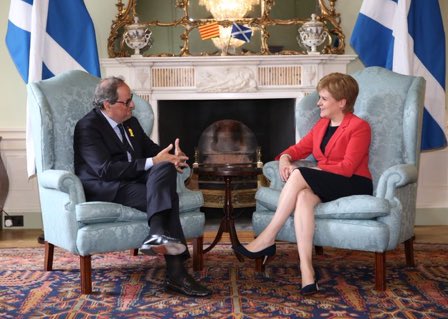
    Scotland's first minister and SNP leader, Nicola Sturgeon met with the Catalan president, Quim Torra on Wednesday during the newly elected leader's visit to Edinburgh this week. 

    In a joint statement issued after the meeting the two leaders said "the way forward for Catalonia must be through peaceful and democratic solutions involving dialogue between the Spanish and Catalan authorities".

    "In 21st century Europe, issues of self-determination must ultimately be addressed through democratic referendums", which should be "agreed between both parties and have corresponding international recognition," they added. 

    Their meeting came as a Catalan minister, Clara Ponsati faces extradition from Scotland to Spain over Catalan's independence referendum. 

  • Bosnian Muslims bury 35 victims of Srebrenica genocide, 23 years later

    Bosnian Muslims marked 23 years since the Srebrenica genocide in a commemoration that saw the remains of 35 victims buried at the genocide’s memorial centre.

    According to The Hague Tribunal and Bosnian state court, over 7000 Bosnian Muslims, mostly men and boys, were killed by Bosnian Serb forces in July 1995.

    The forces then carried out operations to conceal the crimes by using secondary and tertiary mass graves.

  • Cameroon government to investigate video showing execution of women and children

    Cameroon’s government stated that it will open an investigation into a video that allegedly shows soldiers executing two women and their children, accusing them of being members of Boko Haram.

  • Ethiopia, Eritrea declare end to long state of war

    Ethiopia and Eritrea signed a declaration on Monday ending the war that existed between the two countries since the border conflict in 1998-2000. 

    Despite a previous peace deal in 2000 the two countries remained in a state of no war no peace as the deal failed to be implemented. 

  • France court upholds life sentences for two former Rwandan mayors accused of genocide

    Life sentences handed to two former Rwandan mayors for their part in the Rwandan genocide were upheld by a French court on Friday.

    Octavien Ngenzi and Tito Barahira had appealed after they were found guilty of crimes of against humanity, genocide and summary executions in 2016.

Subscribe to International Affairs