Tamil Affairs

Tamil News

Latest news from and about the homeland

""
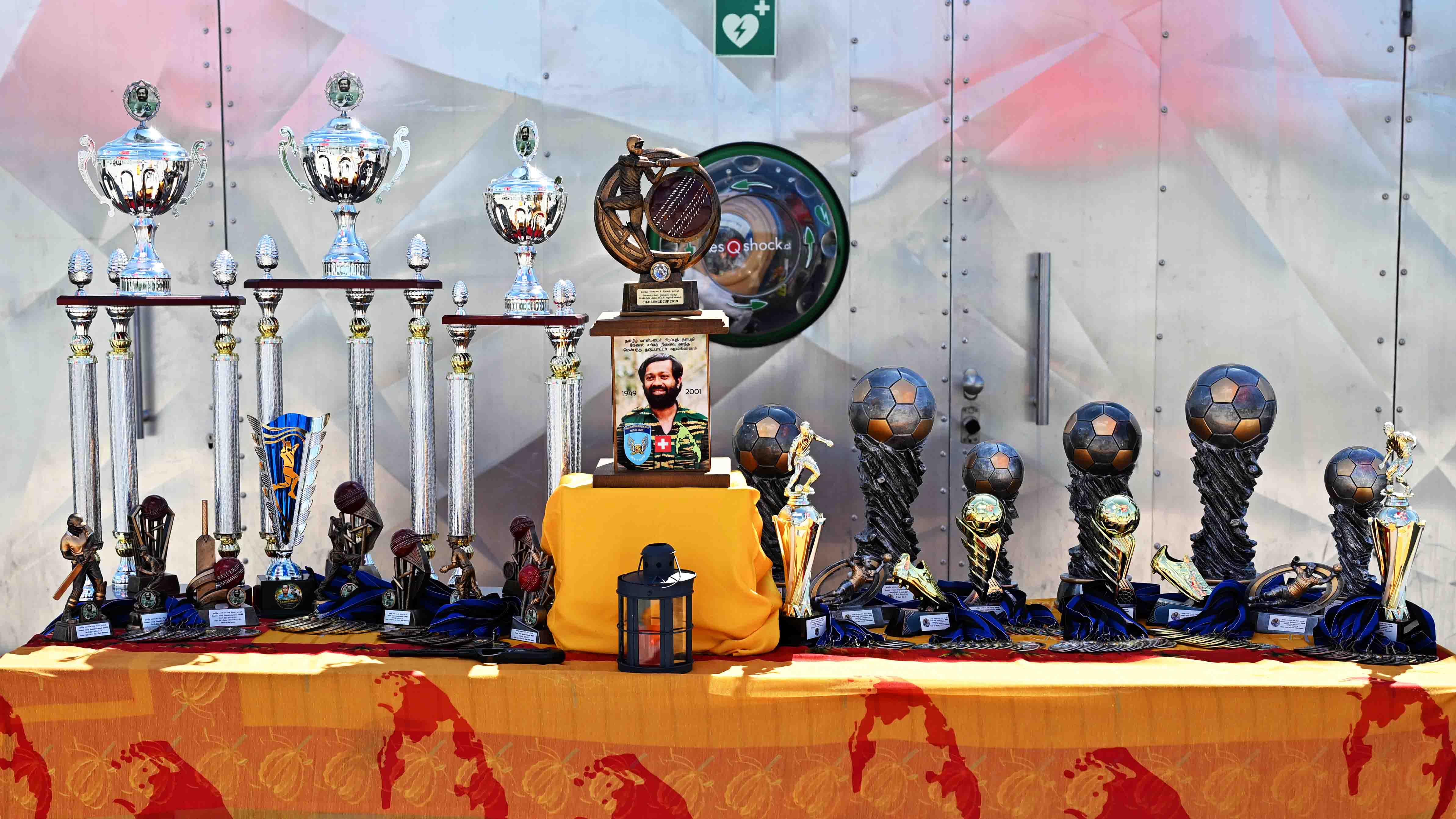
  A memorial sports tournament commemorating Colonel Shankar, the Special Commander of the Tamil Eelam Air Force (Sky Tigers) who was killed in an attack carried out by Sri Lankan deep penetration forces in Ottusuddan, Mullaitivu, on 26 September 2001, was held in Switzerland on 7 June 2026. Organised by the Sports Division of the Swiss Tamil Coordinating Committee, the event took…

OISL recommendations will ‘receive due attention’ says Sri Lanka

Sri Lanka said that the recommendations of the Office of the High Commissioner for Human Rights' Investigation into Sri Lanka (OISL) will “receive due attention”, in a statement delivered to the UN Human Rights Council today.

Sri Lanka’s ambassador Ravinatha Aryasinha told the council that the OISL report had “set out clearly the path we intend to take”.

“We stated we take note of the Report of the OISL and that we will ensure that its content as well as recommendations receive due attention of the relevant authorities including the new mechanisms that are envisaged to be set up,” he added.

Earlier the High Commissioner had
reiterated one of  the reports key recommendations – “the establishment of an ad hoc hybrid special court, integrating international judges, prosecutors, lawyers and investigators, mandated to try notably war crimes and crimes against humanity, with its own independent investigative and prosecuting organ, defence office and witness and victims protections programme”.

EU calls for ‘immediate adoption of essential confidence building measures’ for victims in Sri Lanka

The European Union called on the Sri Lankan government to implement the “immediate adoption of essential confidence building measures” for the victims of Sri Lanka’s armed conflict.

In a statement delivered to the UN Human Rights Council in Geneva, the EU said it expresses its “deepest solidarity with the victims and their relatives” and had “sincere admiration for the manner in which victims have contributed to the work of the OISL and have placed their confidence in the Human Rights Council”.

Stating the tabled resolution on Sri Lanka “marks a crucial step towards a credible transitional justice process... with the active support and participation of the international community”, the EU said:

“The full implementation of these commitments is now needed, starting with prompt action on a fully participatory national consultation, especially with the victims, for the design of a comprehensive justice process and the immediate adoption of essential confidence building measures”.

Resolution is not an end in itself says UK

Whilst welcoming the Sri Lankan government's commitments to deliver justice, the UK, in its address to the UN Human Rights Council debate on the OHCHR Investigation into Sri Lanka report (OISL) stressed that the resolution being discussed was not an end in itself.

"We warmly welcome the constructive approach that the government of Sri Lanka has taken during this session to agreeing a consensual resolution. However, the UK recognises that this resolution is not an end in itself, but the start of a process that will require commitment from all parties if it is to deliver meaningful reconciliation and long-term peace and stability in Sri Lanka."

Welcoming the OISL report's conclusions and recommendations, the UK said "without facts, there can be no justice, no end to impunity and no reconciliation.

"The report sets out a range of extremely grave human rights violations and abuses, committed by all sides in the conflict. While this account will be difficult for many in Sri Lanka, it was essential for the Council to have seen it and for the people of Sri Lanka. Without facts, there can be no justice, no end to impunity and no reconciliation. We therefore welcome the report's conclusions and recommendations. They provide an important basis for Sri Lanka and all those affected by the conflict and its aftermath to look to the future."

Estonia and Switzerland invite Sri Lanka to ratify Rome Statute of ICC

Addressing the UN Human Rights Council (UNHRC) discussion the report of the Office of the High Commissioner for Human Rights (OHCHR) Investigation on Sri Lanka (OISL), Estonia and Switzerland invited Sri Lanka to ratify the Rome Statute of the International Criminal Court (ICC) as a guarantee against non-recurrence.

Switzerland urges institutional reform to allow for prosecutions of war crimes and genocide in Sri Lanka

Switzerland has urged Sri Lanka to reform its laws and institutions to allow for the prosecution of war crimes, crimes against humanity and genocide.

Addressing the United Nations Human Rights Council during the general debate on the findings of the UN report into Sri Lanka’s atrocities, Switzerland called on Sri Lanka "to amend its Criminal Code in order to fully integrate war crimes offences, crimes against humanity, genocide and forced disappearance with retroactive effect and while guaranteeing their imprescriptibility. It urges Sri Lanka to commit so that crimes do not go unpunished."

Switzerland also called on Sri Lanka to "develop a credible transitional justice process with international participation and reform its institutions and its laws."

Justice essential for lasting peace says France

France has said that ensuring justice for the atrocities committed during the war is essential for lasting peace.

Speaking at the United Nations Human Rights Council during the general debate on the findings of the OISL report, France said "justice is, indeed, an essential condition for lasting peace," and "the swift establishment of a credible and independent transitional justice mechanism, to which the international community will be linked, is therefore a crucial element to this process."

Addressing the crimes against humanity detailed in the report, France said  "it is now essential that all light be shed on the responsibility of these crimes, and that justice is ensured, both for victims' families, who bravely contributed to this report, and to facilitate the reconciliation process in Sri Lanka and definitively turn the page on the civil war."

HRW calls for OHCHR presence in Sri Lanka to monitor implementation of OISL recommendations

Sri Lanka’s government must implement important recommendations of the Office of the High Commissioners report into Sri Lanka’s atrocities, including supporting the set up of a “dedicated OHCHR office in the country,” said Human Rights Watch on Wednesday.

In a statement to the UN Human Rights Council during the general debate on Sri Lanka, Human Rights Watch Geneva Director, stressing the need for effective foreign participation to build trust of victims said,

“Sri Lanka’s government, through its co-sponsorship of the resolution, is making important promises to all the victims of Sri Lanka’s long civil war. However, effective foreign participation and international engagement will be needed to build trust and confidence in the process, which is necessary for a successful outcome.”

John Fisher, added that international involvement in a judicial justice process “must be meaningful and not tokenisms or a façade.”

‘Burden now rests with Sri Lankan government’ – HRW

Human Rights Watch said the proposed UN Human Rights Council resolution on Sri Lanka needs to be thoroughly implemented and the burden now rests with the Sri Lankan government to honour its pledges.

“This resolution makes it clear the time has come for the Sri Lankan government to act,” said John Fisher, Geneva director at Human Rights Watch. “The resolution’s endorsement of a judicial mechanism with international participation is an important recognition of the need for an international role to ensure justice for victims.”

British MPs express ‘concern and disappointment’ at lack of international probe for war crimes in Sri Lanka

British parliamentarians have written to Prime Minister David Cameron to express “concern and disappointment” at the government’s apparent support for a domestic mechanism to investigate and prosecute violations of international humanitarian law in Sri Lanka.

The group of nine MPs said there was “no reason to pass all responsibility for justice to the national government,” and they disagreed with Minister of State at the Foreign Office Hugo Swire’s statement that the new Sri Lankan government has the UK’s “full confidence”.

“Change in Sri Lanka is slow, and confidence in the state apparatus is very low amongst Tamils,” said the MPs in a letter to Mr Cameron.

Noting a recent report from Freedom From Torture, the letter said “there has been limited action from the new administration to tackle vested interests in the military, police and intelligence services”. “Furthermore, President Sirisena himself served as Defence Minister in the final days of the civil war, when most civilian casualties occurred. Meanwhile, many of the most senior government and military figures remain unchanged from those dark days.”

“How can the Sri Lankan people have faith in a purely national mechanism, when key witnesses still do not have access to proper protection and are afraid to speak out? How can a national tribunal convened by a government whose members are themselves implicated in the crimes be expected to hold the right people thoroughly to account?”

Ranil consults with military and monks over UN resolution

Sri Lankan Prime Minister Ranil Wickremesinghe met with members of the Buddhist clergy and the Sri Lankan security forces to discuss a United Nations Human Rights Council resolution on prosecuting violations of international humanitarian law on the island.

Government minister Harsha de Silva tweeted a photograph from the meeting on Saturday, stating that the prime minister met with Buddhist monks, as well as with Sri Lankan civil society members.


Mr De Silva further tweeted on Monday that the prime minister had met “all 2 star and above officers of the military and police” to discuss the resolution.