
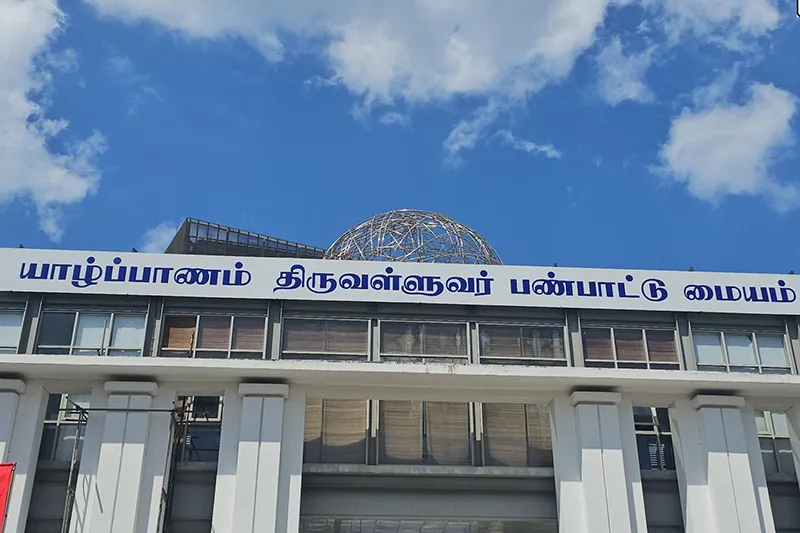
The Jaffna Thiruvalluvar Cultural Centre has become the focus of fresh controversy after Sri Lanka’s Cabinet approved the establishment of a trust to oversee the management of the India-funded cultural complex, prompting opposition from the Jaffna Municipal Council and Tamil political parties.
According to Cabinet decisions issued on May 11, the Sri Lankan government approved a proposal submitted by the Minister of Buddhasasana, Religious and Cultural Affairs to establish a trust for the continued management of the cultural centre.
The 11-storey Thiruvalluvar Cultural Centre in Jaffna was constructed with financial assistance from the Government of India and was intended to function as a centre for cultural activities and the preservation and promotion of Tamil cultural heritage.
Cabinet documents noted that a Joint Management Committee had already been appointed under a Memorandum of Understanding signed regarding the operation of the centre. Under the agreement, ownership of the facility was to be transferred through the Sri Lankan government to the Jaffna Municipal Council following completion of the project.
However, the Sri Lankan government has now moved to establish a separate trust structure for the administration of the centre, with Attorney General’s clearance reportedly granted for the draft trust deed.
The decision has drawn objections from the Jaffna Municipal Council, which has decided to send a letter to Sri Lankan President Anura Kumara Dissanayake opposing the move.
Critics argue that the establishment of a trust undermines the authority of the elected municipal body and raises concerns regarding state control over a major Tamil cultural institution in the North-East.
Speaking on May 14, Tamil National People’s Front (TNPF) leader Gajendrakumar Ponnambalam strongly criticised the inclusion of the Ministry of Buddhasasana, Religious and Cultural Affairs within the trust structure.
He alleged that the move amounted to a “planned genocide” aimed at destroying and fragmenting the cultural and religious identity of the Tamil nation in the North-East.
Gajendrakumar further accused the Department of Archaeology, which functions under the Buddhasasana Ministry, of carrying out what he described as “planned Buddhist encroachment” across Tamil areas.
Referring to the controversial Buddhist vihara in Thaiyiddy, Jaffna, he stated that Buddhist constructions had been established on private Tamil land with the support of the Sri Lankan military and that efforts to further expand such structures were continuing in coordination with the ministry.
Thaiyiddy has become a major flashpoint over allegations of state-backed Buddhisisation and land appropriation in the Tamil homeland, with repeated protests by local residents and Tamil civil society groups demanding the return of occupied lands.
Gajendrakumar also accused the ruling National People’s Power (NPP) government of intensifying policies targeting Tamils, alleging that the current administration was acting in a manner “worse than previous governments”.
He claimed that the inclusion of the Buddhasasana Ministry in the management structure of the Thiruvalluvar Cultural Centre reflected an ideology that Tamil people “should not have a separate cultural identity”.
The controversy comes amid continuing concerns from Tamils over the expansion of Sinhala-Buddhist state institutions into the North-East through archaeological interventions, Buddhist monuments, land acquisitions and military-backed religious projects.
Tamil political representatives and rights groups have repeatedly warned that such initiatives form part of a broader state-sponsored effort to alter the historical and cultural character of the Tamil homeland.