.jpg)
Raviraj's vehicle in the aftermath of the killing.
Sri Lanka's Court of Appeal has ordered a retrial in the assassination case of Tamil National Alliance parliamentarian Nadarajah Raviraj, setting aside a High Court acquittal that had stood for nearly a decade and drawing fresh attention to a killing that has come to symbolise the island’s culture of impunity.
The judgment, delivered earlier today by a bench comprising Justices B. Sasi Mahendran and Amal Ranaraja, followed an appeal by the Attorney General challenging the original High Court verdict.
The Court of Appeal found that the High Court judge had failed to adequately instruct the jury on how to assess the evidence of an accomplice witness who had been granted a conditional pardon and whose testimony formed a central part of the prosecution's case. After reviewing the evidence, the court concluded there was sufficient material to proceed with the case and ruled that the acquittal should be set aside. A fresh trial is to be conducted before the High Court.
Nadarajah Raviraj was a human rights lawyer and TNA member of parliament for Jaffna district. He was shot at close range by gunmen on a motorbike at around 8:30am on 10 November 2006 as he got into his car after giving a television interview near his residence at Manning Town in Narahenpita, Colombo.
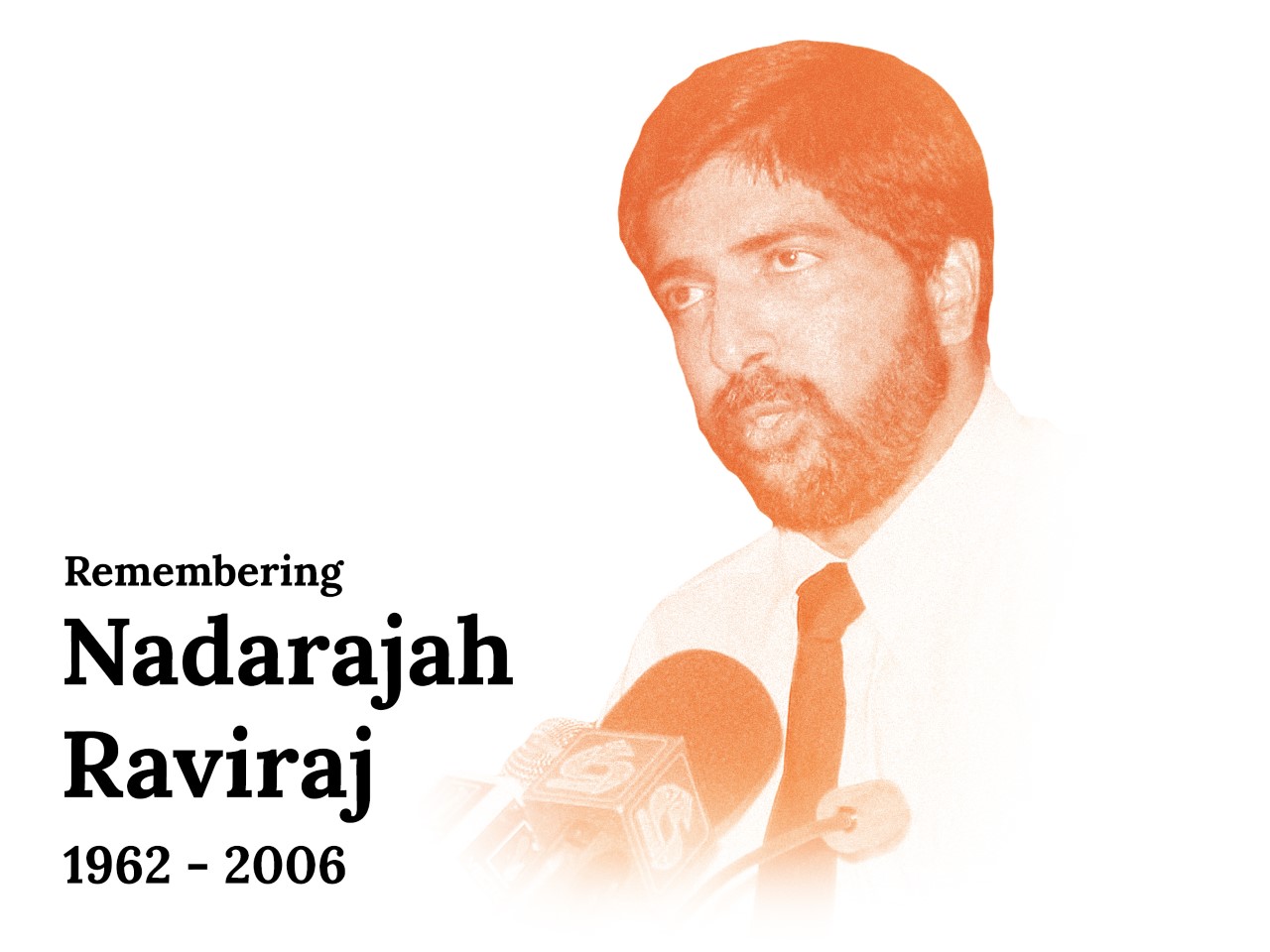
Image courtesy of @Tamil Narratives
He died later in hospital. Police Constable Lakshman, who was travelling with him as his bodyguard, was also killed. The killing prompted immediate shutdowns across the North-East and drew widespread condemnation internationally. It came within a year of the assassination of fellow TNA parliamentarian Joseph Pararajasingam in Batticaloa.
The accused indicted before the Colombo High Court included three Sri Lanka Navy intelligence officers among others. They faced multiple charges under the Prevention of Terrorism Act and the Penal Code, including conspiracy to assassinate Raviraj and causing his death, as well as the killing of Constable Lakshman. Three of the accused, identified as individuals connected to the Karuna faction – a paramilitary group backed by the Sri Lankan state - were tried in absentia having evaded court proceedings since investigations began.
A crown witness, who had himself been an earlier suspect before being turned into a state witness, gave evidence that the killing had been planned by officials attached to the Navy intelligence office in the Gangarama, Laundrywatta area of Colombo. He testified that after the shooting, the perpetrators fled directly to that Navy intelligence office. It was this witness, granted a conditional pardon in exchange for his testimony, whose evidence the Court of Appeal found had not been properly assessed by the jury.
The trial before a special jury concluded in December 2016. The High Court judge began charging the jury late in the evening of 23 December 2016 and continued until around 11:00pm, with the verdict delivered shortly after midnight. The Court of Appeal noted the unusual circumstances of the timing. On 24 December 2016, the jury returned a unanimous not guilty verdict on all charges, and the judge discharged all accused.
The Attorney General subsequently appealed the decision. Raviraj's widow, Sasikala Raviraj, also filed a separate appeal before the Court of Appeal, arguing that the evidence presented at trial had been sufficient to convict the accused and contesting the decision to conduct the case by special jury rather than before a judge alone as provided for under the PTA. The appeals process has continued for years, with the Court of Appeal finally delivering its ruling this week.
.jpg)
Raviraj's widow and mother mourn his slaying.
The case has a wider backdrop that has never been fully aired in court. A police constable from the intelligence unit, Liyanarachchige Abayaratne, gave evidence before a Colombo Additional Magistrate alleging that Gotabaya Rajapaksa, who was serving as Defence Secretary at the time of the killing, had known about the murder and arranged a payment of Rs. 50 million to factions associated with the Karuna group. Those allegations have never resulted in any prosecution.
One of the accused, former Navy Lieutenant Commander Chandana Prasad Hettiarachchi, known as 'Navy Sampath', had previously skipped bail and remained a wanted person for years before being arrested. He is also the main suspect in the abduction and disappearance of eleven Tamil youths from Colombo between 2008 and 2009. Sri Lanka's then navy chief, Admiral Ravindra Wijegunaratne, was reported to have provided Rs. 500,000 in cash to help him evade arrest.
The retrial order marks a significant procedural development in a case that has dragged across two decades without anyone being held to account.