
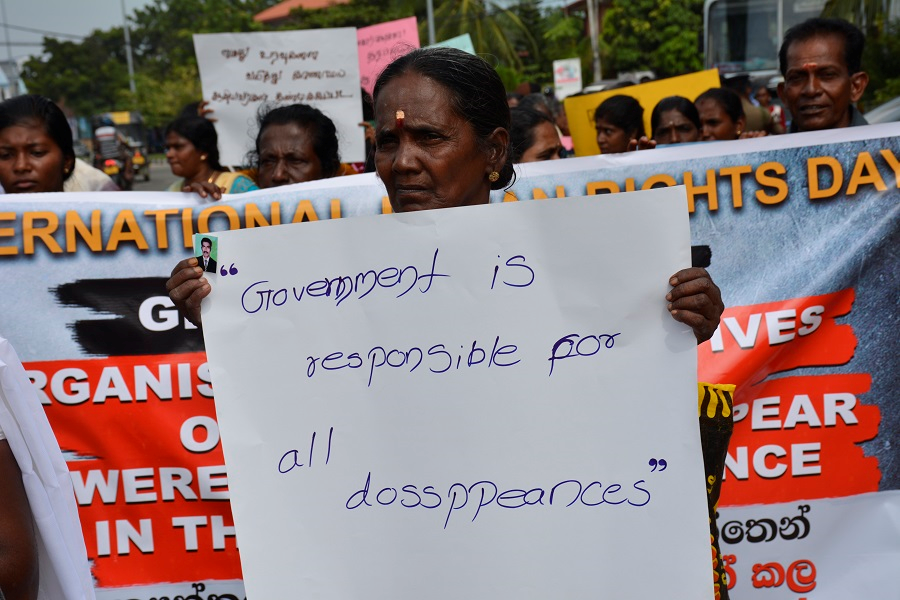
A new concept paper published in February by the Sri Lanka Campaign for Peace and Justice sets out a detailed proposal for an independent DNA bank to identify the remains of Sri Lanka's forcibly disappeared, offering what its authors describe as a credible scientific pathway to truth after decades of failure by successive governments.
Sri Lanka holds the second highest number of cases registered with the United Nations Working Group on Enforced or Involuntary Disappearances. Since the 1980s, an estimated 60,000 to 100,000 people from across the island's ethnic and religious communities have been disappeared. The vast majority, particularly those disappeared during and at the end of the armed conflict in 2009, were Tamil. Many are believed to have been abducted, tortured and killed by government security forces and units operating under the country's political and military leadership.
For the families left behind, the decades since have been defined not by answers but by a relentless cycle of broken promises and deliberate obstruction. Former Prime Minister Ranil Wickremesinghe dismissed the disappeared as being "probably dead." Former President Gotabaya Rajapaksa said simply: "I can't bring back the dead." The Office of Missing Persons, established in 2017 under international pressure, has not traced a single disappeared person nor identified a single perpetrator in the years since. Tamil families across the North-East have long rejected it outright, describing it as an instrument designed to absorb international pressure rather than deliver justice. In 2022, the UN High Commissioner for Human Rights told the Human Rights Council that "expecting accountability from any state-led mechanism is futile." The Dissanayake government has largely echoed its predecessors, directing families towards the same domestic mechanisms they have long rejected.
The problem with the graves
Around 32 mass graves have been identified across Sri Lanka over the past three decades. Only 20 have been partially exhumed. Hardly any family has had remains returned to them. Some graves are unmarked and unprotected. Others lie inside military bases, making them physically inaccessible to investigators. New structures have been built over or around certain sites. In several cases, the Sri Lanka Campaign paper notes, sites have been actively disturbed.
The fundamental obstacle is the absence of any mechanism capable of matching recovered remains to living relatives. Exhumations alone cannot provide answers without a centralised system capable of linking DNA from remains to family reference samples. Sri Lanka currently has limited forensic capacity to handle investigations of this complexity and scale. Without such a system, the paper argues, investigations remain fragmented and inconclusive. The evidence that could one day support accountability processes is degrading with time.
What the proposal calls for
The concept paper proposes a legally protected, independent body to oversee three interconnected processes: voluntary family DNA collection, forensic analysis of recovered remains, and the dignified return of identified remains to families. Family samples would be stored in a secure, encrypted database and matched against DNA profiles extracted from exhumed material, using specialist software and additional forensic verification. Confirmed identifications would then be communicated through trained liaison officers before remains are formally returned.
The initiative is designed to be funded independently, primarily through international donors and institutional partnerships, rather than through the Sri Lankan state. This is a deliberate structural choice. State funding would create the conditions for political interference of precisely the kind that has undermined every previous accountability mechanism on the island.
Drawing on international experience from Argentina, Bosnia and Latin America, the paper proposes new legislation to guarantee the body's independence, protect informed consent and confidentiality, and provide clear legal authority for exhumations and the admissibility of findings in court. International forensic bodies, specialist laboratories abroad and experienced NGOs would support exhumations in the early stages, build domestic capacity and ensure internationally recognised standards are met throughout.
The proposal applies to all those who remain missing, civilians and members of armed groups alike, affirming under international law every family's right to know the fate of their loved ones. It is designed to be implemented in phases, beginning with family DNA collection and expanding to targeted exhumations as the process develops.
The question of government cooperation
The Sri Lanka Campaign is frank about the political obstacles. The paper acknowledges that forensic investigations in post-conflict contexts regularly face resistance from those in institutions with a direct interest in preventing identification, and that it would be unrealistic to assume there will be no pushback. But it argues, pointedly, that government cooperation is not a prerequisite for beginning this work.
Collecting DNA from living relatives of the disappeared can begin independently of the state. This is, the paper argues, a matter of some urgency. Many parents and close relatives of those disappeared are elderly. If their DNA is not collected while they are still alive, the possibility of future identification may be permanently lost, regardless of what political conditions eventually emerge.
The paper notes that Sri Lankan president Anura Kumara Dissanayake has publicly emphasised the importance of uncovering the truth in high-profile cases such as the 2019 Easter Sunday bombings, and that the National People's Power manifesto referred to establishing a truth and reconciliation process commanding public trust. Detailed commitments specifically on enforced disappearances have not been clearly articulated, but the Sri Lanka Campaign argues that a credible, independent DNA bank aligns with any genuine commitment to truth-seeking.