
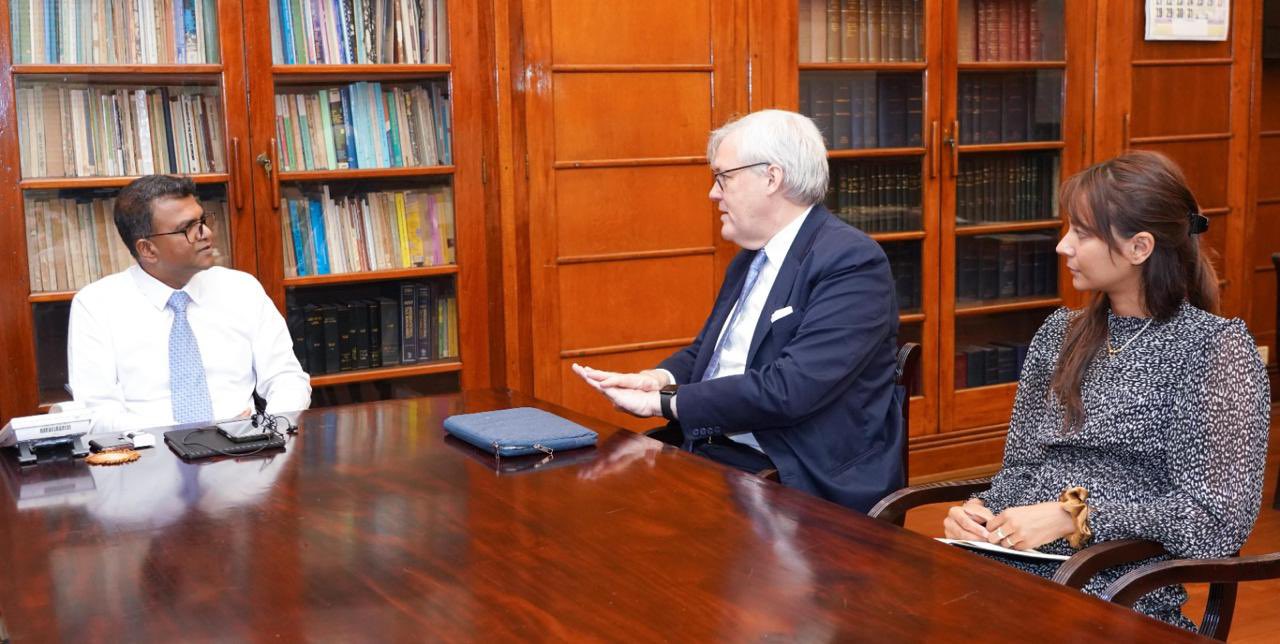
UK High Commissioner to Sri Lanka Andrew Patrick meeting Sri Lanka's Secretary to the Ministry of Finance Harshana Suriyapperuma, Secretary to the Ministry of Finance, to discuss the new deal.
The United Kingdom has announced a package of trade reforms that will further liberalise garment imports from Sri Lanka under the Developing Countries Trading Scheme (DCTS), sparking concern from rights advocates over the continued absence of any human rights conditions tied to such trade preferences.
Unveiled on 10 July, the new measures will simplify rules of origin, allowing more Sri Lankan-made garments to enter the UK tariff-free, even when materials are sourced from other regions in Asia and Africa. The reforms are expected to take effect in early 2026 and have been welcomed by both British officials and the Joint Apparel Association Forum (JAAF), Sri Lanka’s key industry body.
British High Commissioner to Sri Lanka, Andrew Patrick, called the changes “a win for the Sri Lankan garment sector, and for UK consumers”, citing the sector’s importance to the bilateral trade relationship.
However, human rights advocates have been wary of the announcement, noting the lack of accountability benchmarks, particularly in light of Sri Lanka’s continued use of the Prevention of Terrorism Act (PTA) - a law repeatedly condemned by the United Nations and international watchdogs for enabling arbitrary detention and torture.
Earlier this year, over a dozen Sri Lankan and international civil society organisations urged the European Union to make any renewal of the GSP+ trade preferences contingent on tangible human rights reforms, including the full repeal of the PTA. The law remains in effect, with Tamils disproportionately subjected to arrests under its provisions.
By contrast, the UK’s trade engagement appears to bypass such rights-based conditions entirely, raising concerns that economic incentives are being extended to a government that has failed to demonstrate accountability for past and ongoing violations.
The announcement follows months of collaboration between UK trade officials, the Sri Lankan government, and JAAF. In a joint statement, JAAF Secretary General Yohan Lawrence hailed the deal as a “game-changer” for the industry, which exports over USD 675 million in apparel to the UK annually. Britain is Sri Lanka’s second-largest garment market.
JAAF claimed the move would help secure employment and allow Sri Lanka to compete on equal terms with regional exporters.
The new reforms fall under the UK’s post-Brexit “Trade for Development” initiative. Officials said the goal is to increase access to high-quality, low-cost goods in the UK while supporting growth in developing economies.
In addition to liberalising garment trade, the UK also pledged ongoing support for Sri Lankan exporters to meet British import standards. These programmes include digital marketing training, certification audits, and gender-focused policy development under the SheTrades Commonwealth+ initiative.
Critics argue that such technical assistance, while beneficial, does little to address the structural failures of justice, demilitarisation, and rule of law in Sri Lanka, particularly in the Tamil homeland, where land occupation, surveillance, and military interference in civil life remain widespread.
With no enforceable rights conditions attached to the DCTS, observers warn the UK risks following the path of previous trade agreements that reward Sri Lanka’s economic elite while enabling continued repression and impunity.