
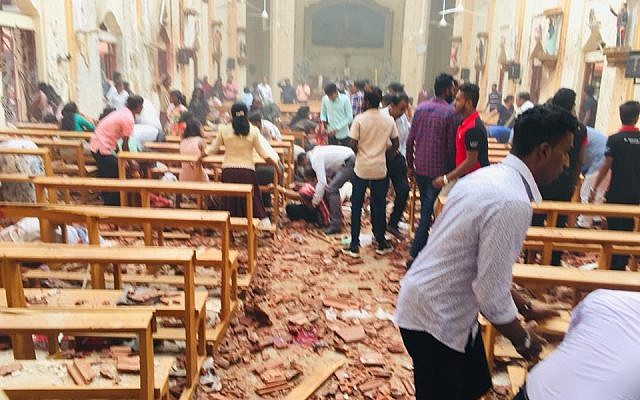
The aftermath in one of the churches targeted in the Easter Sunday bombings.
Sri Lanka’s Leader of the House Bimal Rathnayake alleged that the extremist climate that culminated in the Easter Sunday attacks was “deliberately cultivated” to facilitate the political return of the Rajapaksa regime, which had lost power in 2015.
His remarks came during a parliamentary adjournment debate on the 2019 Easter Sunday bombings, where several lawmakers levelled serious accusations of state complicity, intelligence failures, and deliberate political manipulation surrounding the attacks, which killed over 250 people and injured hundreds more.
“The Easter Sunday attack cannot be taken as an isolated incident,” Rathnayake said. “There was a need to create a situation for the Rajapaksas to return... They started this in 2013 by creating and maintaining Sinhala and Muslim extremist groups through intelligence agencies.”
He went on to describe the manipulation of political conditions as akin to the “Cambridge Analytica incident,” claiming that Sri Lanka’s intelligence agencies helped engineer an “objective situation” to weaken democratic governance and manufacture consent for the Rajapaksas’ return.
Public Security Minister Ananda Wijepala also revealed a series of intelligence failures that occurred in the days leading up to the attacks.
He disclosed that on 20 April 2019, the Taj Samudra Hotel had emailed the State Intelligence Service (SIS) at 4:52 p.m. to report the check-in of Abdul Latheef Mohamed Jameel, one of the suicide bombers. Despite Jameel being on a terrorism watch list, the SIS reportedly failed to act. Jameel would later detonate a bomb at the Tropical Inn in Dehiwala.
The Criminal Investigation Department (CID) is now probing the SIS’s inaction, Wijepala confirmed, as well as the identity of those responsible for ignoring the alert.
Wijepala also claimed to have "strong evidence" that Tamil paramilitary leader Pillayan, also known as Sivanesathurai Chandrakanthan, "knew about the attacks before they happened”.
The Minister went on to address the controversy over the fate of Pulasthini Mahendran, also known as Sarah Jasmin, the wife of a deceased bomber and a key suspect in the attacks. He stated that two DNA tests conducted to confirm her death in a suicide blast on 24 April 2019 failed to match samples from her close relatives. A third DNA test was later carried out under former Minister Sarath Weerasekara. Wijepala added that irregularities in how the samples were collected have “raised serious doubts,” and investigations are ongoing.
Further compounding suspicions, MP Mujibur Rahman told Parliament that survivor testimony suggested Sarah may still be alive. He cited the account of Haadiyah, Zahran’s wife, who survived the Saindamarudu bombing and testified that Sarah spoke to her in Tamil after the explosion and was later seen being taken away.
Rahman also questioned the killing of Zahran’s brother Shiny, stating that he was not killed in the explosion but shot outside the house shortly after. “So who killed him?” Rahman asked, directly implicating military officials, including Major General Aruna Jayasekara, then the Eastern Commander and now Sri Lanka’s Deputy Minister of Defence.
Rahman contrasted the impunity allegedly granted to those involved in the attacks with the prosecution of a youth detained for a pro-Palestine social media post. “A youth was imprisoned over baseless charges... Meanwhile, the individuals behind the 2019 attacks walk free,” he said.
Opposition MPs also questioned the recent arrest and subsequent bail of “Podi Zahran,” allegedly involved in surveillance activity near the Bohra Conference and previously linked to terrorism-related charges.
The remarks from lawmakers come amidst calls for an independent and international investigation into the attack, amid concerns that key evidence continues to be suppressed or manipulated.