
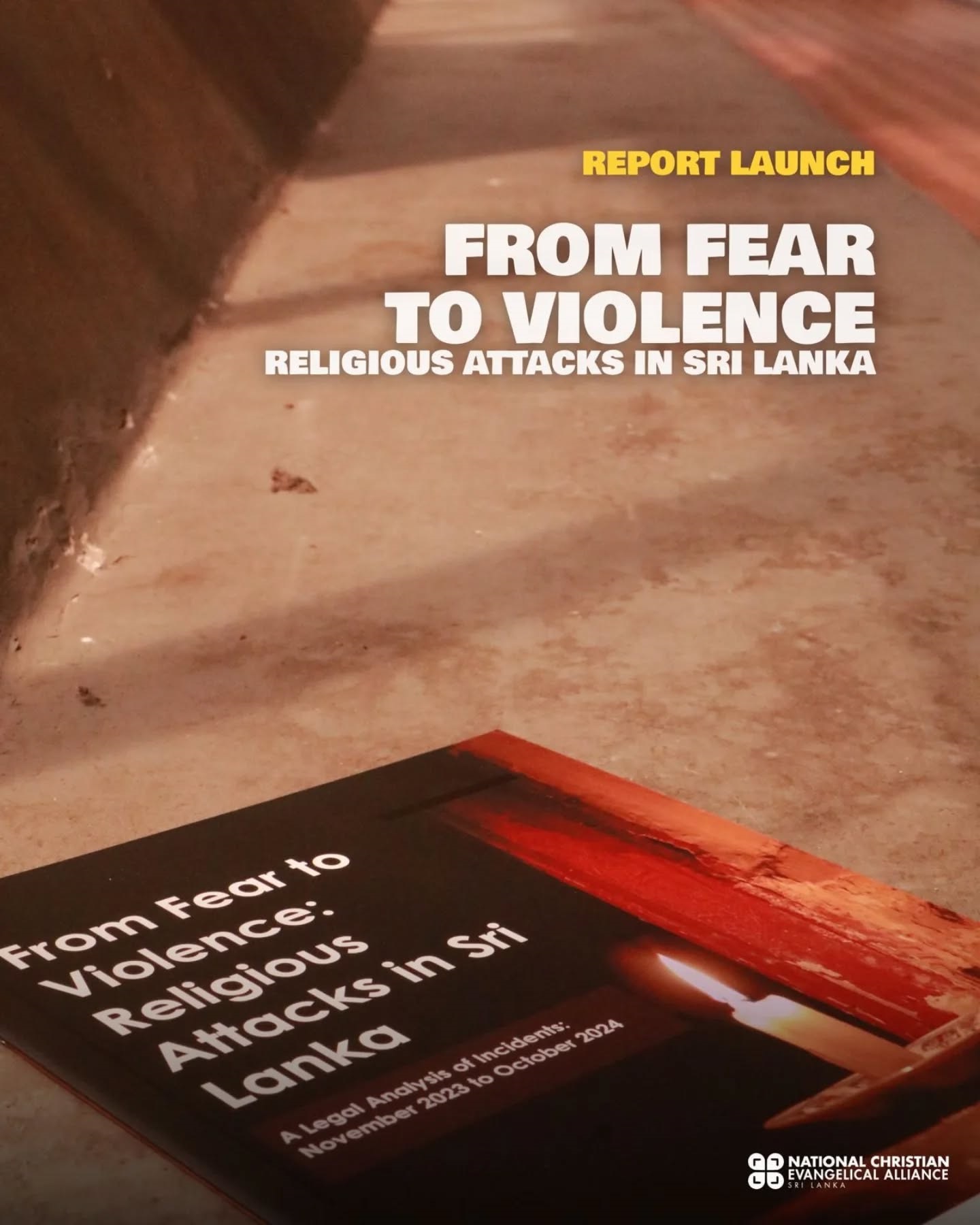
A report titled ‘From Fear to Violence: Religious Attacks in Sri Lanka’ has revealed an alarming escalation in religiously motivated violence across the island, exposing a pattern of aggression, impunity, and systemic discrimination that disproportionately targets non-Sinhala Buddhists.
Published by the National Christian Evangelical Alliance of Sri Lanka (NCEASL), the legal analysis documents over 100 incidents between November 2023 and October 2024 and presents a stark picture of Sri Lanka’s deteriorating religious freedoms. Conducted by a team of attorneys, the report examines these attacks through a constitutional and human rights lens, highlighting serious breaches of domestic law and international obligations.
“A large portion of the religious attacks recorded during the period of the study involved the state, and the police was alleged to be the principal perpetrator in most of these incidents,” the report added.
Central to the report is the argument that an entrenched Sinhala-Buddhist majoritarian ideology drives the ongoing persecution. “Certain members of the Sinhalese Buddhist community consider Sri Lanka to be a Sinhala-Buddhist country, and that religious groups perceived to be of ‘foreign origin’ should be controlled, restricted or eliminated,” it states. This belief, it adds, underpins hostilities against religious minorities and enables a climate in which violence is not only tolerated but often facilitated by state actors.
The study also offers a sobering sociopolitical analysis of “existential fears” harboured by Sinhala-Buddhists, rooted in perceived threats from Tamils, Muslims, and Christians. These fears, particularly over claims to territory in the Tamil North-East, fuel disputes over sacred sites and embolden hardline elements to assert cultural and religious dominance.
The report documents how these fears manifest through violent attacks, bureaucratic harassment, and structural marginalisation. Incidents range from the vandalisation of places of worship and threats to clergy, to police officers forcibly shutting down Christian prayer gatherings based on non-binding government circulars. In one such instance, pastors were ordered to stop house-based worship services under a Ministry of Religious Affairs circular—despite the fact that such directives do not hold legal authority under Article 15(7) of the Constitution. The report concludes that this constitutes a violation of Article 14(1)(e), which protects the freedom to manifest one’s religion.
Additionally, the study reveals the weaponisation of public order laws. Rather than safeguarding victims of violence, police have often sided with aggressors, framing minority worshippers as public nuisances and securing Magistrate’s Court orders to halt religious activities. “The continuing impunity of state actors involved in religious attacks and the erosion of the Rule of Law perpetuate the entrenchment of these existential fears,” the report notes.
The geography of violence is also mapped: most incidents occurred in regions with visible non-Buddhist populations, and perpetrators included private citizens, local officials, and law enforcement officers. The NCEASL’s data shows that attacks extended beyond verbal abuse and administrative obstruction to include physical assaults, destruction of religious property, and incitement to violence.
These findings build on a broader trend previously documented by civil society organisations, particularly in the Tamil-majority North and East, where the expansion of Buddhist religious structures - often overseen by the Department of Archaeology and backed by the military - has led to the desecration or displacement of Hindu temples and Muslim mosques. Such actions further exacerbate ethnic and religious tensions in a region already scarred by decades of conflict and militarisation.
In conclusion, the NCEASL calls for urgent legal and institutional reform. It urges the Sri Lankan government to uphold its constitutional commitment to religious freedom, equality, and non-discrimination. The report warns that without accountability, non-Sinhala Buddhists will continue to live under siege.
The full report by the National Christian Evangelical Alliance of Sri Lanka can be found here.