
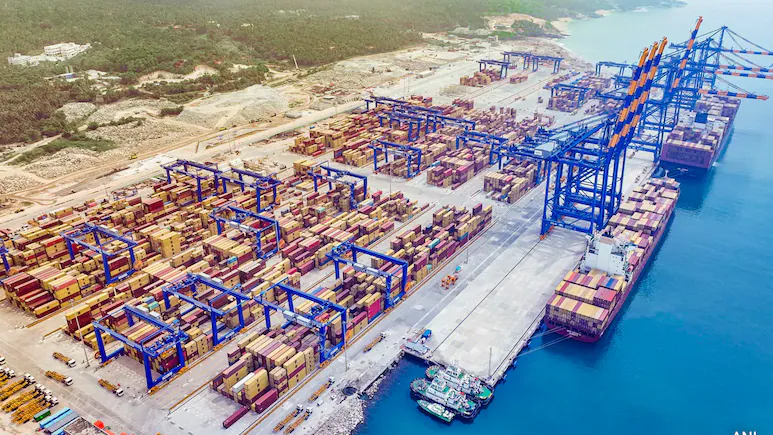
India has launched the Vizhinjam International Seaport in Kerala, with Prime Minister Narendra Modi inaugurating the facility. Located at the country’s southern tip, Vizhinjam is set to enter the global shipping network and compete with existing transshipment hubs, including Colombo, Jebel Ali, and Singapore.
Karan Adani, Managing Director of Adani Ports and Special Economic Zone Ltd, said the port is intended to become one of the most efficient globally. Vizhinjam currently handles 1.2 million TEUs (twenty-foot equivalent units) and aims to expand to 5 million TEUs by 2028.
The port is expected to reduce India’s logistics costs and provide Indian exporters and importers with quicker and more direct access to global shipping routes. Supported by Adani Group’s larger port network, Vizhinjam is positioned to attract more international cargo to Indian shores.
A key feature of Vizhinjam is its ability to handle container transshipment. The port is equipped with automation and large cranes that help reduce vessel turnaround times. Its location, near major shipping lanes in the Arabian Sea, allows for more direct cargo movement between Europe, the Gulf, Southeast Asia, and the Far East.
The port has a natural depth of 24 meters, enabling it to accommodate ultra-large container ships without dredging. Each berth is designed to handle vessels carrying up to 24,000 TEUs. It is also India’s first port with full automation and sustainability features.
This infrastructure puts Vizhinjam in direct competition with Sri Lanka’s Colombo Port, which currently handles about 70% of India’s transshipment cargo. Colombo has played a central role in regional shipping, but its shallower depth and rising congestion may reduce its competitiveness as Vizhinjam begins operations.
Vizhinjam’s launch comes as India promotes the India-Middle East-Europe Economic Corridor (IMEC), a proposed trade route that bypasses the Suez Canal. The port is expected to play a role in supporting India’s participation in this corridor and altering established trade flows.
For years, India relied on Colombo, Singapore, and Dubai for transshipment. Plans for a domestic port were delayed in part by concerns that redirecting cargo might harm Sri Lanka’s economy. However, India reconsidered after China became involved in developing Sri Lanka’s Hambantota Port.
Security concerns increased when a Chinese firm was given a majority stake in Colombo International Container Terminal and a new warehousing project. These developments, along with Sri Lanka cancelling a port agreement with India and Japan, raised questions in New Delhi about regional influence and trade control.
