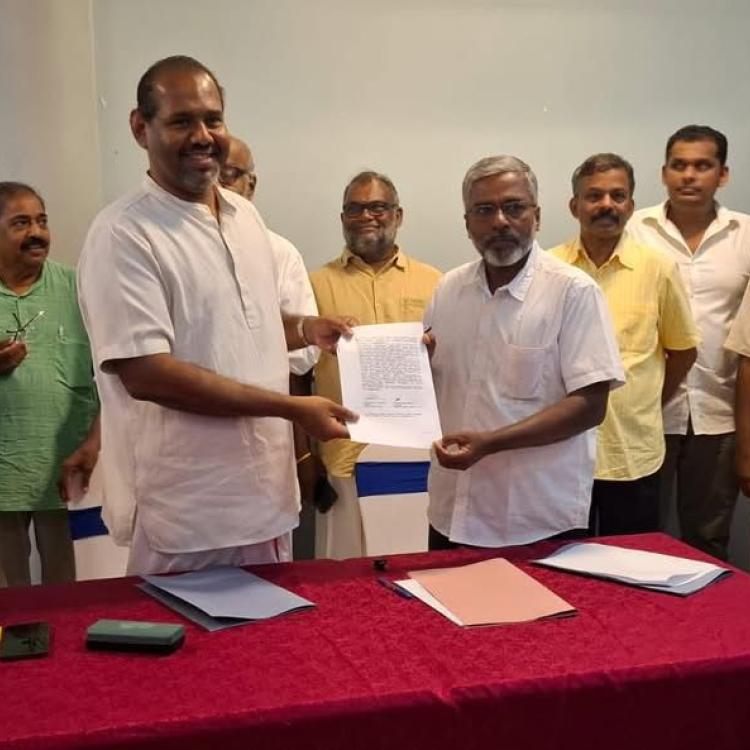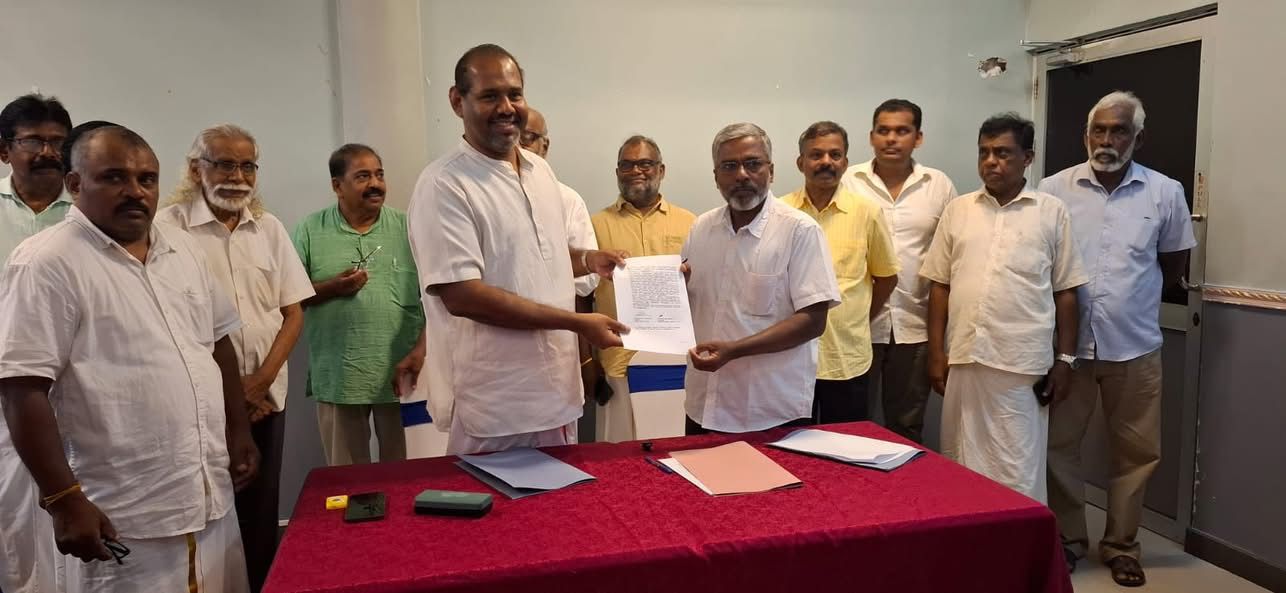
The Tamil National Assembly and the Democratic Tamil National Alliance (DTNA) have signed a Memorandum of Understanding (MoU) in Jaffna, pledging to jointly pursue a federal solution recognising the Tamil homeland and to seek international justice for the genocide committed against the Tamil people.
Signed on 2 June 2025 at the Tilko Hotel in Jaffna, the agreement sets out a joint political vision that firmly rejects the current unitary structure of the Sri Lankan state and calls for a fully federal autonomy system for the North-East, based on the Tamil people’s right to self-determination.
“We do hereby declare that we have decided with harmony to strive jointly to form a Federal State with full self-ruling power in our traditional homeland comprising of North and Eastern Provinces within the Independent Sri Lankan Island to enable the Tamil speaking people to meet their political aspirations and to confirm their identity with the right of self-determination and to handle their affairs independently,” the MoU states.
The parties explicitly reject the 13th Amendment as an adequate solution to the Tamil national question, stating: “We point out that the 13th amendment to the constitution shall not be an utmost or final solution for the Tamil National Ethnic issue.”
They also reject the internal accountability mechanisms proposed by successive Sri Lankan governments to address wartime crimes.
“We, the both parties hereby reject the internal mechanism to be created to inquire into the war crimes and genocide committed against the Tamil people during the war and the crimes committed against humanity even after the war. We insist for an international criminal inquiry on the above crimes.”
This renewed push comes amidst growing frustration over the failure of domestic processes to deliver justice for crimes committed during and after the armed conflict, including mass atrocities in Mullivaikkal in May 2009 that killed tens of thousands of Tamil civilians.
The parties further expressed their rejection of the 2015 Constitutional Assembly draft, which they say offered no meaningful autonomy for the Tamil nation and remained bound to a unitary state structure.
In the MoU, both parties committed to broadening Tamil political unity: “We therefore have to make a wide democratic political structure by bringing all Tamil National Forces under one umbrella and to make a possible harmony among the Tamil people.”
The document also includes a pledge to actively engage the Tamil diaspora and international Tamil communities in support of this joint political project.
“We should make use of all opportunities we get under the representative government and at the same time we should seek the support of the Tamil diaspora living out of Sri Lanka and all Tamil communities in all over the world.”
Both parties reaffirmed their long-standing rejection of Sinhala Buddhist majoritarianism and the unitary state framework, instead calling for a new constitution that explicitly recognises the political aspirations and territorial rights of the Tamil people.
The MoU was signed by Gajendrakumar Ponnambalam, President of the Tamil National Assembly (also the leader of the Tamil National People’s Front), and Nagalingam Ratnalingam, Secretary of the Democratic Tamil National Alliance.
See the full text of the agreement below.
.jpg)
.jpg)