
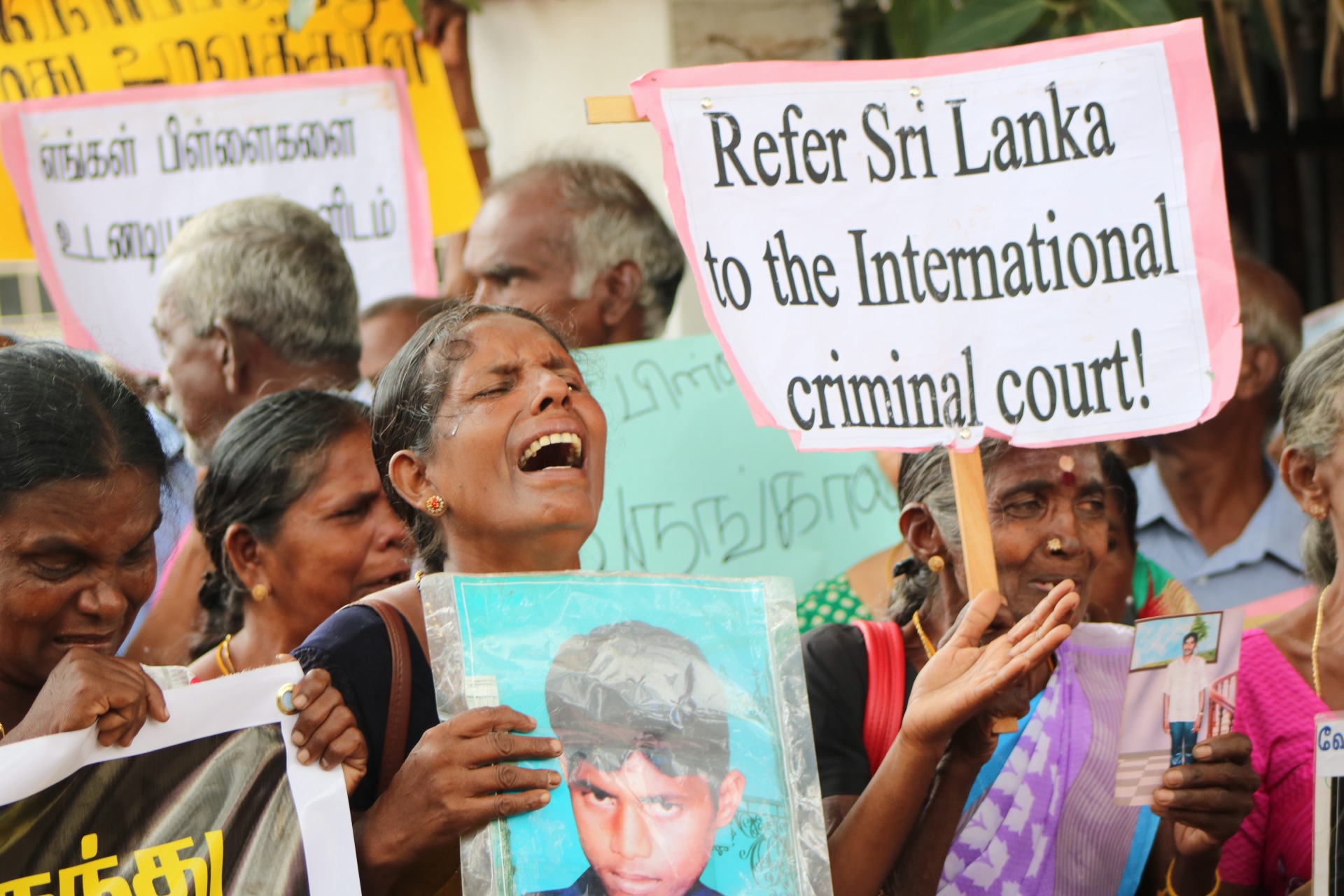
Tamils protest demanding a referral to the ICC in 2020.
A coalition of Tamil political parties, over 100 civil society groups, religious leaders, and academic institutions from across the North-East have called on member states of the UN Human Rights Council (UNHRC) to take decisive action against Sri Lanka by initiating a referral to the International Criminal Court (ICC) for the crime of genocide.
In a letter addressed to the UN High Commissioner for Human Rights and diplomatic missions, the signatories demanded that the UNHRC pass a resolution urging the UN General Assembly, Secretary-General, and Security Council to formally pursue accountability for war crimes, crimes against humanity, and genocide committed during island’s armed conflict.
They called on member states to “initiate a process, without any further delay, that results in referring Sri Lanka to the International Criminal Court.”
The letter has been signed by a broad alliance of Tamil actors, including political parties such as the Tamil National People’s Front (TNPF), Tamil Eelam Liberation Organisation (TELO), Democratic Tamil National Alliance (DTNA), Tamil National Green Organisation, Tamil National Council, and hundreds of civil society organisations from the North-East. Religious leaders, including bishops from Mannar and Trincomalee, also lent their names in support of the appeal.
The signatories specifically objected to any resolution that “gives the new regime in Sri Lanka political space and time to initiate domestic mechanisms,” warning that the Sri Lankan state’s entrenched ethnocratic structure and ideological dominance continue to obstruct genuine justice. They noted that similar promises made by the so-called “good governance” government of 2015 had failed, and cautioned against repeating the same mistake with the current administration led by Sri Lankan president Anura Kumara Dissanayake.
“The solution does not come through change in governments,” the letter stated. “The solution cannot be also ‘positive engagement’ with governments who rhetorically play obeisance to reconciliation – empty promises of change that do nothing to repudiate deeply rooted bonds to the politics of ethnic domination and ideological supremacy.”
The letter also highlighted the recent exhumations at the Chemmani mass grave site, where 135 bodies, including remains of children, have been identified so far. The signatories urged urgent international involvement in future excavations, stressing the need for “monitoring, supervision and technical support” to safeguard forensic evidence and ensure it can be used in international criminal proceedings.
They proposed that the UN Special Rapporteur on extrajudicial killings be tasked with coordinating the international monitoring of such grave sites, while reiterating that only an internationally mandated inquiry – not domestic efforts – could deliver justice.
In addition to ICC referral, the coalition also called for:
1. Extending the mandate of the UN’s Sri Lanka Accountability Project (OSLAP), but making it time-bound and “coupled with an explicit message… asking for a referral of Sri Lanka to the ICC”;
2. Support for universal jurisdiction cases outside Sri Lanka;
3. A re-mapping of mass graves across the North-East;
4. Greater scrutiny of ongoing militarisation, land grabs, surveillance of activists, and Sinhala-Buddhist colonisation;
5. Repeal of repressive legislation such as the Prevention of Terrorism Act (PTA) and the Online Safety Act.
The letter concluded with a solemn reminder: “For the last 16 years, Tamils have in one voice… asked for the UN system and the international community to deliver on the promise held out by international institutions entrusted with delivering justice. We write this letter with weariness, without much hope that action will follow – but hope is all we can.”
Read the full text of the letter and signatories here.