
.jpeg)
Sri Lankan political leaders have offered tributes following the killing of Iran’s Supreme Leader Ayatollah Ali Khamenei, highlighting the longstanding relationship between Colombo and Tehran that has spanned successive Sri Lankan administrations.
Sri Lanka’s Foreign Minister Vijitha Herath expressed condolences in a message posted on social media.
“Today l offered my deepest condolences to the Islamic Republic of Iran on the death of His Eminence Ayatollah Ali Khamenei. Our bilateral ties broadened significantly under his tenure. Sri Lanka remains appreciative of lran's friendship. Our thoughts are with the Iranian people.”
.jpg)
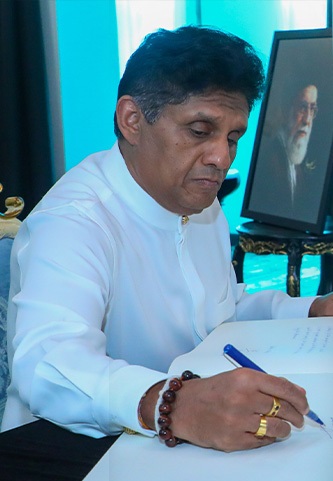
Tributes were also delivered in person at the Iranian embassy in Colombo, where Herath signed a book of condolences and was photographed bowing before a portrait of the late Iranian leader.
Former president Ranil Wickremesinghe and Opposition Leader Sajith Premadasa also visited the Iranian embassy to convey condolences, while Sri Lanka Podujana Peramuna General Secretary Sagara Kariyawasam also paid respects at the mission.
.jpg)
.jpeg)
The tributes come as Sri Lanka recalls decades of diplomatic engagement with Iran during Khamenei’s tenure as Supreme Leader, including several meetings between him and Sri Lankan presidents.
Meetings with Chandrika Kumaratunga
.jpg)
Sri Lanka’s engagement with Iran’s Supreme Leader dates back more than two decades.
In November 2004, then Sri Lankan president Chandrika Bandaranaike Kumaratunga met Ayatollah Ali Khamenei during an official visit to Tehran. The meeting took place ahead of the signing of several agreements and memoranda of understanding aimed at expanding cooperation between the two countries.
Speaking during the visit, Khamenei said, “Iran and Sri Lanka should utilise the capacity for bilateral cooperation and there are grounds to develop Iran- Sri Lanka co-operation.”
During Kumaratunga’s visit, Sri Lanka and Iran signed one agreement and four memoranda of understanding covering cooperation in areas including trade, environment, health and politics.
Rajapaksa meeting during Non-Aligned summit
.jpg)
The relationship between the two countries continued under subsequent administrations.
In 2012, former president Mahinda Rajapaksa met Ayatollah Khamenei on the sidelines of the 16th Non-Aligned Movement summit held in Tehran.
During that meeting, the Iranian leader praised Sri Lanka for standing up against what he described as colonial powers.
He said hegemonic powers try “to portray themselves as invincible, but Iran and Sri Lanka's experiences show that resistance against colonialists and hegemons is possible”.
.jpg)
Rajapaksa welcomed Khamenei’s proposal for a nuclear free Middle East during the summit and emphasised the importance of cooperation between the two countries.
“We are ensured that we can overcome many problems through your aid and assistance.”
The Sri Lankan president also held talks with then Iranian president Mahmoud Ahmadinejad, including discussions on the Uma Oya development project funded through a US$450 million loan from the Export Development Bank of Iran.
Sirisena’s visit to Tehran
.jpg)
In 2018, former Sri Lankan president Maithripala Sirisena also met Ayatollah Khamenei during a visit to Iran.
According to Sri Lanka’s Ministry of Mass Media, Sirisena was warmly received by the Iranian leader, who emphasised the importance of strengthening bilateral ties between the two countries.
Khamenei said both nations were located in strategically important regions and highlighted the need to utilise their capabilities to benefit from their geographical positions.
The Iranian leader also reportedly remarked that he had a particular fondness for Sri Lankan tea and stressed the importance of implementing agreements signed between the two countries.
Sirisena reportedly said that “Sri Lanka has a society based on Buddhist philosophy,” and “societies can be healed through such religious philosophies”.
Longstanding relationship
The meetings over the years reflected the broader relationship between Sri Lanka and Iran, which has included cooperation in areas such as trade, energy and development projects.
Iran was among the countries that supported the Sri Lankan state during its war on Tamils, having reportedly supplied around $150 million worth of arms to Sri Lanka in 2005, as well as loans and financial assistance that enabled Colombo to acquire military equipment.