
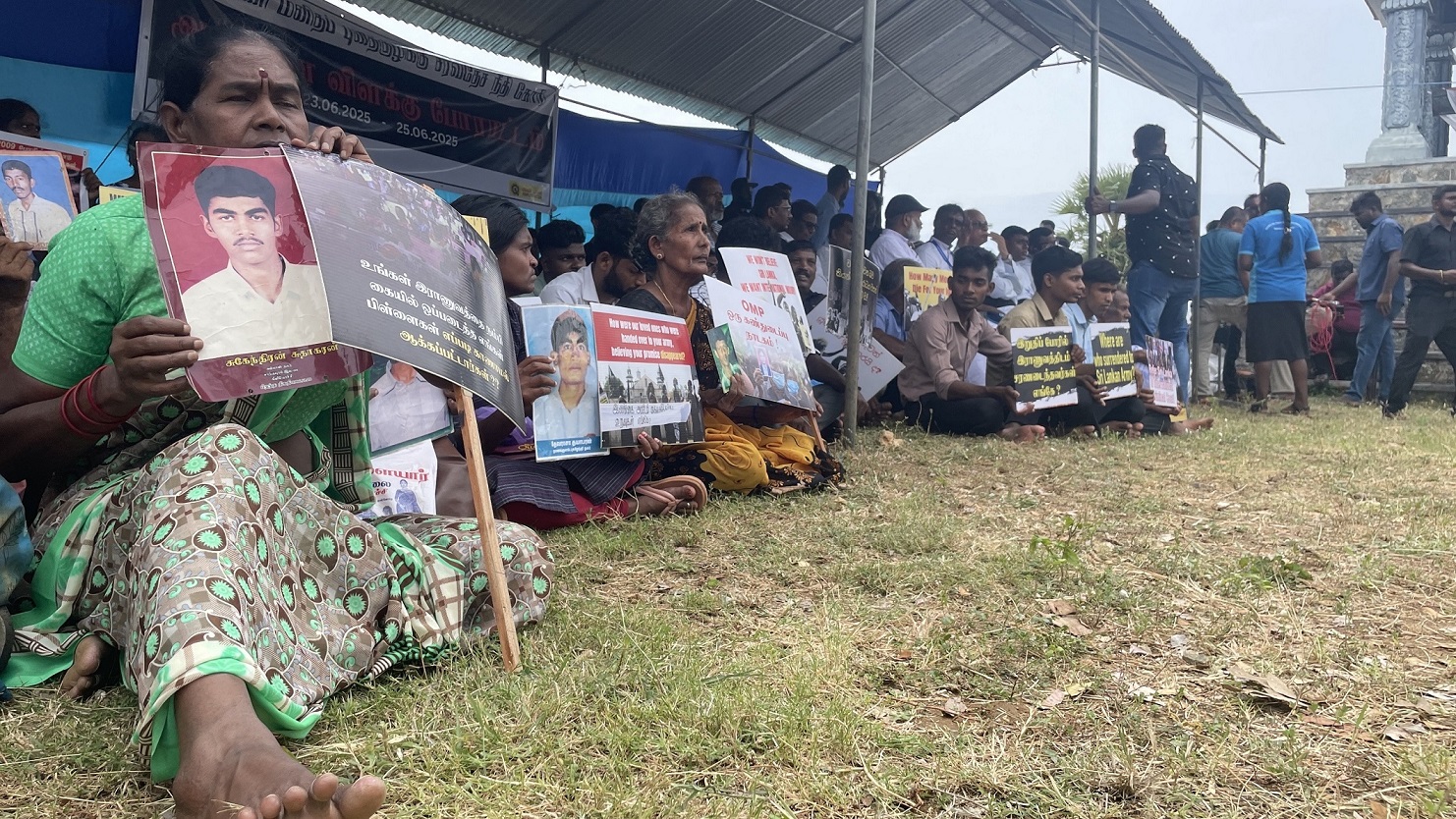
Protestors in Chemmani yesterday.
The Adayaalam Centre for Policy Research (ACPR), a Jaffna-based think tank organisation, has issued a strongly worded letter to the United Nations High Commissioner for Human Rights, Volker Türk, urging him to avoid enabling Sri Lanka’s continued “denial, repression, and impunity” during his official visit to the island this week.
The letter, dated 19 June 2025, raises serious concerns that the visit may be “instrumentalised by the Government of Sri Lanka (GOSL)” to project a false narrative of normalcy and reform while continuing to obstruct truth, justice and accountability for past and ongoing violations.
Highlighting a litany of unresolved abuses, the ACPR notes that “more than sixteen years after the end of the armed conflict, the GOSL has yet to demonstrate a genuine commitment to post-war justice and accountability.” It warns that successive governments have adopted the rhetoric of “home-grown accountability” merely to deflect international scrutiny and delay meaningful reforms.
The letter criticises the government’s rejection of international mechanisms, such as the UN Human Rights Council’s Sri Lanka Accountability Project (OSLAP), and instead its continued promotion of domestic institutions like the Office on Missing Persons (OMP) and a proposed Truth and Reconciliation Commission — mechanisms the ACPR say “have been widely rejected by Tamil victim-survivor communities” as politically compromised and ineffective.
Among its urgent calls to Türk, the ACPR urges the High Commissioner to:
• Publicly support the extension and resourcing of OSLAP;
• Press the Sri Lankan government to ratify the Rome Statute and incorporate it retroactively into domestic law;
• Meet families of the disappeared and visit the Chemmani mass grave and Mullivaikkal, the site of the 2009 Tamil genocide;
• Demand the repeal of the Prevention of Terrorism Act (PTA) and the Online Safety Act;
• Condemn ongoing militarisation, land grabs and the construction of Buddhist temples on contested Tamil land;
• Call for an internationalised and victim-centred process for mass grave exhumations.
The ACPR warned that the Sri Lankan state continues to pursue “the same patterns of denial, repression, and impunity as its predecessors”, citing recent government actions such as the expropriation of nearly 6,000 acres of land in the North under a new Gazette, continued surveillance and intimidation of activists, and the rejection of international oversight.
“The visit must not become a tool for legitimising a façade of progress,” the letter concludes. Instead, it calls on Türk to stand in solidarity with Tamil victim-survivors, to affirm their demands for international justice, and to “highlight the persistent challenges they face in the pursuit of truth and accountability”.
Türk is currently on a four-day visit to the island, where he is scheduled to meet with government officials, civil society, and religious leaders. His arrival coincides with the uncovering of remains at the Chemmani mass grave in Jaffna and large-scale Tamil protests calling for international intervention.
Read the full text of the letter here.