

Sri Lankan president Anura Kumara Dissanayake has once again pledged to repeal the Prevention of Terrorism Act, claiming the law will be abolished before the end of the year, even as his government prepares new legislation on organised crime.
Addressing parliament on Wednesday, Dissanayake said the draconian law, first introduced as a temporary measure in 1979, had remained in force for 46 years despite sustained calls for its repeal.
“The PTA was brought as a temporary law in 1979, but has remained in force over the past 46 years. There have been strong calls from the public to repeal the PTA,” he said.
Dissanayake said Justice Minister Harshana Nanayakkara had completed the formulation of the new law that would replace the PTA, adding that final discussions had already been held.
In his parliamentary remarks, Dissanayake placed the pledge within a wider speech on drugs, organised crime, corruption and the role of the state security apparatus.
“For many years, people struggled to secure the repeal of the Prevention of Terrorism Act. I am pleased to state that this Act will be repealed within this year. The final discussions on the matter have already been concluded and we will move swiftly to abolish it. However, we are also conscious of the threat posed by organised crimes at this moment. Therefore, we are formulating strong legislation specifically designed to combat organised criminal activity.”
He claimed the new legislation would be more narrowly defined than the PTA.
“Under the PTA, terrorism could be interpreted in many different ways, creating an excessively broad scope for legal action. One could potentially bring charges under the Act based on wide-ranging interpretations. By contrast, the legislation we are preparing on organised crime will contain precise definitions tailored specifically to organised criminal activity. The broad and ambiguous provisions that existed under the PTA made it possible to target individuals simply because they disagreed with those in power. We are determined to eliminate such possibilities.”
Dissanayake also said the proposed Organised Crime Act would focus “exclusively on organised criminals” and contain “a clear and specific legal definition” for that purpose.
But the latest pledge has already drawn scrutiny, given Dissanayake’s record of repeated assurances, delays and reversals on the PTA since taking office.
The National People’s Power government said in October 2024 that it would retain the PTA, despite Dissanayake’s campaign pledge to abolish oppressive laws, including the PTA. At the time, the government claimed the problem lay not with the Act itself but with its “misuse”, a familiar position adopted by successive Sinhala-dominated governments to avoid repealing one of Sri Lanka’s most repressive security laws.
In February 2025, Dissanayake again announced that his government would repeal the PTA and replace it with a new legal framework. That announcement raised concern that the law would simply be repackaged, rather than abolished, particularly after he warned of what he described as the possible resurgence of “terrorism”.
Since then, the government has continued to use the PTA.
In March 2025, Dissanayake personally authorised a 90-day PTA detention order against 22-year-old Mohamad Liyauudeen Mohamad Rusdi, in his capacity as Minister of Defence. Rusdi had been arrested in Colombo and accused of associating with extremist or terrorist organisations, but Sri Lankan authorities did not present credible evidence or file formal charges in the weeks following his arrest. The Human Rights Commission of Sri Lanka later concluded that Rusdi’s fundamental rights had been violated and urged the Justice Minister to repeal the PTA.
International human rights organisations have repeatedly warned that the PTA’s structure itself enables abuse, including arbitrary detention, coerced confessions and torture.
For Tamils, the law has been central to decades of state repression, enabling prolonged detention without charge, targeting of activists and journalists, the criminalisation of remembrance and the policing of Tamil political expression.
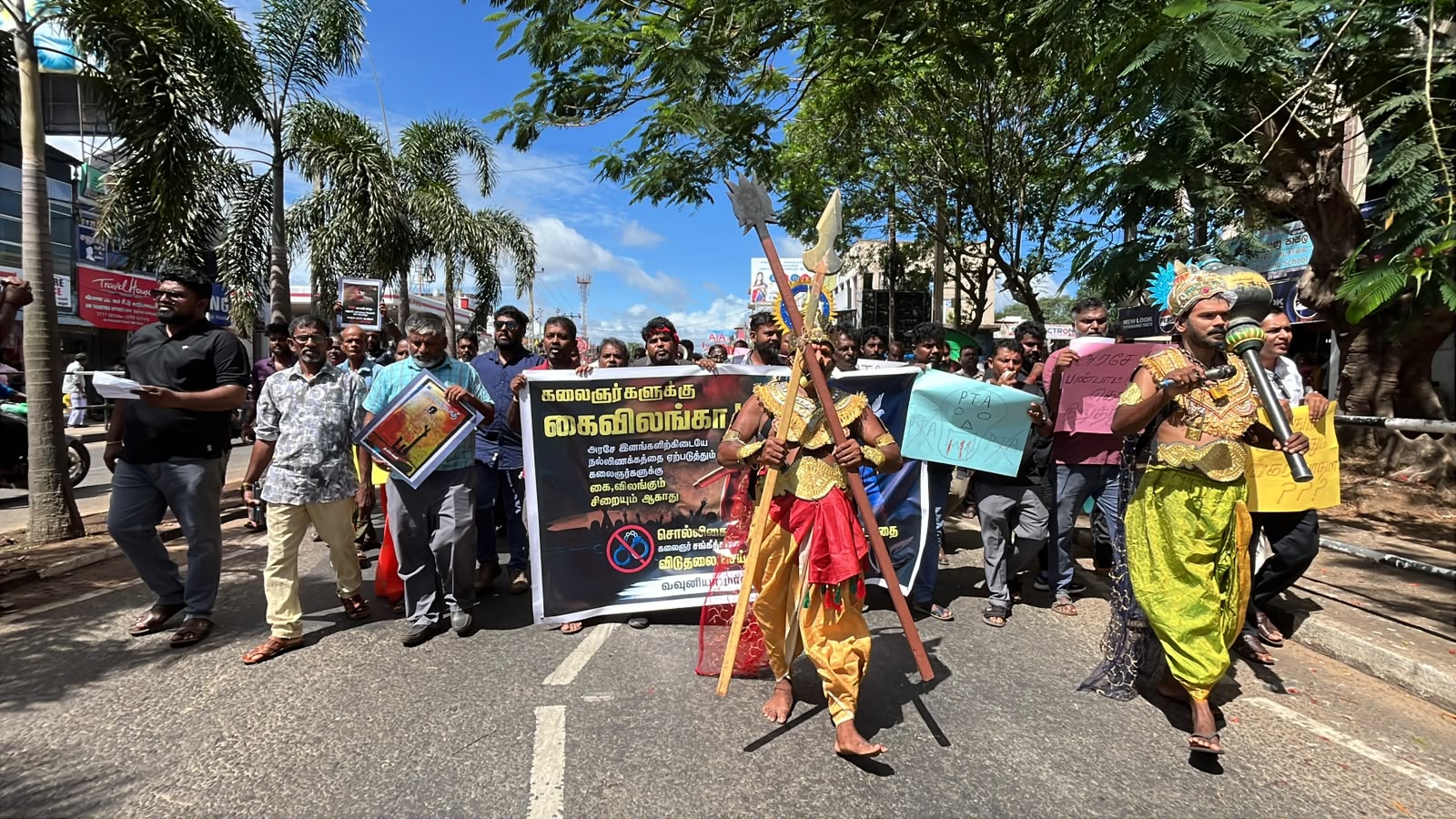
Dissanayake’s latest promise also comes just weeks after the PTA was used against Tamil rapper Sangeethsan Ganeshkumar, widely known as HipHop Sangee.
Sangeethsan was arrested earlier this month after Sri Lankan authorities alleged that videos he uploaded to social media promoted the Liberation Tigers of Tamil Eelam (LTTE). His arrest sparked protests across the Tamil homeland and abroad, with artists, activists and civil society organisations demanding his release and condemning the use of anti-terror legislation against Tamil cultural expression.
At a protest in Vavuniya, demonstrators carried placards reading “Handcuffs for artists?” and “Is singing and dancing terrorism?”
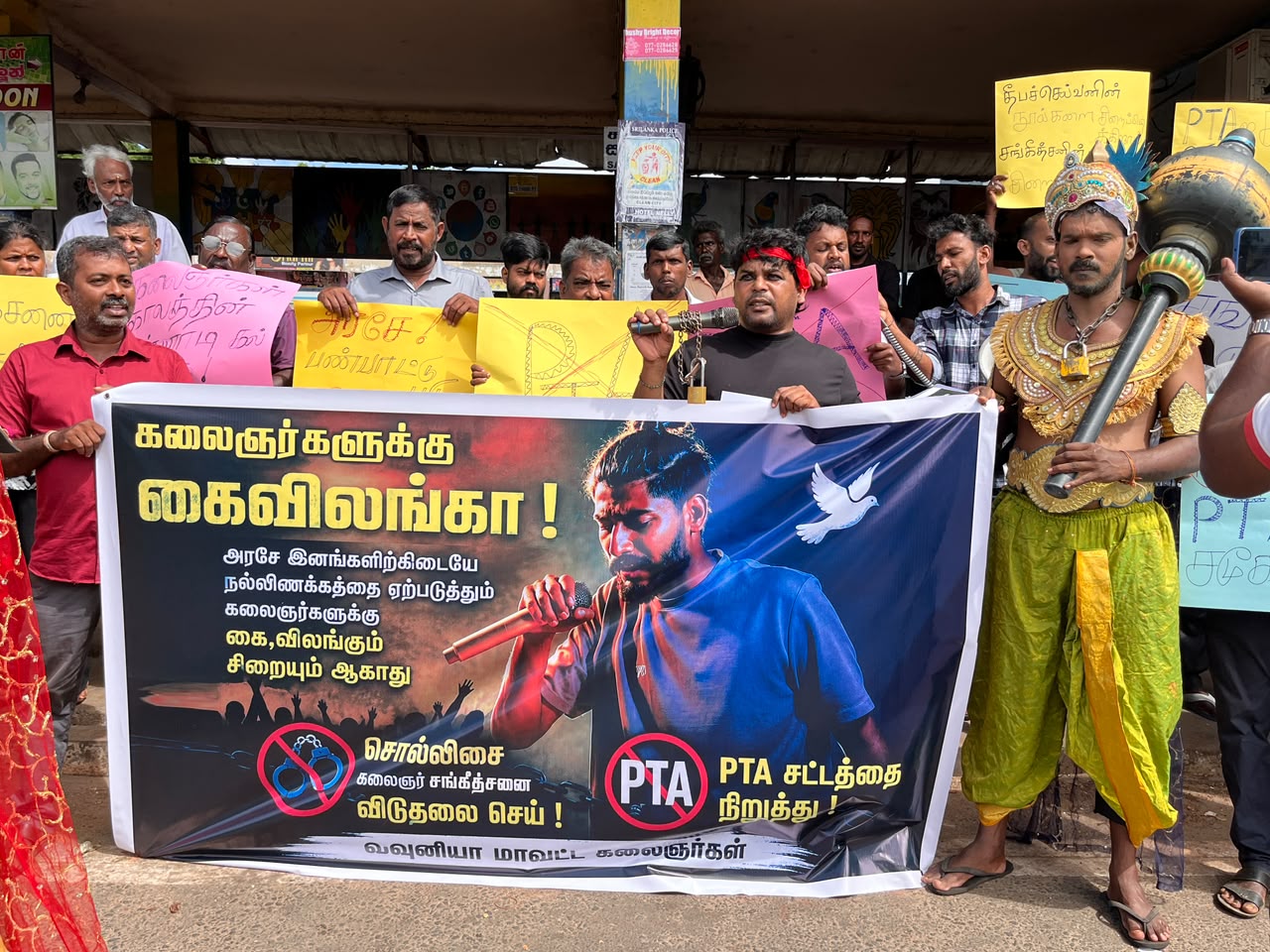
Amnesty International cited Sangeethsan’s case in renewed calls for the law’s repeal, warning that Sri Lanka’s continued use of the PTA facilitates arbitrary detention and other abuses.
The rights group said it was “concerned by the continued arrests and detentions carried out under the Prevention of Terrorism Act (PTA),” describing the law as one that has “long been criticized for its overly broad provisions and incompatibility with international human rights law and standards.”
The latest pledge therefore comes against a record of contradiction. Dissanayake promised repeal while campaigning, his administration then defended retaining the Act, later promised repeal through replacement legislation, continued to use the law, and is now again promising abolition while preparing another security framework.
That replacement process has already raised concern.
United Nations experts warned earlier this year that Sri Lanka’s proposed Protection of the State from Terrorism Bill risked repeating the same abuses as the PTA and failed to meet international law standards. The proposed bill was criticised as part of a wider pattern in which Dissanayake’s government promised democratic reform while seeking to normalise expansive executive and security powers.
The PTA was introduced as temporary legislation but became a permanent weapon of the Sri Lankan state. It has been used overwhelmingly against Tamils, both during and after the armed conflict, and remains one of the clearest legal instruments through which Colombo criminalises Tamil dissent, memory and political expression.