
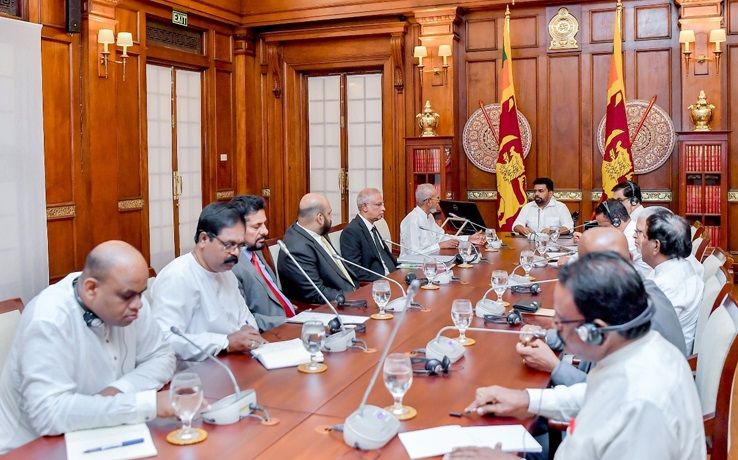
Sri Lankan President Anura Kumara Dissanayake met a delegation from the Illankai Tamil Arasu Kachchi (ITAK) at the Presidential Secretariat yesterday, asserting that the “old frameworks” for addressing Tamil political grievances were no longer adequate.
However, despite ITAK’s push for constitutional reform and Provincial Council elections, Dissanayake failed to offer any concrete timeline.
The meeting, held on ITAK’s request, centred on stalled Provincial Council polls, a new Constitution, and unresolved issues in the North-East, including land disputes, fishing conflicts, and long-ignored infrastructure needs.
According to the President’s Media Division, Dissanayake claimed that “longstanding issues faced by the people of the Northern and Eastern Provinces can no longer be addressed through outdated political solutions,” adding that the country “must move towards a new political framework.” He insisted that the support of “everyone” was needed in this process.
Tamil MPs express cautious support – and frustration
Former parliamentarian and Attorney-at-Law M. A. Sumanthiran said the ITAK had expressed support for Dissanayake’s remarks on combating extremist politics but stressed that such gestures must be matched by substantive action.
“In our meeting, we expressed support to the President’s statement, and agreed that we must work together to prevent racists from stoking tensions. But it can’t be at the cost of our people’s rights, so we need substantive action on the government’s part too,” Sumanthiran said.
While describing the discussion as having “many positives,” he added pointedly that the President “did not commit to quick action on the Constitution or Provincial polls,” highlighting the gap between rhetoric and delivery.
Batticaloa MP Shanakiyan Rasamanickam was more direct, noting that although the meeting was “a year late,” Dissanayake did demonstrate an understanding of Tamil aspirations and the technical processes tied to past agreements.
“We are willing to engage constructively,” he said, but warned that the government must present “a clear timeline and concrete confidence building measures.” Rasamanickam added that the Janatha Vimukthi Peramuna (JVP), which historically opposed federalism and Indian involvement, had shifted positions on economic and foreign-policy matters. “I am hopeful that the President will be able to bring his party along on the Tamil question, too,” he said.
Grand promises, few commitments
Dissanayake issued “immediate directives” to officials on several administrative issues raised by ITAK MPs, particularly around land and fisheries. But on the major political questions – devolution, constitutional reform, and the future of the Provincial Council system – he remained vague.
Critics note this mirrors Dissanayake’s broader pattern since taking office, by seemingly acknowledging Tamil grievances while refusing to articulate a concrete political roadmap. Despite declaring that outdated solutions can no longer apply, his National Pweople’s Power (NPP) government has yet to clearly state what form his new framework will take, or whether it will address the core demands of the Tamil nation, including self-determination, and protection against Sinhala-Buddhist majoritarian rule.
The ITAK delegation included MPs S. Rasamanickam, P. Sathiyalingam, G. Srinesan, S. Shritharan, T. Raviharan, K. Kodishwaran, and K. S. Kugathasan, as well as former MPs M. A. Sumanthiran and C. V. K. Sivagnanam. Secretary to the President Dr. Nandika Sanath Kumanayake and Senior Additional Secretary Roshan Gamage were also present.