
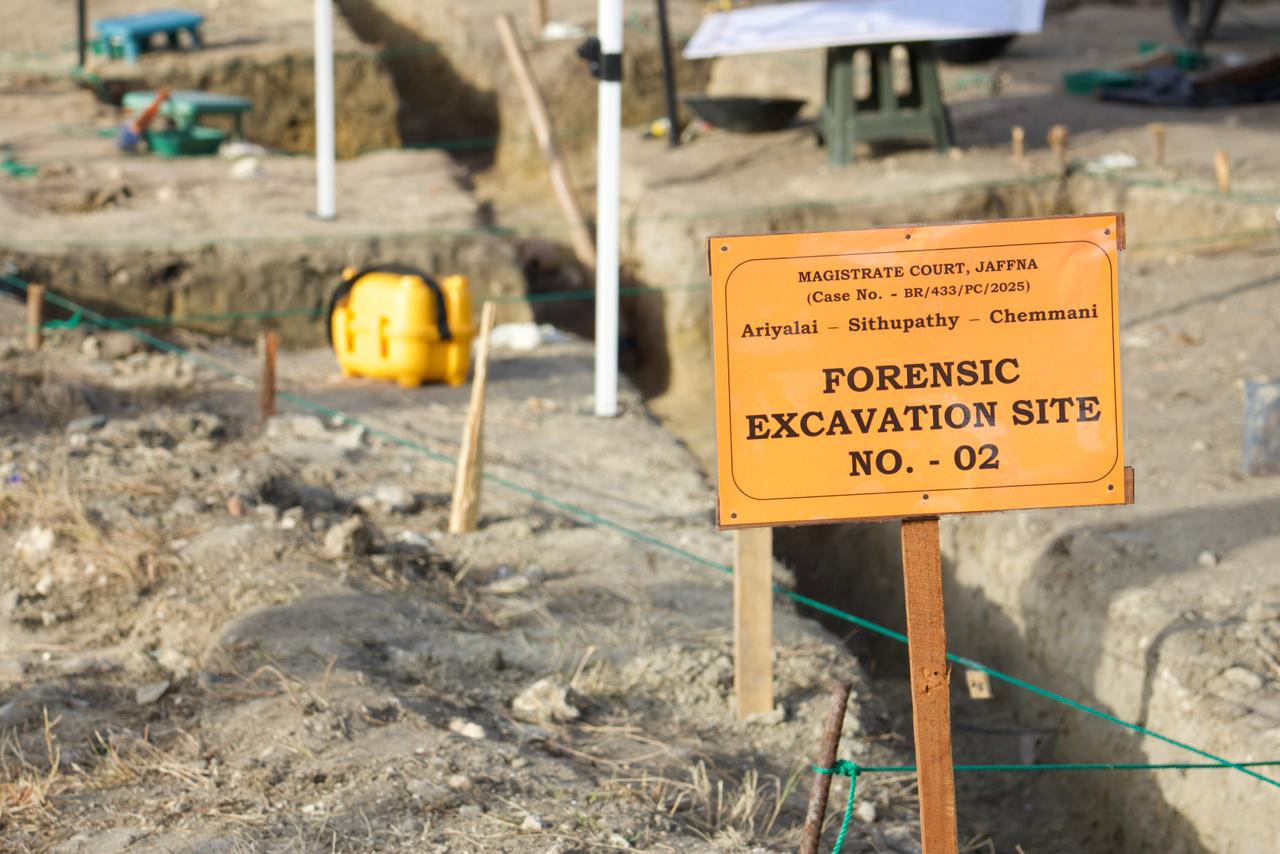
The Ilankai Thamil Arasuk Katchi (ITAK) has issued a formal letter to Sri Lankan president Anura Kumara Dissanayake, calling for immediate international oversight, accountability, and justice in the ongoing Chemmani mass grave investigation in Jaffna.
In a letter dated 11 July 2025, ITAK expressed “profound concern” over the excavation, which has so far unearthed 65 skeletal remains, including those of infants and children, accompanied by personal items such as a schoolbag, toy, bangles, sandals, and fragments of clothing. The party stressed the urgency of uncovering the truth and ensuring that all forensic protocols meet internationally recognised standards.
“These excavations, along with several other mass graves in the Tamil areas of the North-East, constitute clear evidence of war crimes and a genocidal campaign against the Tamil population in this country, a grave history that must be acknowledged in full,” the letter said.
The Chemmani site first gained notoriety in 1998 when Sri Lankan army Lance Corporal Somaratne Rajapakse, who had been convicted of the rape and murder of Tamil schoolgirl Krishanthi Kumaraswamy and her family, disclosed during his sentencing that between 300 and 400 Tamil civilians had been buried in the area. A subsequent excavation in 1999 uncovered 15 bodies, two of which were confirmed to be from 1996 disappearances. Despite forensic confirmation of assault and execution, prosecutions never followed and the case stagnated.
ITAK now calls for the consolidation of the original 1999 excavation case with the current proceedings at the Jaffna Magistrate’s Court, urging that both be treated as part of a “single criminal transaction.”
“The silence of successive regimes is not merely a political failure but a grave moral one,” the letter states.
The party underscored Sri Lanka’s limited domestic forensic capacity and history of opaque mass grave investigations, calling for independent international forensic experts to be engaged throughout the process. It demanded that all interim and final forensic reports, DNA profiles, and identification results be made public and accessible to victims’ families, civil society, and international observers.
“Sri Lanka’s limited domestic forensic capacity and the history of opaque handling of mass graves make transparent protocols and credible international oversight indispensable,” it said.
“Chain of custody must be documented meticulously. Independent forensic experts of recognized international standing should be engaged to oversee excavation, identification and analysis. Interim and final reports must be publicly disclosed to victims’ families, civil society, international observers and the wider public.”
The letter also highlighted reports that the remains excavated in 1999 were transferred to the University of Glasgow for analysis and called for their immediate repatriation. “To date, successive Sri Lankan governments have taken no meaningful steps to repatriate those remains, identify the victims or facilitate their proper last rites,” it said.
ITAK put forward five key demands:
1. Legal consolidation of the 1999 and 2025 Chemmani excavations into a single judicial inquiry.
2. Engagement of independent international forensic experts to ensure transparency and integrity.
3. Public disclosure of forensic findings and DNA results.
4. Repatriation of the 1999 remains currently believed to be in Glasgow for reinvestigation and dignified return.
5. Significantly enhanced resources for the ongoing excavation and immediate steps to prosecute those responsible.
“The earth at Chemmani is speaking again,” the letter reads. “Symbolic gestures of reconciliation ring hollow without real legal action.”
The call for international oversight comes amid mounting pressure from Tamil families of the disappeared, civil society actors, and international human rights organisations who have long criticised the Sri Lankan state’s failure to address enforced disappearances and mass atrocity crimes.
Read the full text of the letter here.