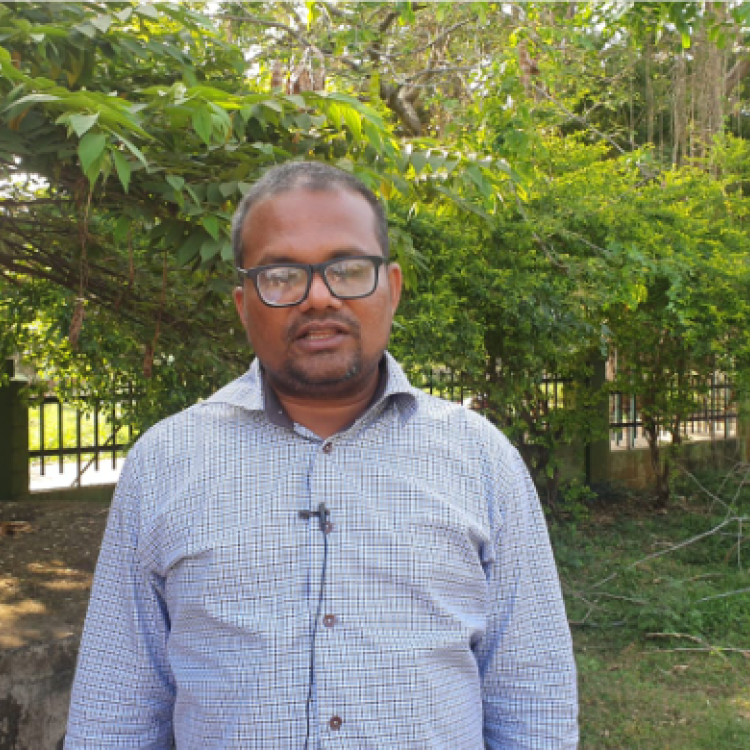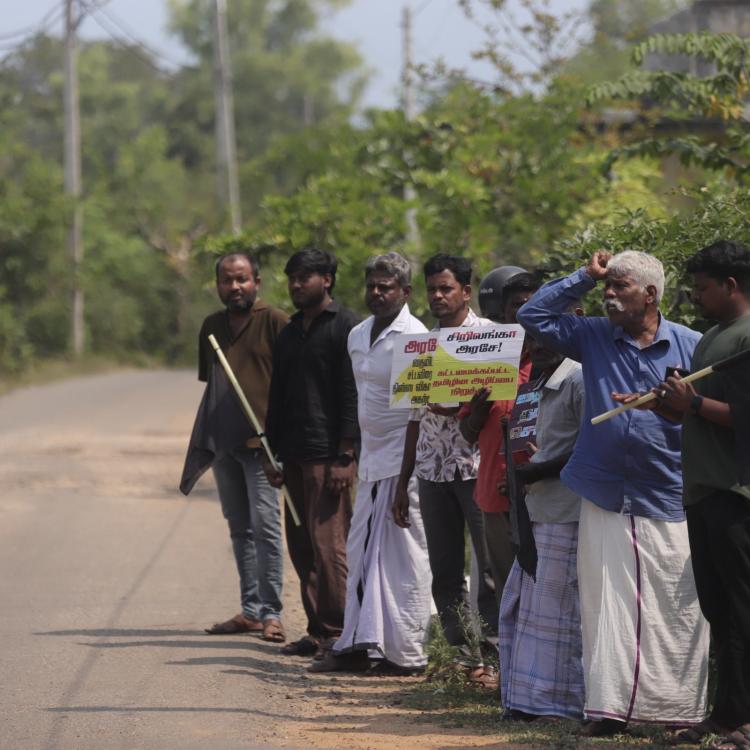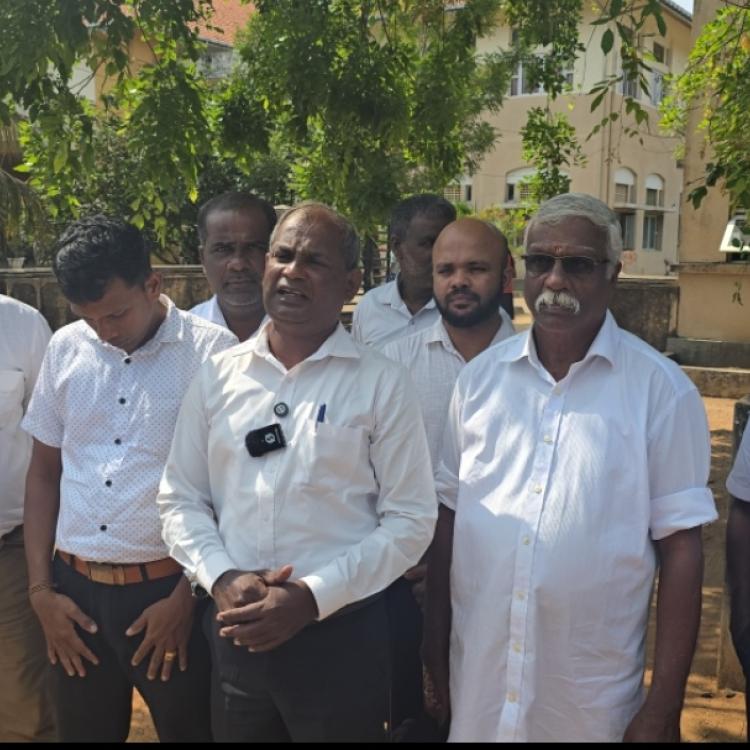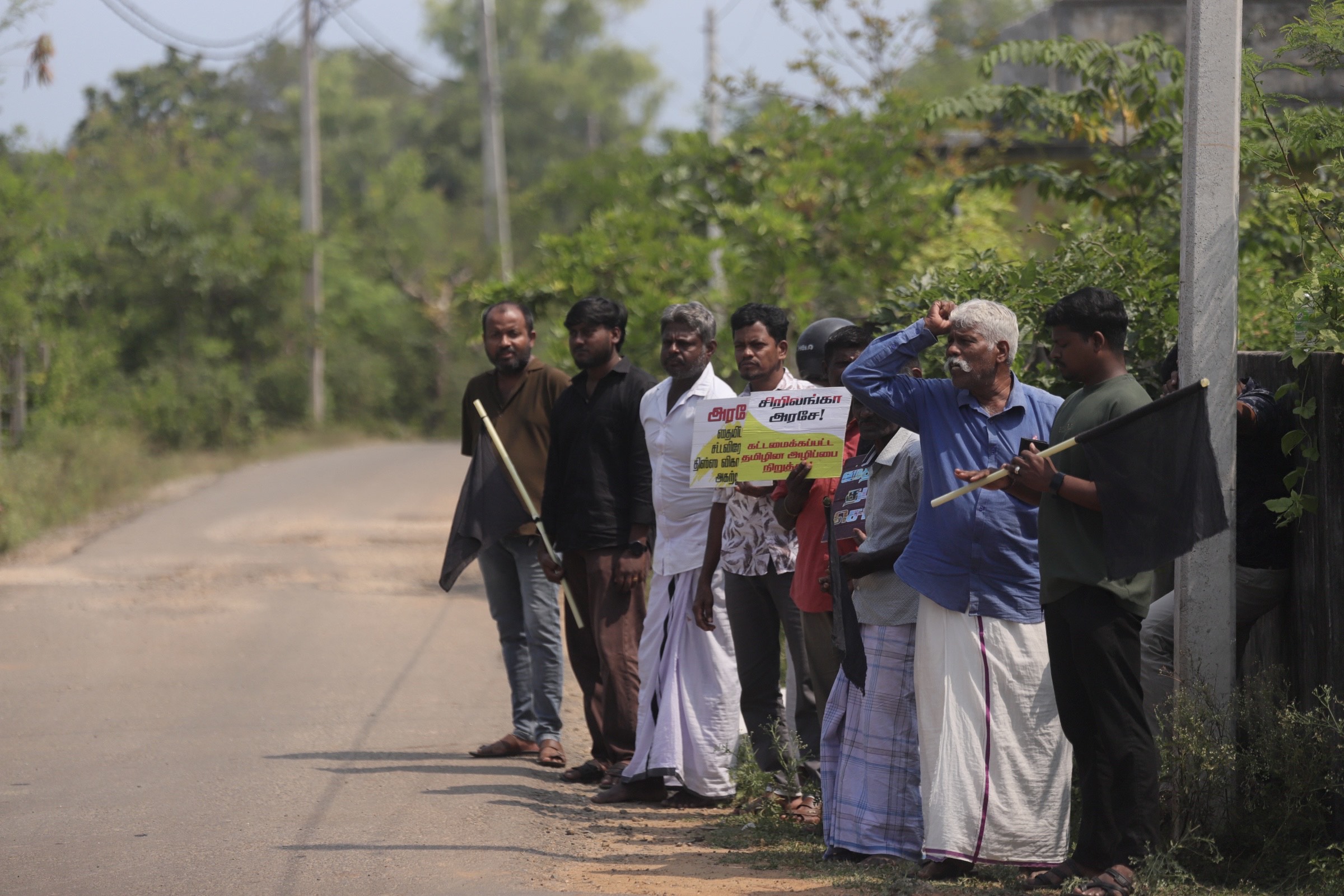
Landowners in Thaiyiddy in Jaffna have accused Sri Lankan authorities of discrimination and administrative harassment, stating they are being “punished by bureaucracy” while Sinhala Buddhist monks occupying their lands are treated with “honour and privilege.” Their remarks come as the government proceeds with a land survey linked to the long-disputed site of the Tissa Vihara.
A meeting held on 11 April 2026 at the Jaffna District Secretariat, chaired by Fisheries Minister Ramalingam Chandrasekar and attended by District Secretary Maruthalingam Piratheepan, discussed steps to survey lands claimed by 17 individuals in Thaiyiddy, within the Tellippalai Divisional Secretariat Division. The claimants had previously submitted documentation asserting private ownership over lands on which the Tissa Vihara now stands.
The move follows earlier discussions in January and February at the Ministry of Buddhasasana, Religious and Cultural Affairs, involving Minister Hiniduma Sunil Senevi and Justice Minister Harshana Nanayakkara. Landowners say assurances were given acknowledging their claims, after which the Survey Department was instructed to carry out formal measurements.
Officials have now notified claimants that surveys will take place on 17 April at 9:00 a.m., requiring their presence to identify plots. Survey plans are expected to be submitted to a designated committee for further action, including potential release of the lands.
Landowners argue that key decisions continue to be made through closed-door discussions involving state officials and ruling party politicians, with minimal participation from affected communities.
Several described repeated summons to produce documentation and attend meetings as a form of bureaucratic coercion. In contrast, they say, Buddhist monks who established the Tissa Vihara on the disputed land are afforded institutional protection and “royal treatment.”
The dispute has triggered sustained protests by landowners, civil society groups, and students in recent years. In December 2025, at least five individuals, including local representatives, were arrested during a protest in Thaiyiddy, with demonstrators alleging excessive use of force. The arrests were widely viewed by activists as an attempt to deter mobilisation.
Tensions resurfaced during Sri Lanka’s Independence Day in 2026, when students at the University of Jaffna hoisted black flags in protest, citing concerns over safety and ongoing Sinhalisation. Several students were later summoned for police questioning before being released with legal support. Thaiyiddy featured prominently in these demonstrations as a symbol of broader grievances over land and identity in the North.
One landowner noted that the Jaffna District Secretary had stated the land does not fall within a High Security Zone but is classified as state-controlled. However, lawyers supporting affected communities argue that privately owned lands, once no longer designated as High Security Zones, should not remain under prolonged government control. A civil lawyer familiar with land law noted that such disputes are typically resolved through the courts, raising questions about the involvement of ministers and state officials in the current process.
Landowners say this points either to political interference or to structural bias favouring Buddhist interests.
While authorities have engaged with 17 claimants able to produce documentation, many original landowners remain excluded. Decades of war and displacement have left numerous Tamil families without formal records, effectively preventing them from resettling in their original homes.
Residents say there has been little effort to identify or include these individuals, with information about the land’s status shared selectively. Many in the area still believe the land remains under High Security Zone restrictions.
Locals also say no action appears to have been taken regarding the Buddhist structure itself. The origins of the Tissa Vihara site remain contested. Some accounts suggest a limited Buddhist presence during the colonial period, centred on a 1946 land registration, which had ceased by 1959. Critics question how such a brief presence has been reinterpreted as evidence of longstanding historical significance. Recent claims linking the site to the era of Devanampiya Tissa and the arrival of Mahinda Thero have also been challenged by experts, who point to a lack of credible archaeological evidence and note that such narratives have emerged largely in the post-war period.
Residents maintain that Thaiyiddy has long formed part of a Tamil Hindu cultural landscape, and view the elevation of the Tissa Vihara as a post-2009 development rather than a continuation of historical tradition. Tamil historians and residents have long accused state-backed narratives of privileging Sinhala-Buddhist interpretations while marginalising Tamil traditions..