
Marginalised Tamil tea plantation workers took to the streets of Colombo on Wednesday, abandoning Thai Pongal celebrations to demand land rights, secure housing, and rehabilitation after recent climate disasters devastated their communities.
The demonstration, titled “Pongal for Rights,” was organised by the Civil Society Alliance for Reforms for the Malayagha Community and brought together Upcountry Tamil plantation workers, rights activists, and civil society representatives at the Liberty Roundabout in Colombo.
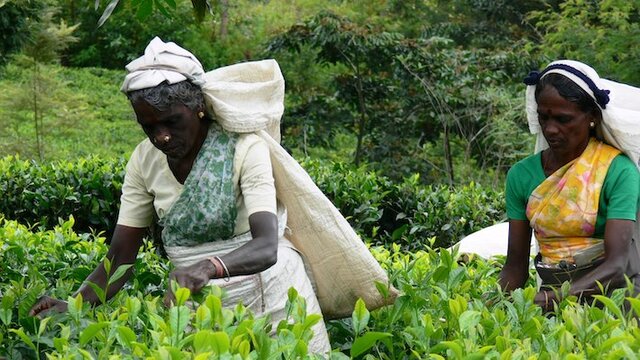
The protest highlighted the continuing plight of Malayagha Tamils, whose labour has sustained Sri Lanka’s tea economy for generations, yet who remain among the most impoverished and neglected communities in the country.
Tamil people celebrate Thai Pongal on the first day of the Tamil calendar month of Thai, marking the end of the winter solstice, a tradition observed by Tamils worldwide. However, instead of festive celebrations, Malayagha workers chose to mark the day by raising their voices for basic rights that have long been denied to them.
Many continue to live in overcrowded line rooms without land ownership, permanent housing, or access to proper public services.
Protesters carried traditional Pongal offerings to symbolise harvest and dignity, alongside placards calling for permanent housing, land ownership, and the establishment of new villages for families displaced by floods and landslides.
“Land and housing must be recognized not as charity but as fundamental rights essential to dignity, citizenship, and climate resilience,” Anthony Jesudasan, Executive Director of the Voice of Plantation People Organization, told UCA News.
Speakers at the rally noted that Malayagha Tamils have remained the backbone of Sri Lanka’s plantation economy, yet continues to be treated as disposable.
“Our labour built this economy, but our lives remain disposable,” one organiser said. “Pongal is about harvest and dignity, yet dignity is what we are still denied.”
The protest followed the devastation caused by Cyclone Ditwah, which struck Sri Lanka on November 28, affecting more than 2.3 million people and killing more than 600 across 25 districts, according to government figures. The World Bank estimates the cyclone caused losses totalling US$4.1 billion, equivalent to about four percent of Sri Lanka’s gross domestic product.
In the plantation regions of Kandy, Nuwara Eliya, Badulla, Matale, and Kegalle, landslides and floods destroyed homes and infrastructure, leaving entire communities without shelter.
“Some estates and homes are now buried underground,” said Dilki Nimalka, whose mother worked on a tea plantation in Kandy district. “Many seniors and children have been traumatized to the point that they are afraid even to think of returning.”
Jesudasan stressed that tea workers continue to be ignored despite their enormous contribution to the national economy.
“The tea workers need individual houses instead of line rooms, land with guaranteed titles, and new villages with basic infrastructure,” he said.
Around 1.5 million Malayagha Tamils help Sri Lanka earn approximately US$1.3 billion in tea exports annually, yet the community continues to suffer from poverty, malnutrition, poor educational facilities, and social exclusion.
In November 2025, plantation workers protested demanding a 200-rupee daily wage increase and a 200-rupee government attendance incentive on their existing daily pay of 1,350 rupees. Although the government later approved the wage increase, workers say it remains insufficient to address their hardships.
Nimalka criticised plantation politicians and opposition leaders for failing to understand the depth of the crisis faced by workers.
Father Basil Rohan Fernando, National Director of the Pontifical Mission Societies, said Catholic communities across Sri Lanka have been providing emergency relief and long-term support since the disaster.
“Material, financial, psychological, and spiritual assistance have been extended to affected families, but much more is needed from the state,” he said.
Organisers of the rally presented several key demands: individual houses instead of line-room housing, secure legal titles to land, the establishment of new villages with proper infrastructure, and comprehensive reconstruction of disaster-affected settlements.