
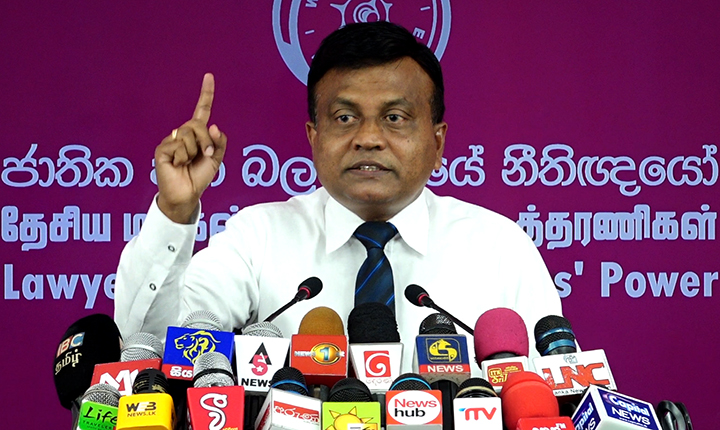
Sri Lanka’s Deputy Minister of Public Security, Sunil Watagala, has ordered the police to use emergency regulations to pursue and arrest individuals accused of circulating defamatory statements about Sri Lankan president Anura Kumara Dissanayake on social media, despite the president’s own public assurance that emergency powers would apply strictly to disaster management.
Speaking at a meeting with senior police officers, Watagala claimed that “extremely malicious attacks” were being spread online targeting the president and several government ministers. He alleged that many such posts originated from individuals living overseas and insisted that continued publication of what he deemed false or distorted content would trigger legal action under Section 5 of the Public Security Act.
“Spreading false and defamatory statements during a disaster situation is a punishable offence. The President is being badly slandered on social media. Arrest those responsible under the emergency law and initiate legal action,” he instructed.
“If this continues for another day or two, the orders issued by the President and the emergency regulations clearly cover this situation,” he said. “No one is permitted to spread false information, distort facts or engage in propaganda that undermines the situation through online platforms or the use of AI technology.”
The deputy minister went further, warning that the dissemination of such material, including content produced with AI tools, could result in prison sentences exceeding five years, and in some cases up to ten years. He described the criticism of the president as attacks “impossible to bear”, accusing unnamed groups of attempting to destabilise society.
His remarks stand in stark contrast to Dissanayake’s recent national address, in which he emphasised that emergency regulations would be used solely for disaster-related concerns. Watagala’s directive directly contradicts that assurance and expands the reach of emergency law into the sphere of online political speech, raising fears of renewed censorship and repression.
Successive Sri Lankan governments have a long history of invoking national security and emergency powers to silence dissent, particularly critics from the Tamil North-East and those outside the country.
Watagala’s comments indicate the administration’s willingness to use the current disaster to widen police authority and crack down on digital expression at a time when public anger is growing over the state’s slow and unequal response to Cyclone Ditwah.