
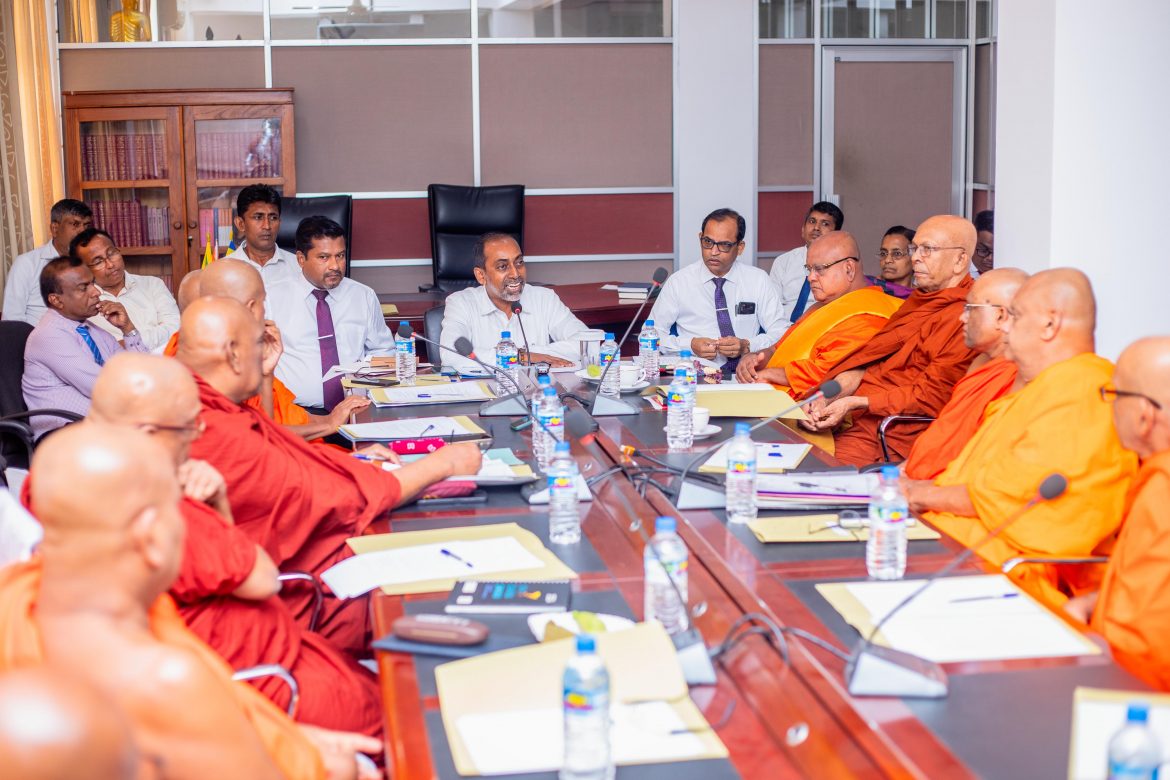
Sri Lanka’s Ministry of Buddhasasana, Religious and Cultural Affairs has inaugurated a newly established Buddha Sasana Council, as the state continues to draw closer to Buddhism on the island.
The council was launched in Colombo under the patronage of Buddhasasana Minister Dr Hiniduma Sunil Senevi, with monks from the Siam, Amarapura and Ramanna Nikayas, minister-appointed members, lay representatives and senior officials. Its mandate includes work on social security, monk education and research, and inter-religious reconciliation.
The inaugural session was chaired by Dr Venerable Pahamune Sumangala Nayaka Thero, Chief Registrar of the Malwatta Chapter, while Venerable Attangane Sasanarathana Maha Na Thero, General Registrar of the Ramanna Nikaya, was appointed honorary secretary.
The close relationship between the Sri Lankan state and Buddhist clergy has long been a contentious issue. Article 9 of the constitution grants Buddhism the “foremost place,” obliging the state to “protect and foster” the Buddha Sasana, while rights for other religions are outlined only secondarily in Articles 10 and 14(1)(e).
Since the end of the Mullivaikkal genocide in 2009, successive governments have accelerated the construction of Buddhist temples across the Tamil homeland, often bypassing legal requirements and local opposition. The state’s insistence on maintaining a rigid unitary structure, alongside constitutional privilege for Buddhism, has fuelled Sinhala Buddhist majoritarianism.
Last year, the United States Commission on International Religious Freedom recommended placing Sri Lanka on a special watchlist for "severe violations of religious freedom". Meanwhile Sinhala Buddhist monks have remained fervently hostile to Tamils and others on the island, frequently engaging in colonisation activities or attempting ot halt other cultural and religious festivals.
Such incidents underscore what Tamils have long decried as state-sponsored oppression, carried out alongside militarisation and land appropriation in the North-East.