
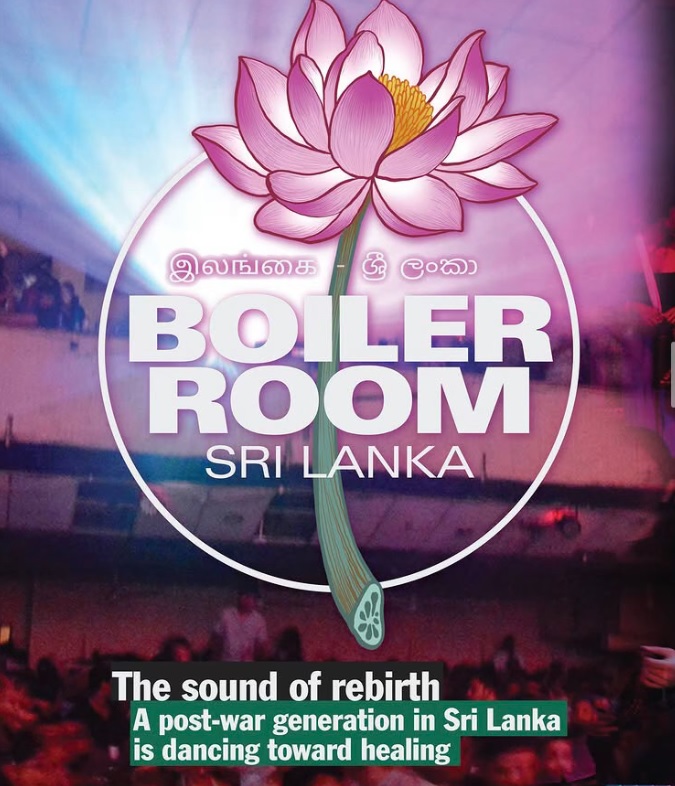
A December 2024 Boiler Room music event held at the former Rio Cinema, a site set alight during the 1983 anti-Tamil pogroms, has drawn scrutiny over its corporate backing, promotional narrative, and ethical implications. The event, a collaboration between the global music platform Boiler Room, South Asian collective DialledIn, and Colombo based creative agency Fold Media, was publicly promoted as a post-war reconciliation initiative when content was released during July 2025’s Black July memorial period.
Boiler Room was acquired by Superstruct Entertainment, a subsidiary of private equity firm KKR, in a deal announced in January 2025. KKR holds major investments in defense manufacturers, including Allison Transmission, which produces armored vehicle parts for military use globally. This acquisition has since sparked international boycotts from artist collectives who cite contradictions between the company’s stated cultural values and its financial ties to military supply chains. KKR have been a key player in the ongoing genocide in Gaza.
The event was hosted by London born Eelam Tamil DJ Goldtooth and opened with a cypher featuring Tamil artists from Batticaloa’s DreamSpace Records, Darshikan, Dinoj, OJ Da Tamil Rapper, and Sajas, followed by sets from Sinhala DJs. In interviews, the Tamil performers expressed that they were not informed of the “reconciliation” framing later used by Boiler Room in publicity materials, nor were they aware of the company’s then-pending acquisition by Superstruct.
Goldtooth stated he approached the event with honor and caution, considering it an opportunity for “representation and reclamation,” and specifically requested that no Sri Lankan flags be displayed noting also that he would not identify as Sri Lankan. However, Asvajit Boyle of Fold Media, who also performed at the event under the alias This Does Not Apply, confirmed he approved Boiler Room’s promotional language. Boyle acknowledged communication was rushed stating “one could say we could have brought the framing of the event up more forcefully but because of the circumstances, that ended up not happening”.
The choice of venue has drawn particular interest. The Rio Cinema, located in Colombo’s Slave Island area, a rapidly gentrifying area, was a Tamil-owned business destroyed during Black July. It has been used over the decades by artists in conjunction with the owner’s son Ratnarajah Navaratnam. Its reuse as a party space, without visible commemoration or historical acknowledgment, coincides with ongoing violations in the North East areas, including the discovery of unmarked graves in Chenmanni and the recent killing of Ethirmanasingham Kapilraj in Mullaitivu.
The event raises questions aligned with broader critiques of art institutionalism. Scholars like Andrea Fraser have long argued that art is instrumentalized by capital and power to sanitize controversial histories, a process often termed “art-washing.”
Furthermore, the history of Boiler Room’s former director, Noam Ohana, an ex-IDF special forces member who helped scale the company, deepens concerns around conscious complicity. Where Sara Ahmed critiques the “practical mechanics of inattention” that allow such affiliations to be overlooked, failing to investigate publicly available histories is not neutrality, but a form of alignment with oppressive systems. While local producers claimed ignorance of the KKR sale, information regarding the company’s leadership and direction has always been accessible, raising critical questions about the ethical diligence expected of cultural collaborators operating in post-conflict zones. This selective ignorance functions as a non-confrontational facilitation of controversial capital.
One Tamil artist who asked to remain anonymous questioned “who gets to attend these types of events anyway? Rave culture was born in working class Detroit but it’s usually the elite in attendance at parties like this in Colombo”.
In fact, just last year, the GoetheInstitut, which has funded other arts events at the Rio and maintains operations in Israel, commissioned TechnoWorlds, an arts initiative particularly underscoring rave culture as a Berlin export. Where Make Techno Black Again’s DeForrest Brown Jr states the dubbing of techno music as a European product is erasure, with UNESCO declaring the genre as “German cultural heritage”. Despite originating in Black and queer underground scenes in Detroit, when transposed to invite only venues, the very essence of techno becomes stripped of political context and repackaged as apolitical entertainment for global elite consumption. Video footage from the event shows a crowd enjoying the vices that come along with popular dance culture, smoking and drinking all in a site that was marked by ethnic violence, once again calling into question the ethics of such an event.
Some attendees, like multidisciplinary artist Ruvin De Silva, acknowledged the dissonance, admitting that partying in a place touched by anti-Tamil violence felt “quite strange,” and noting that Colombo’s scene is often removed from the realities of the island’s ethnic violence.
This disconnect invites reflection: one might wonder whether the pro-Palestinian activists present, who advocate passionately against spatial erasure in Gaza, would find themselves equally comfortable celebrating in a venue reclaimed from Zionist destruction abroad. The parallel invites a deeper conversation about how solidarity traverses geography, and why certain struggles resonate globally while others, much closer to home, remain overlooked in our own circles. It asks us to consider how consistently we apply the principles we champion elsewhere.
For Toni Cade Bambara, the Black radical writer and activist, the role of the artist was “to make the revolution irresistible.” This vision stands in stark contrast to cultural production that serves capital and power. The Boiler Room event, despite the sincere participation of Tamil artists, ultimately prompts difficult questions for the Colombo art scene: Who is reconciliation for? Who is allowed to remember, and who is encouraged to forget? And can a space truly be reclaimed when structural conditions of violence remain unchanged?
If the true goal is unity and reconciliation, then the path forward must be one of continuous learning and a conscious relinquishing of control. It requires creating and protecting space for off-center voices, particularly those from the North and East, to lead the narrative not simply be an opening act. This process involves recognizing the profound interconnectivity between all struggles for liberation, understanding that the fight against militarization in Gaza, the demand for justice in Mullaitivu, and the resistance to gentrification in Slave Island are not isolated battles, but interconnected fronts in a global struggle for dignity.
This is not a question of individual artists’ intentions, but of the systems that enable, fund, and frame their work. As Tamil artists seek visibility and voice, the infrastructures that platform them must too be held to account.