
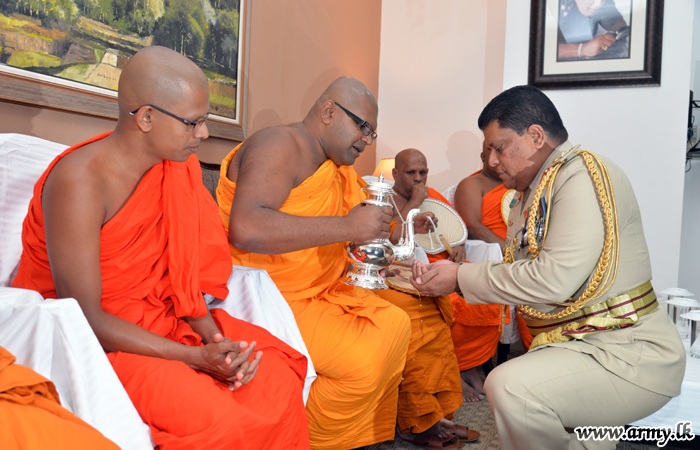
File photo: Shavendra Silva with Sinhala Buddhist monks last year.
The Sri Lanka Podujana Peramuna (SLPP) has written to the Sinhala Buddhist clergy, raising concerns over what it described as the government’s attempts to “oppress war heroes” and to defend soldiers who fought in the state’s military campaign against Tamils.
In letters dated 2 September and addressed to the Mahanayake Theras of both the Asgiriya and Malwathu Chapters, SLPP General Secretary Sagara Kariyawasam claimed that while “terrorism” ended 16 years ago, “the ideology behind it still persists.”
The party accused the government of taking steps to appease “groups hostile to war heroes,” allegedly under the influence of “external actors” that backed the administration’s rise to power.
The SLPP went on to allege that there is an “unspoken understanding” between the government and anti-military groups, and criticised officials for neglecting the state’s annual commemorations for soldiers. By contrast, the letter accused the administration of “tolerating events that glorify terrorism” both in Sri Lanka and abroad, a reference to Tamil memorialisation ceremonies, which successive governments have attempted to block.
“The dignity of war heroes who sacrificed their lives for the country’s freedom must be safeguarded,” the SLPP insisted, appealing to the Maha Sangha for their “blessings and supportive guidance.”
The SLPP’s appeal to the Buddhist clergy underscores how Sinhala nationalist forces continue to work with religious institutions to protect the military from accountability for the atrocities committed during the final phase of the armed conflict.
Sri Lanka’s military has been repeatedly accused of genocide, war crimes and crimes against humanity, including massacres, enforced disappearances, and sexual violence against Tamil civilians, particularly during the 2009 Mullivaikkal genocide.
Yet, far from facing accountability, the armed forces are routinely celebrated as “war heroes” by Colombo’s political establishment, with Buddhist monks playing a central role in legitimising that narrative.
To date, none have been held accountable for the genocide.