
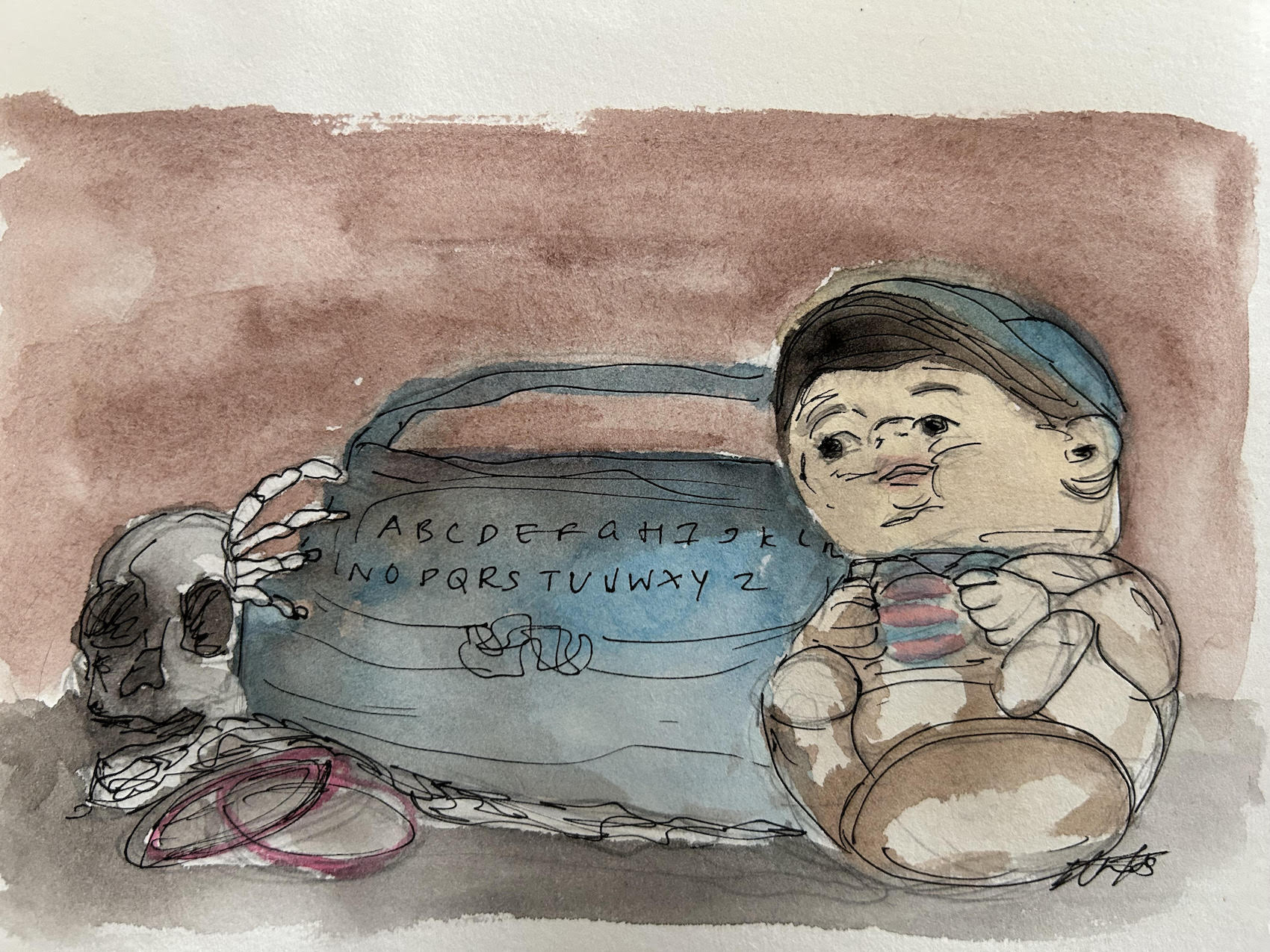
This week, the number of skeletal remains uncovered at Chemmani reached a stark record of 387. With that figure, a patch of earth on the edge of Jaffna town became the largest mass grave ever uncovered on the island, surpassing the 376 remains recovered at Mannar. Recent days alone have seen the bodies of several children exhumed, alongside beads and bangles. These are the contents of the largest crime scene in the Tamil homeland, being catalogued one body at a time.
The number will certainly continue to rise. It has risen with almost every day of digging, from 262 in the spring to 283, to 360, to 387, and the work is still not finished. We have learned to read these bulletins as a grim statistic, each day's count a little higher than the last. It is worth pausing over what the arithmetic represents. Every increment is a person who was alive, who was taken, who was killed, and who was buried in secret by a state that then spent a quarter of a century insisting there was nothing to find. The remains of children and infants have surfaced repeatedly, in one earlier instance an adult skeleton found cradling the bones of a small child. Whatever euphemism Colombo eventually reaches for, no security operation produces graves like this.
That Chemmani is being excavated at all is the result not of the state's conscience but of its forgetfulness. The site has been known since 1998, when Lance Corporal Somaratne Rajapakse, condemned to death for the rape and murder of the schoolgirl Krishanthi Kumaraswamy, her mother, her brother and a neighbour, testified that hundreds of Tamils disappeared during the military's occupation of Jaffna in the mid-1990s lay buried there. An initial dig confirmed the bones and was then abandoned, and the site lay undisturbed for more than two decades, until workers building a crematorium broke the ground again in February 2025. The state did not return to Chemmani. It was dragged back, after twenty-seven years of deliberate cover-up. Had no crematorium been commissioned, the hundreds buried there would still be a secret kept by the soil.
There is every reason to fear that the truth, once counted, will be buried a second time. Sri Lanka has done this before, and recently. The Mannar grave, uncovered during construction in 2018, yielded its hundreds of remains. Bone samples sent to a laboratory in Florida were carbon-dated to between the fifteenth and eighteenth centuries, even as the metal bindings used to tie the victims' legs pointed to far more recent killings. Families of the disappeared rejected the finding, no accountability followed, and the case was closed. The Kokkuthoduvai mass grave site in Mullaitivu has also been left to deteriorate. These graves remain neglected pits, covered over with soil and shrubs, bereft of any type of memorial. It is precisely this precedent that hangs over Chemmani, and precisely why the families have asked, again and again, for the excavation to be placed under international observation.
What Colombo offers instead is the Office on Missing Persons, the latest in a long procession of flawed domestic institutions sent to survey the bones. Every one of these mechanisms has shared a single design feature: it keeps the question of Tamil deaths within the custody of the state that caused them. To ask the perpetrator to weigh the evidence of its own crime is the means by which justice is indefinitely deferred.
Nor will this government prove the exception its supporters promised. The National People's Power (NPP) came to office pledging accountability, the repeal of draconian laws and a break with the impunity of its predecessors. On the evidence it has delivered none of it. Tamil artists have been jailed under the very Prevention of Terrorism Act (PTA) the NPP vowed to abolish. The military still occupies the homeland. And as the remains mount at Chemmani, the government has refused to back the families' demand for international monitoring. A regime that promised to be different has reached the largest mass grave on the island and found nothing in itself to distinguish it from those that dug it.
For the families who gather at the edge of the pit each day, the excavation is neither abstraction nor history, but the possibility, after thirty years, of recovering a name. Many have spent decades carrying photographs along roadsides and refusing the compensation offered in exchange for their silence, insisting that their husbands and sons and daughters did not simply vanish but were taken by an identifiable state with identifiable officers. They are owed more than a count. They are owed the identities of the dead, the names of the men who killed them, and a tribunal beyond Colombo's reach with the power to act on both.
The death toll is already a verdict on the Sri Lankan state, and it will climb higher before the digging stops. The international community that funds Colombo's reconciliation theatre and renews its trade concessions has offered the families of Chemmani no monitoring and no mechanism with teeth, content to look upon the largest mass grave on the island and see, as ever, a domestic matter for Colombo to manage. The only question that matters is whether these dead will be named and their killers tried, or whether they will be buried again beneath the paperwork of a state practised in the disappearance of its own crimes.
_________________
Illustration by Keera Ratnam.