
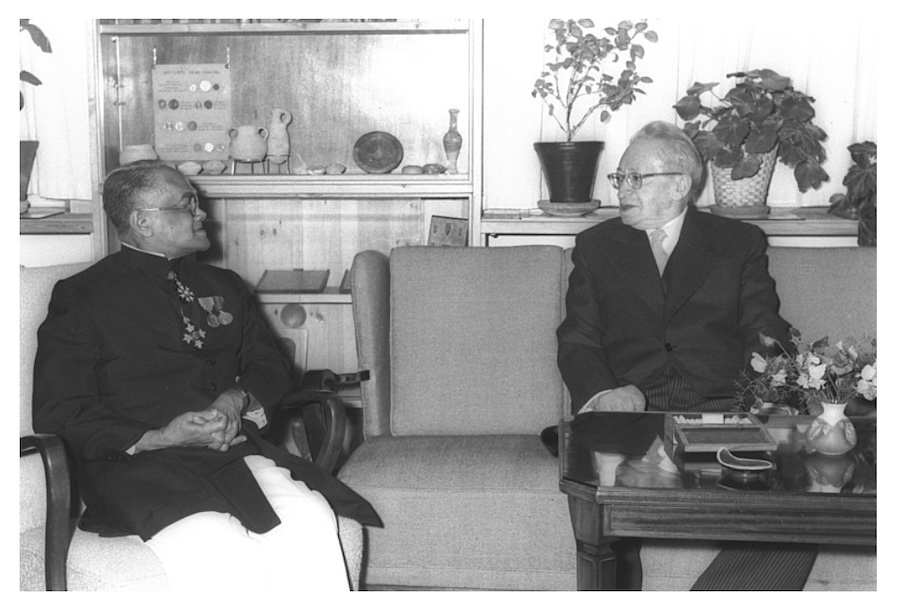
Sir Arthur Ranasinghe meets Israeli President
A Sri Lankan professor at a military university has analysed the Israeli influence behind Sri Lanka’s Sinhala settlement policies during the late 20th century, particularly in the Mahaweli Development Project — the island’s largest post-independence scheme.
The piece, entitled “Israel’s Shadows behind Settlers Policy in Sri Lanka” by Punsara Amarasinghe traces how Israeli agricultural and military models shaped Colombo’s resettlement strategies, especially in the Tamil homeland, embedding militarised demographic engineering that continues to this day.
Drawing parallels between Israeli settler expansion and Sinhala colonisation in the North-East, the article examines how development, displacement, and militarisation became interlinked under the guise of nation-building.
“Don Stephen Senanayake, the first prime minister of independent Sri Lanka, envisioned national development aligned with the island's ancient hydraulic civilization,” writes Amarasinghe. “Senanayake’s proposal to establish agricultural settlements in the dry zone drew inspiration from contemporary examples—most notably the Jewish settlements in the British Mandate of Palestine.”
See more extracts below.
“Senanayake’s 1935 booklet, Agriculture and Patriotism, reflects his political idealism and the goals he sought for independent Sri Lanka. His vision in the text is strikingly similar to the Jewish agricultural settlements in Palestine in the early 1930s. The ethos Senanayake promoted—self-resilience and a prosperous peasantry—mirrored the aspirations of the Zionist movement in Palestine.”
“The acceleration of the MDP as a quick remedy for Sri Lanka’s energy and resettlement goals stemmed from the work of an Israeli agent named Amy Yar. His close ties with J.R. Jayawardene’s administration resulted in more Israelis arriving on the island under the guise of agricultural experts.
Gamini Dissanayake, who oversaw much of the project, maintained good relations with several Israeli agricultural advisers. Two academics from Hebrew University, Jerusalem, provided a comprehensive analysis of the project for the Sri Lankan government, and a major portion of the work was awarded to the Israeli construction company Solel Boneh.
Israeli architect Ulrik Plesner arrived in Sri Lanka in 1981 to plan new towns in the Mahaweli settlements in the hill country. In Plesner’s own words, “I tried to make towns which ten years from now will be pleasant to live in.” Plesner incorporated basic planning principles reminiscent of Jewish settlements in Palestine—such as locating all buildings off the main road to create a dense, urban character with streets, squares, and shaded public spaces. His Mahaweli plans bore remarkable parallels with Israeli settlements such as Ma’ale Adumim and Ariel, highlighting a mutual justification for demographic engineering.
Read the full piece here.