
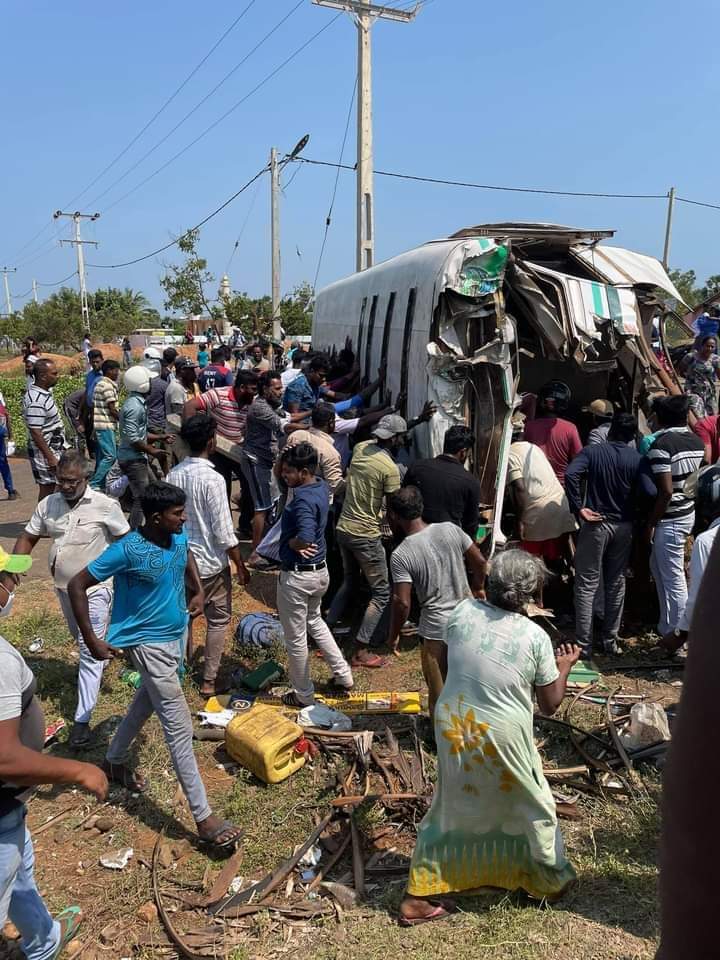
File photograph: A bus crash in Mannar, 2021
Over 1,800 people have been killed in road accidents across Sri Lanka in the first nine months of 2025, according to police data, with the mounting death toll now including foreign tourists.
Analysts warn that the island’s worsening road safety crisis could tarnish its international image and derail efforts to revive the tourism industry.
In May 2025, a fatal bus crash in Kotmale killed 22 passengers, among them a French tourist and an Australian volunteer. The overcrowded vehicle, built to carry 50 passengers but loaded with more than 80, plunged off a mountainside road.
Investigators cited driver fatigue and overloading as contributing factors. Earlier the same month, a separate incident in Nuwara Eliya saw a group of European backpackers injured when their tour bus overturned on a winding hill road, underscoring growing concerns about the safety of public transport used by visitors.
“Road accidents have become a silent epidemic in Sri Lanka,” said Dr Indika Jagoda, Director of the Accident and Emergency Department at Colombo National Hospital.
With road accident fatalities exceeding 2,200 in 2024 and continuing to rise in 2025, Sri Lanka’s roads are among the most dangerous in South Asia. According to the World Health Organization, the country has an estimated road traffic death rate of 19.7 per 100,000 population. This is significantly higher than many of its regional competitors. In contrast, the Maldives, a luxury tourist destination competing directly with Sri Lanka, reports a rate of just 1.5 per 100,000, due to stricter vehicle regulations and urban planning. Indonesia and Thailand, despite larger populations and heavier traffic, have invested in road safety and report rates of 11.9 and 25.4 respectively.
Sri Lankan police insist they are taking steps, with Traffic Police Director SSP Manjor Ranagala announcing the installation of 70 new speed detection machines across the country.
But Northern Province governor N Vethanayahan expressed his dismay at the Sri Lankan state’s inaction. “When we look at the accidents occurring today, it’s clear there is little regard for the lives of others who travel with hopes and expectations,” he said. He added that Tamil regions such as the North-East remain particularly vulnerable due to chronic underinvestment and poorly maintained infrastructure.
Meanwhile, authorities appear slow to respond. The Sri Lanka Tourism Development Authority (SLTDA) has acknowledged the problem in public statements, but blames limited funding and weak coordination between ministries for delays in implementing safety regulations. Tourism is a cornerstone of Sri Lanka’s post-crisis economic recovery plan, contributing roughly 12% of GDP. Yet repeated high-profile crashes, particularly those involving foreigners, threaten to undermine global confidence.