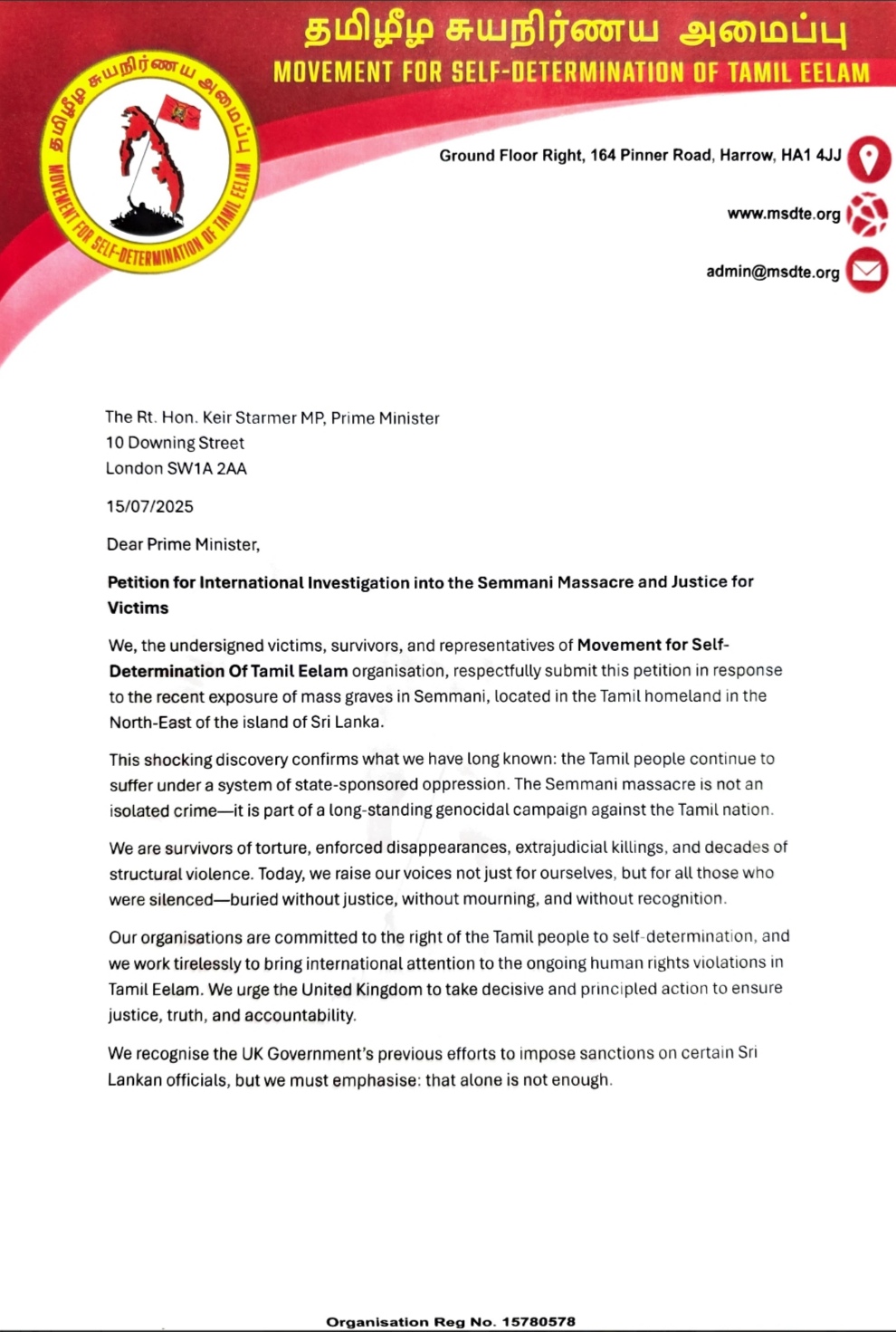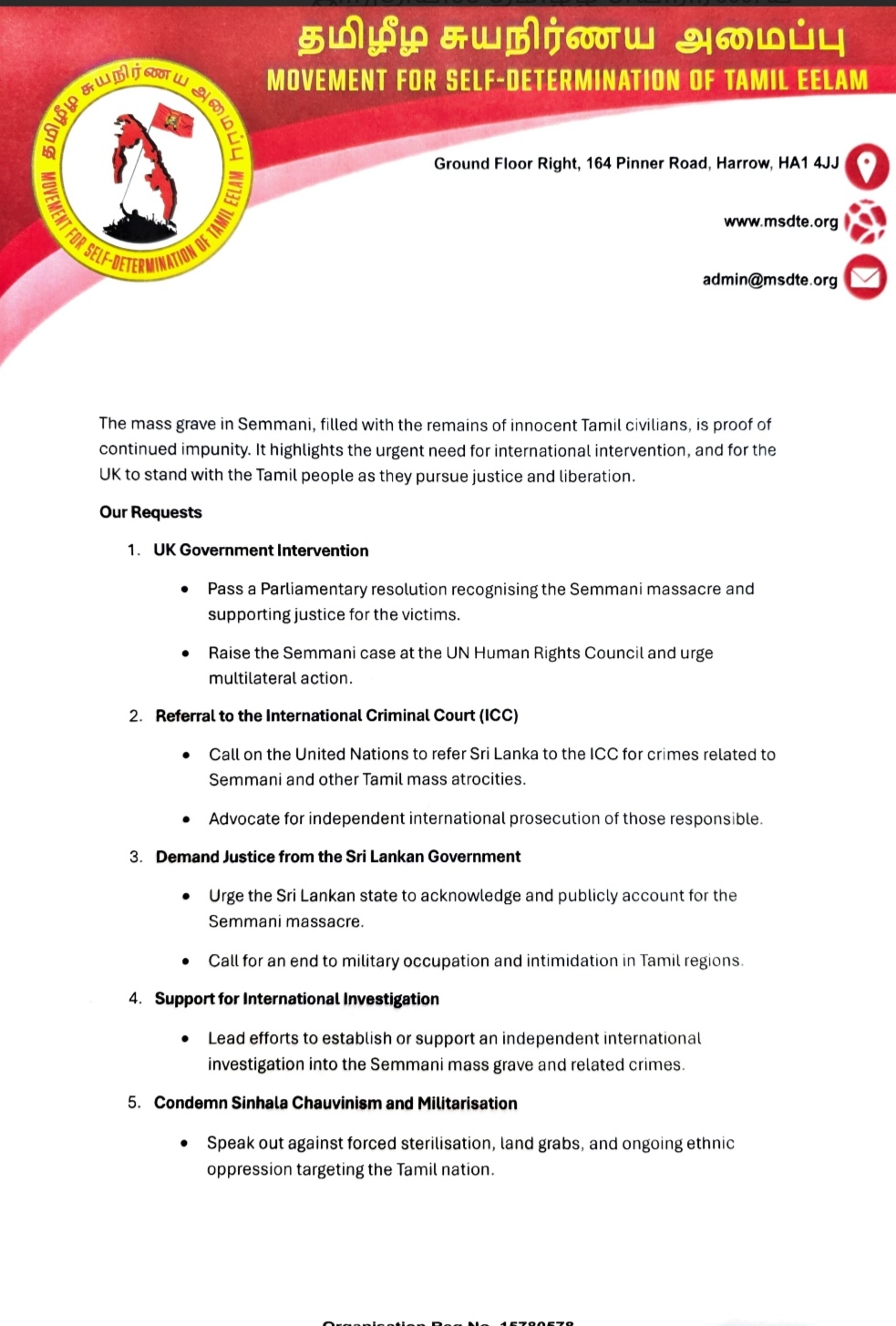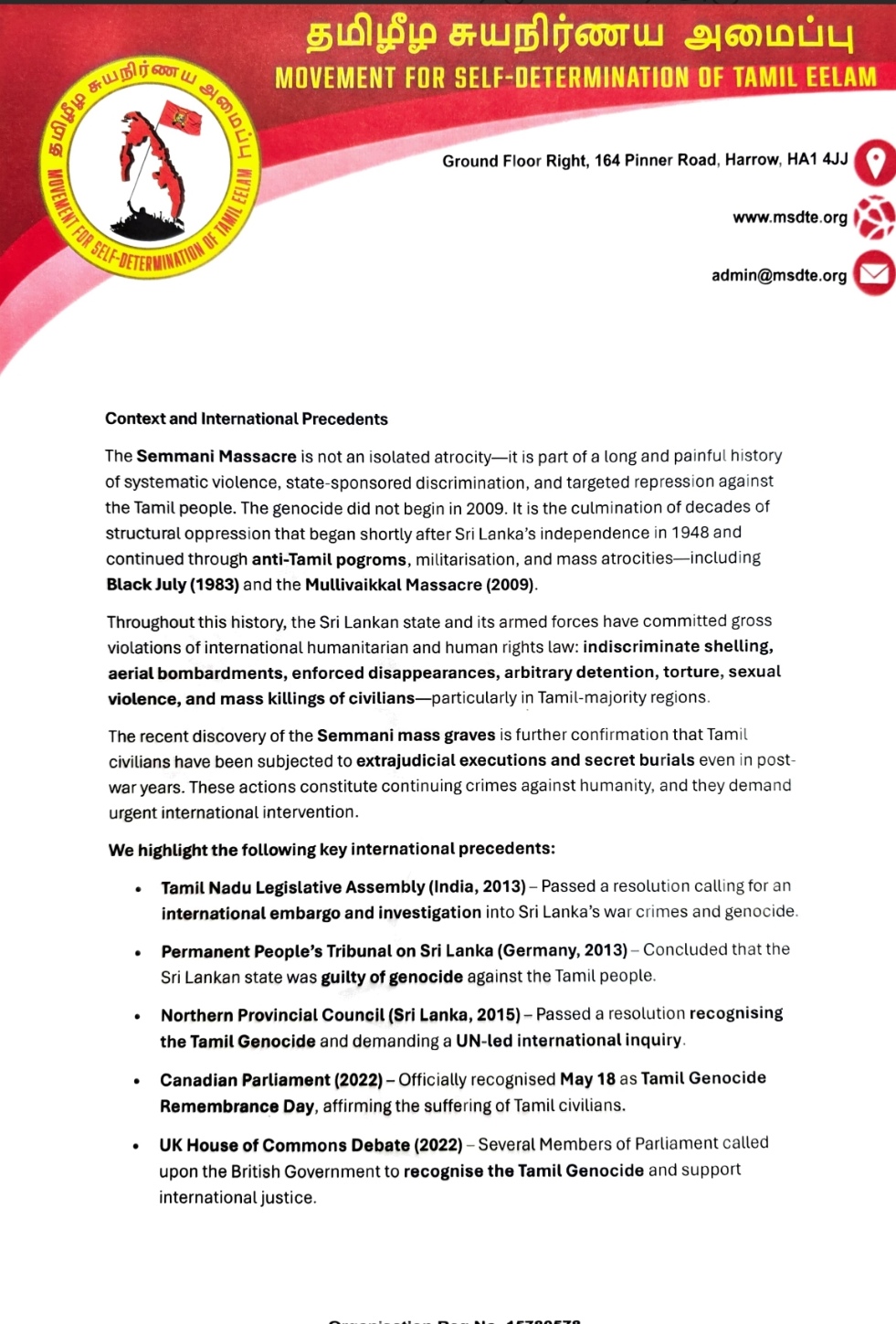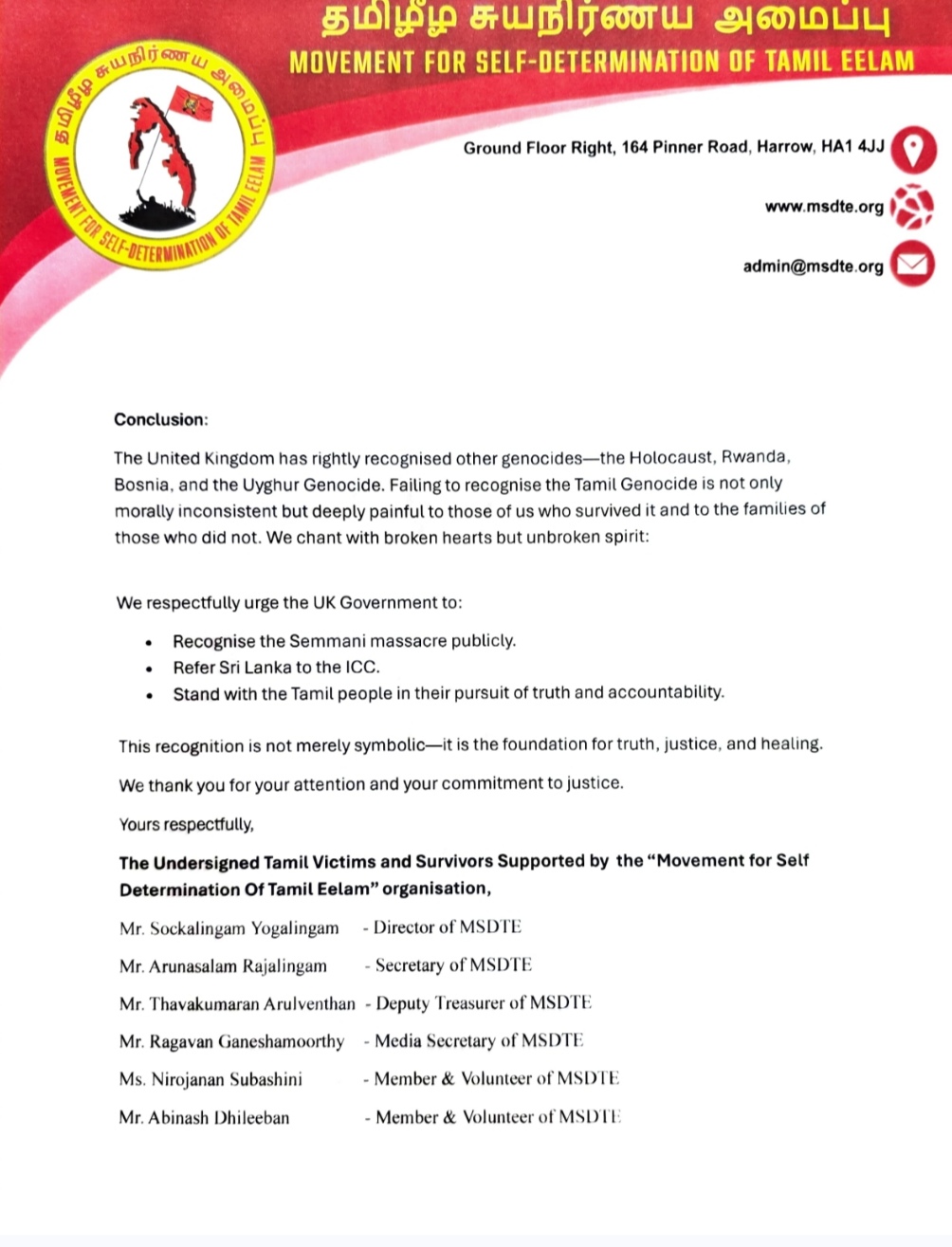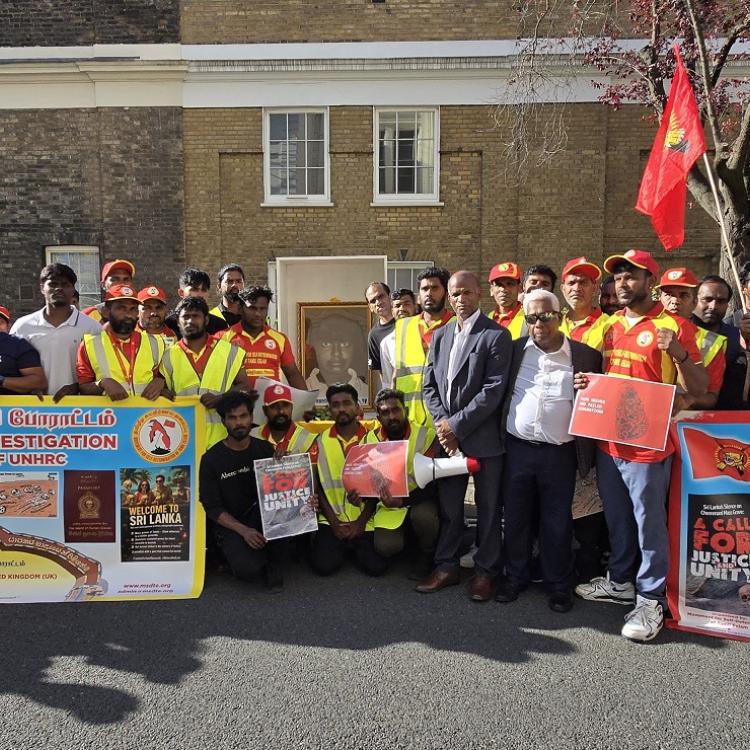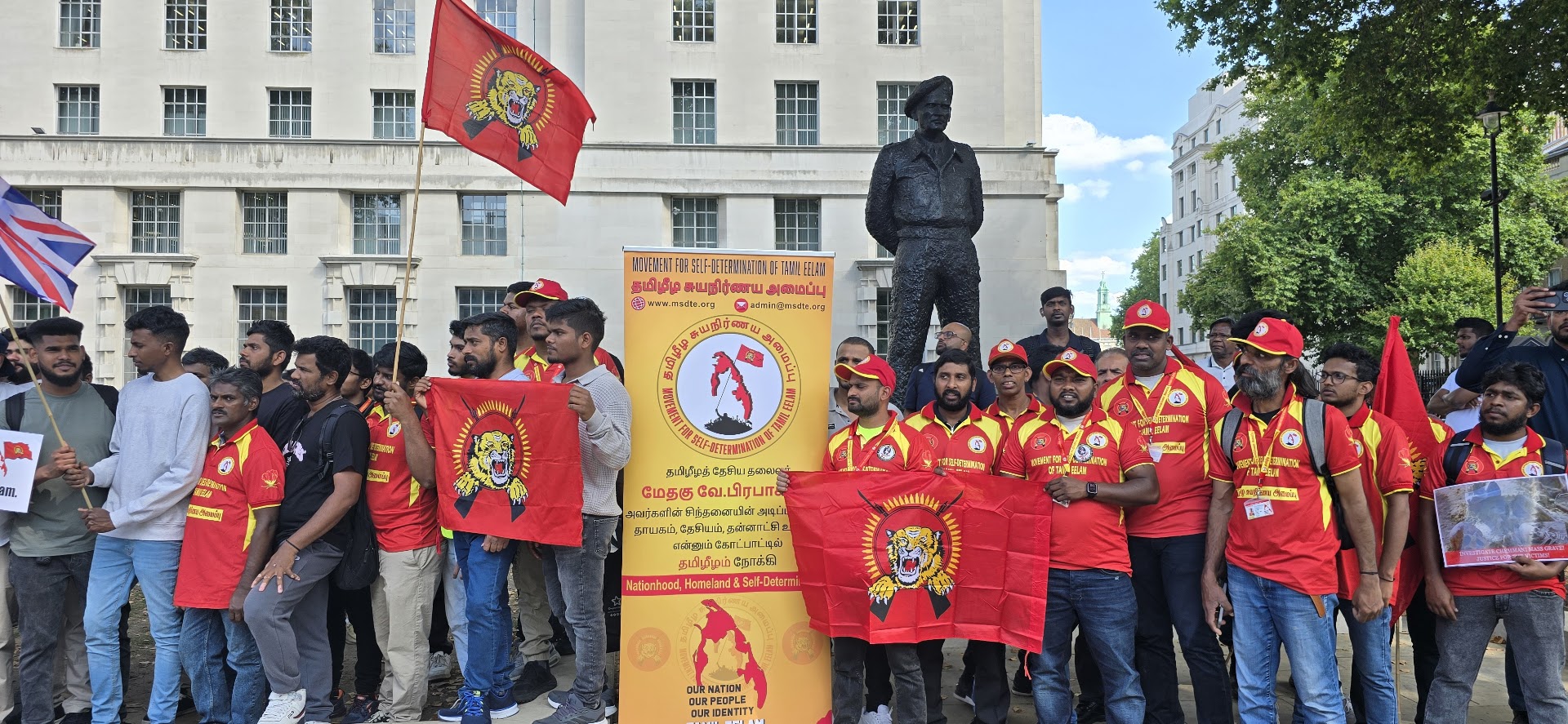
The Movement for Self-Determination of Tamil Eelam (MSDTE) has submitted a petition to British Prime Minister Keir Starmer urging the United Kingdom to pass a parliamentary resolution recognising the crimes committed in Chemmani and referring Sri Lanka to the International Criminal Court (ICC).
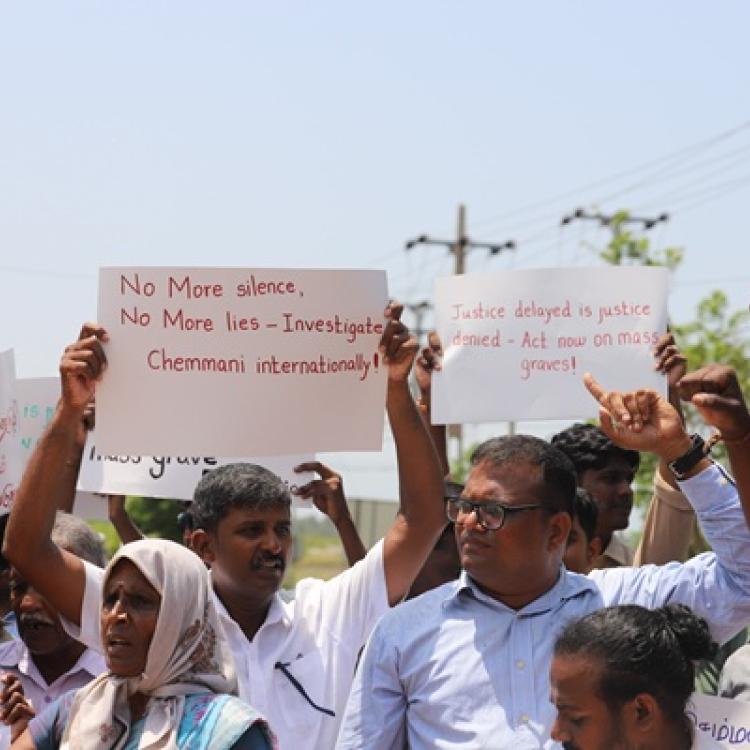
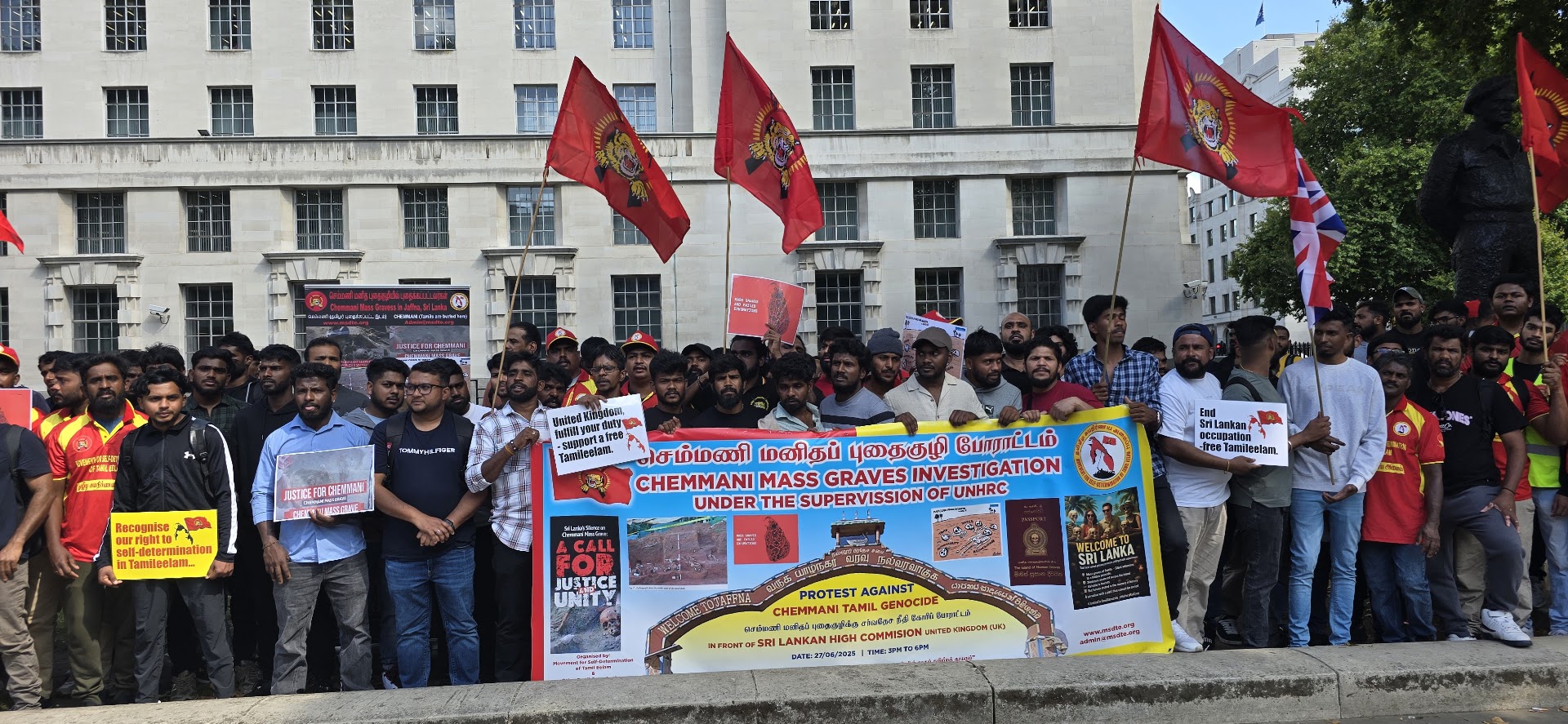
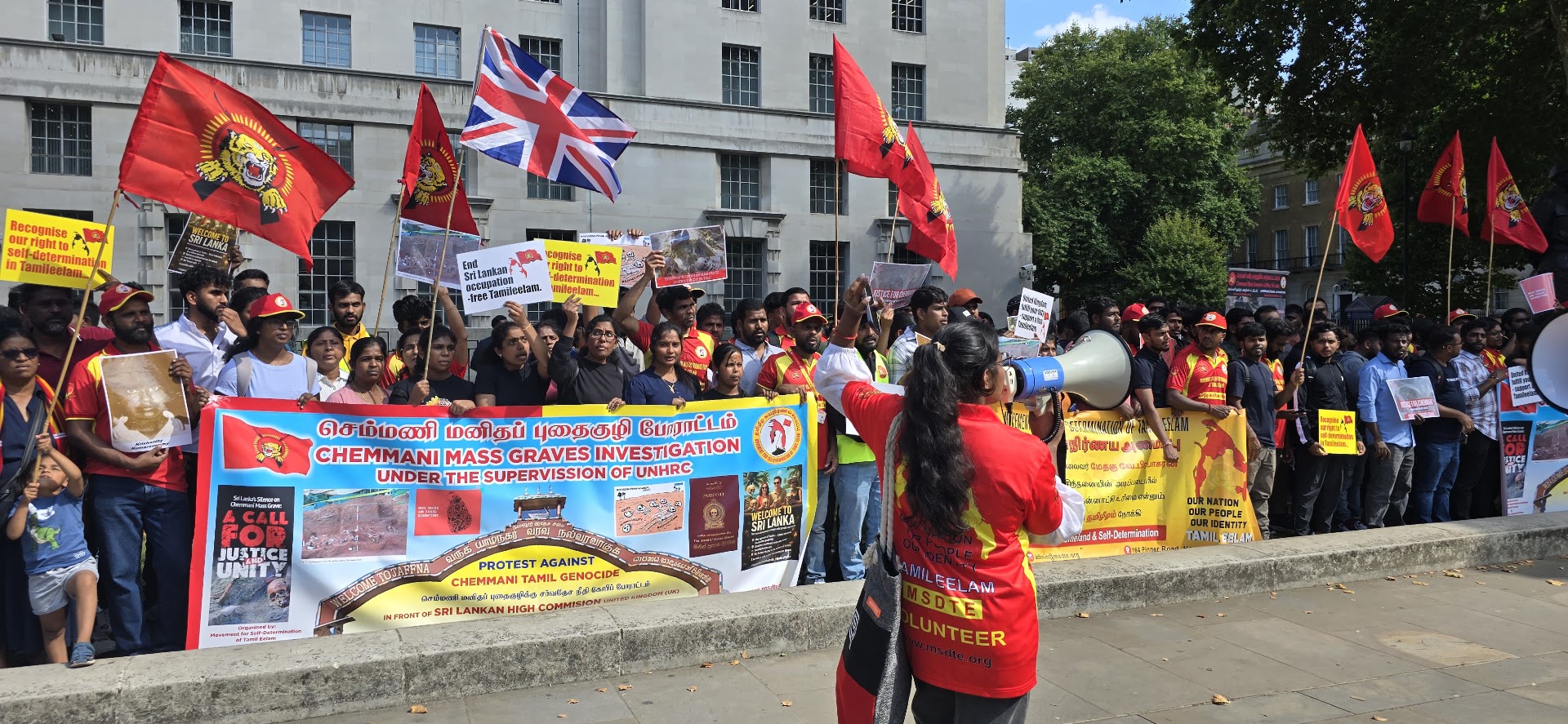
On Friday 15 August, representatives of the MSDTE delivered the petition to Downing Street following a demonstration in London, where hundreds of Tamil activists gathered to demand justice for victims of mass atrocities and enforced disappearances.
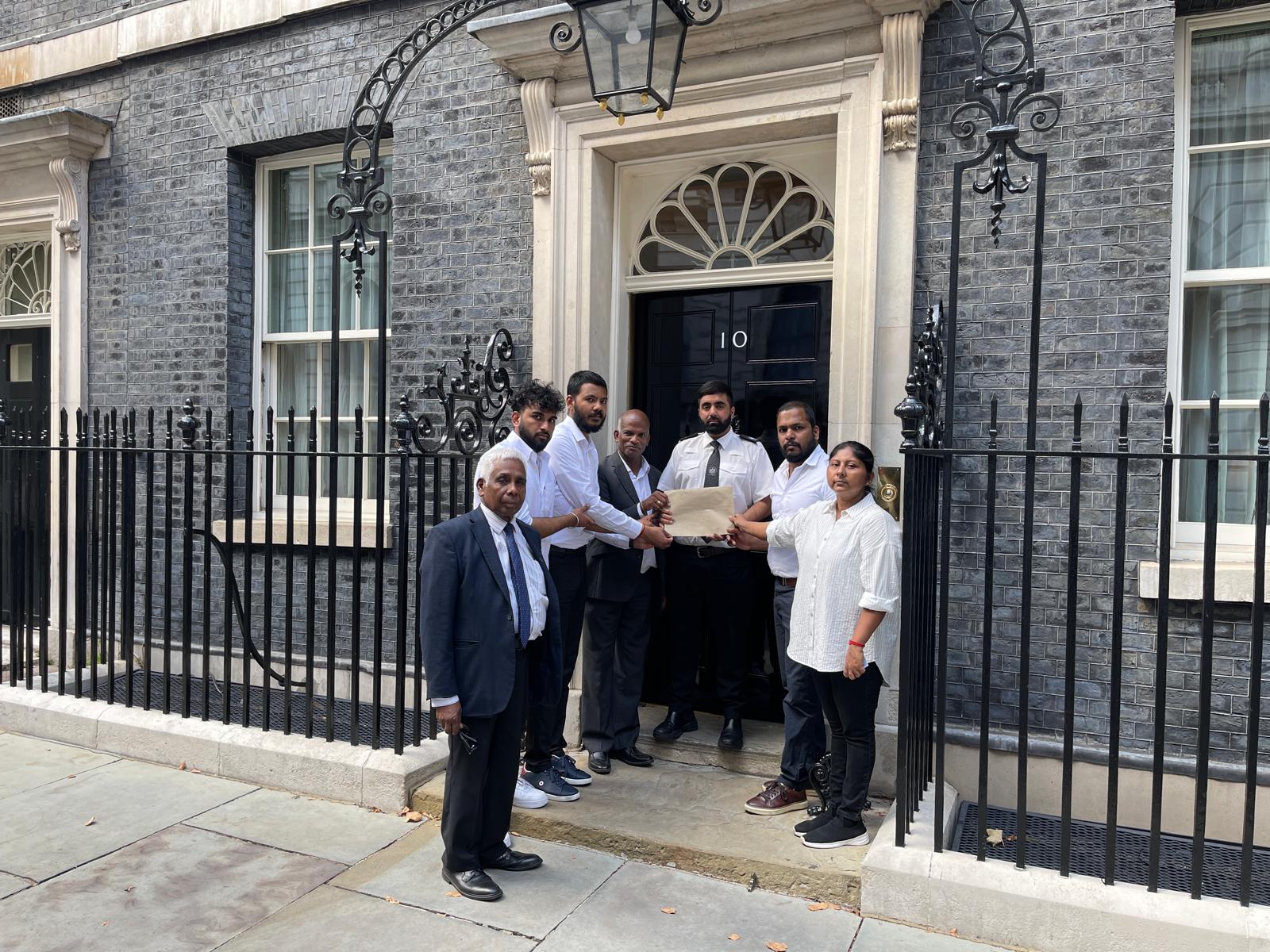
The petition directly links its appeal to the ongoing exhumations at Chemmani, where human skeletal remains continue to be unearthed. For survivors and victims’ families, the graves remain emblematic of the system of state terror and impunity that has long defined Sri Lanka’s treatment of Tamils.
“This shocking discovery confirms what we have long known: the Tamil people continue to suffer under a system of state-sponsored oppression,” the petition states. “The Semmani [Chemmani] massacre is not an isolated crime—it is part of a long-standing genocidal campaign against the Tamil nation.”
Calls for international investigation
The MSDTE urged Britain to lead efforts at the United Nations Human Rights Council to establish an independent international investigation into the Chemmani massacre and other mass atrocities.
It further called on the UK government to:
• Pass a parliamentary resolution recognising the Chemmani massacre and supporting justice for its victims.
• Work to refer Sri Lanka to the International Criminal Court (ICC) for crimes against the Tamil people.
• Condemn the ongoing militarisation and Sinhala-Buddhist chauvinism in the North-East, including land grabs, intimidation, and forced displacement.
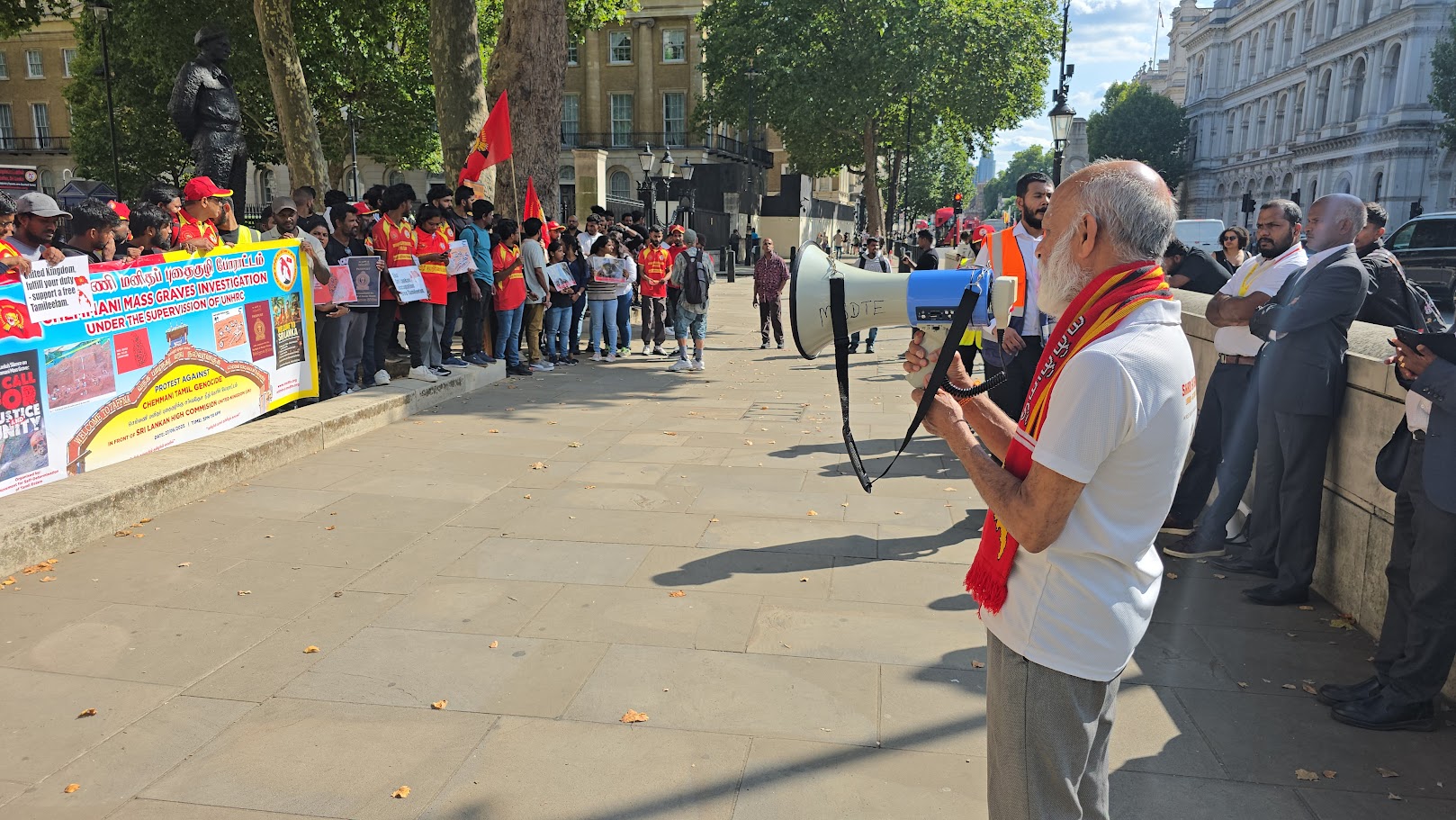
“Our organisations are committed to the right of the Tamil people to self-determination, and we work tirelessly to bring international attention to the ongoing human rights violations in Tamil Eelam,” the group stated. “We urge the United Kingdom to take decisive and principled action to ensure justice, truth, and accountability.”
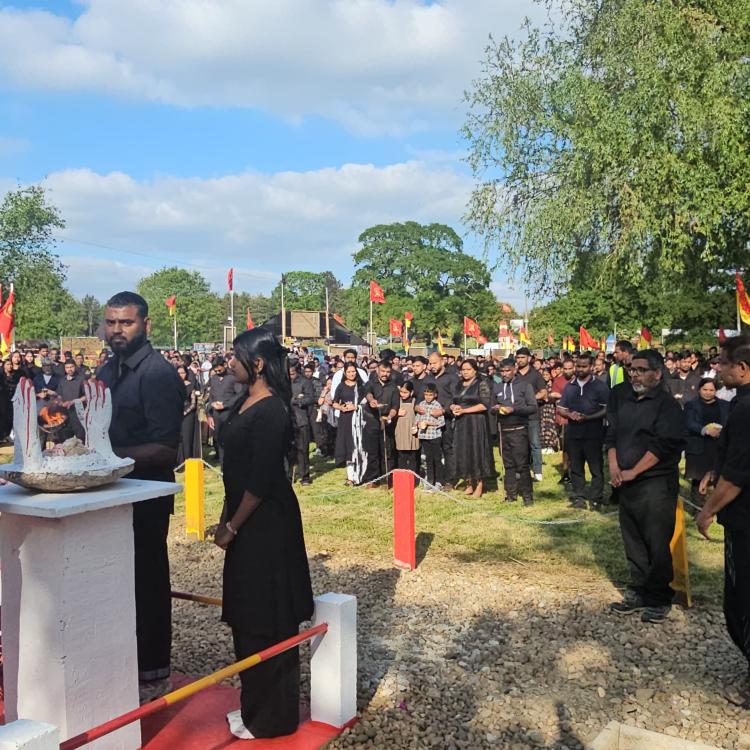
The petition coincided with the remembrance of Black July, marking the 1983 state-orchestrated pogrom that left thousands of Tamils murdered and displaced, and the forthcoming International Day of the Victims of Enforced Disappearances.
It underscored how, despite decades of evidence of massacres, torture, disappearances, and sexual violence, “no credible international judicial mechanism has been established to investigate these crimes.”
Britain’s Labour government had pledged during its election campaign to support an international accountability mechanism into violations committed by Sri Lanka’s security forces. The MSDTE reminded Starmer of that commitment, adding that his background as a human rights lawyer made him well-placed to “understand both the suffering of the Tamil people and the legitimacy of their call for justice.”
“Sanctions are not enough”
The petition also acknowledged Britain’s recent decision to impose sanctions on several Sri Lankan military commanders, including army chief Shavendra Silva, but insisted that “that alone is not enough.”
“The United Kingdom has rightly recognised other genocides—the Holocaust, Rwanda, Bosnia, and the Uyghur Genocide. Failing to recognise the Tamil genocide is not only morally inconsistent but deeply painful to those of us who survived it and to the families of those who did not,” it said.
“We chant with broken hearts but unbroken spirit: Recognise the Chemmani massacre publicly. Refer Sri Lanka to the ICC. Stand with the Tamil people in their pursuit of truth and accountability.”