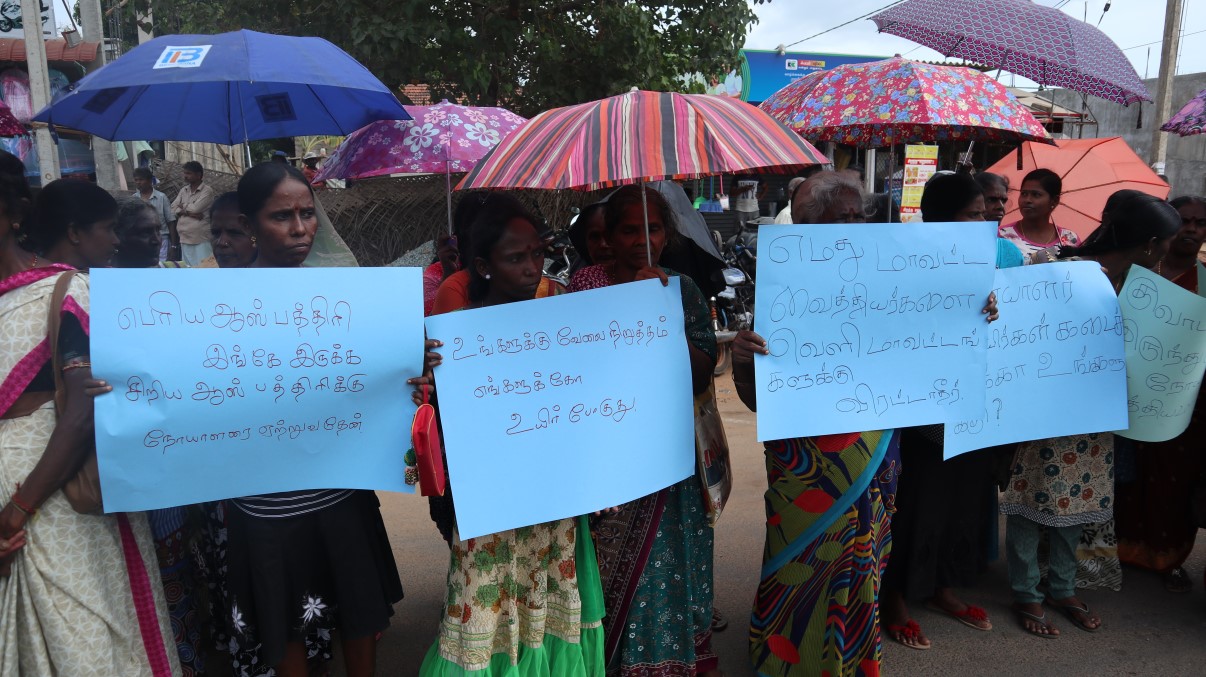
Tamils in Mullaitivu protesting against the lack of doctors in 2019.
The military occupied Tamil homeland, which already grapples with the highest suicide rates on the island, is facing a worsening mental health crisis as the mass migration of psychiatrists leaves vital services on the brink of collapse.
Speaking at the inauguration of the Sri Lanka College of Psychiatrists’ (SLCPsych) 22nd Annual Academic Sessions in Colombo on August 1, the College’s president, Dr Sajeewana Amarasinghe, warned that the shortage of specialists had reached “alarming” levels, with districts in the North-East hardest hit.
He described how psychiatrists in the region, many of whom already work in militarised, under-resourced, and post-conflict environments, are now stretched to their limits.
The Health Ministry is finding it “extremely challenging” to fill the vacancies in the vulnerable North-East Provinces, he said, noting that the College has worked closely with the ministry’s Transfer Board to ensure at least one psychiatrist is posted to every district, in line with the national Mental Health Policy. “The college has stood firmly by this principle at the cost of being unpopular.”
According to Dr Amarasinghe, Sri Lanka has just 108 practising psychiatrists, which includes 71 certified specialists and 37 acting psychiatrists or senior registrars awaiting full certification. Of these, only five are child and adolescent psychiatrists, two are forensic psychiatrists, and two specialise in old-age psychiatry. Eight of these nine sub-specialists are based in the Western Province, leaving general adult psychiatrists to provide all sub-speciality care elsewhere.
The lack of specialists in the Tamil homeland has had severe consequences. Eelam Tamils face higher rates of trauma-related disorders, depression, and suicide stemming from decades of armed conflict, displacement, land dispossession, and continuing military presence. Yet, despite the acute need, the North-East remains one of the least served regions in terms of psychiatric care.
Dr Amarasinghe said the recent economic crisis had accelerated the brain drain to countries such as Australia and the UK. “We will not be able to fill the vacancies in rural Sri Lanka until there are vacancies in Australia,” he remarked.
‘Who would want to work in rural Sri Lanka?’
The SLCPsych president urged the government to provide incentives to psychiatrists working in regional centres, citing poor pay, inadequate accommodation, the absence of schools for their children, and minimal opportunities for private practice. These hardships, compounded by a lack of medical officers, essential staff, and medication, as well as what he described as the “callous” attitude of some administrators, made retention difficult.
“Who would want to work in rural Sri Lanka, when there are highly-paid jobs in Australia?” he asked, calling on younger psychiatrists to serve at least five years in the public sector to “give something back to the nation.”
Crisis in child and adolescent mental health
The mental health crisis among children was another urgent concern. Dr Amarasinghe revealed that there were 80 reported child suicides in 2024. Data from the Global School-based Student Health Survey 2024 indicated that 15% of children had considered suicide in the previous year, while 6.8% had attempted it.
The College’s joint survey with UNICEF exposed a “pressing” need to expand the Child and Adolescent Mental Health Service.
Dr Amarasinghe also criticised the insensitive reporting of high-profile child suicides by some sections of the media, warning that such coverage can increase the risk of further tragedies. In response, the College held a joint press conference with the Sri Lanka Medical Association (SLMA) and organised a two-day workshop for journalists in collaboration with the Mental Health Directorate, promoting ethical and sensitive reporting standards.
Read more from the Sunday Times here.