
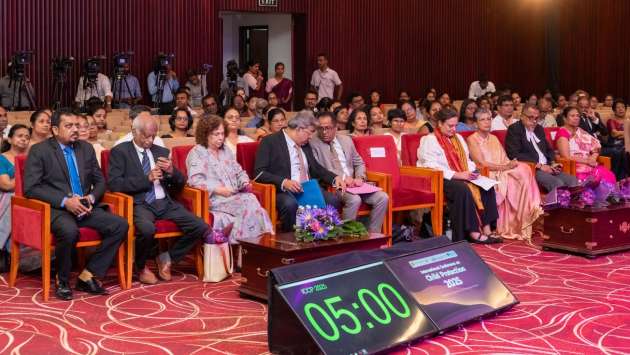
Sri Lanka hosted its first-ever international conference on child protection last month, with the government pledging to reform systems to better safeguard children from abuse, despite Colombo’s continued failure to address long-standing crimes committed against Tamil children during and after the armed conflict.
The International Conference on Child Protection (ICCP’25), held in Colombo from July 25 to 27, brought together more than 250 participants, including government officials, to address violence against children and strengthen national protection frameworks. Organised by the Centre for Gender Studies at the University of Kelaniya in collaboration with the National Child Protection Authority (NCPA) and supported by the European Union through UNICEF Sri Lanka, the event was billed as a landmark initiative.
“This is not just a conference. This is an important contribution to the national discourse on ways to protect our children. This is a platform to act, not just reflect,” said Speaker of Parliament Dr Jagath Wickramaratne during the inaugural session.
Justice Minister Harshana Nanayakkara echoed the sentiment, stating, “Child protection is a justice issue. We are committed to reform systems to focus on the best interests of children and ensure that every victim has access to child-friendly justice.”
Yet for many Tamils, such statements ring hollow. While ICCP’25 champions survivor-centred justice and institutional reform, Sri Lanka continues to evade accountability for grave crimes committed against Tamil children during the armed conflict and its aftermath.
Among the most disturbing examples is the execution of 12-year-old Balachandran Prabhakaran, the son of LTTE leader Velupillai Prabhakaran, who was captured alive by Sri Lankan forces and summarily executed during the final days of the armed conflict in May 2009. Graphic photographs show Balachandran sitting in a bunker before being shot dead at close range - a war crime for which no one has been held accountable.
In the years prior, dozens of Tamil children and infants have been forcibly disappeared. Many were last seen in the custody of the Sri Lankan military. Despite repeated pleas from families, the state has failed to conduct meaningful investigations.
Recent forensic excavations in Chemmani, Jaffna, have uncovered at least 140 skeletal assemblages in mass graves - including remains believed to be those of children. The Chemmani site has long been associated with enforced disappearances and extrajudicial executions by the Sri Lankan military during the 1990s. Human rights advocates argue these findings further underscore the need for an international mechanism to investigate crimes against Tamil civilians, including children.
Sri Lanka’s record of failing to protect Tamil children is not limited to war crimes. In 2009, child rights activist Stephen Sunthararaj, who had been investigating the trafficking of Tamil children into prostitution rings by government-backed paramilitaries, was abducted in Colombo by men believed to be linked to state intelligence services. He has not been seen since.
The government’s attempt to reposition itself as a global advocate for child protection has therefore been met with scepticism.
As Tamil activist commented, “You cannot champion child rights while concealing the bones of murdered children beneath the soil.”