
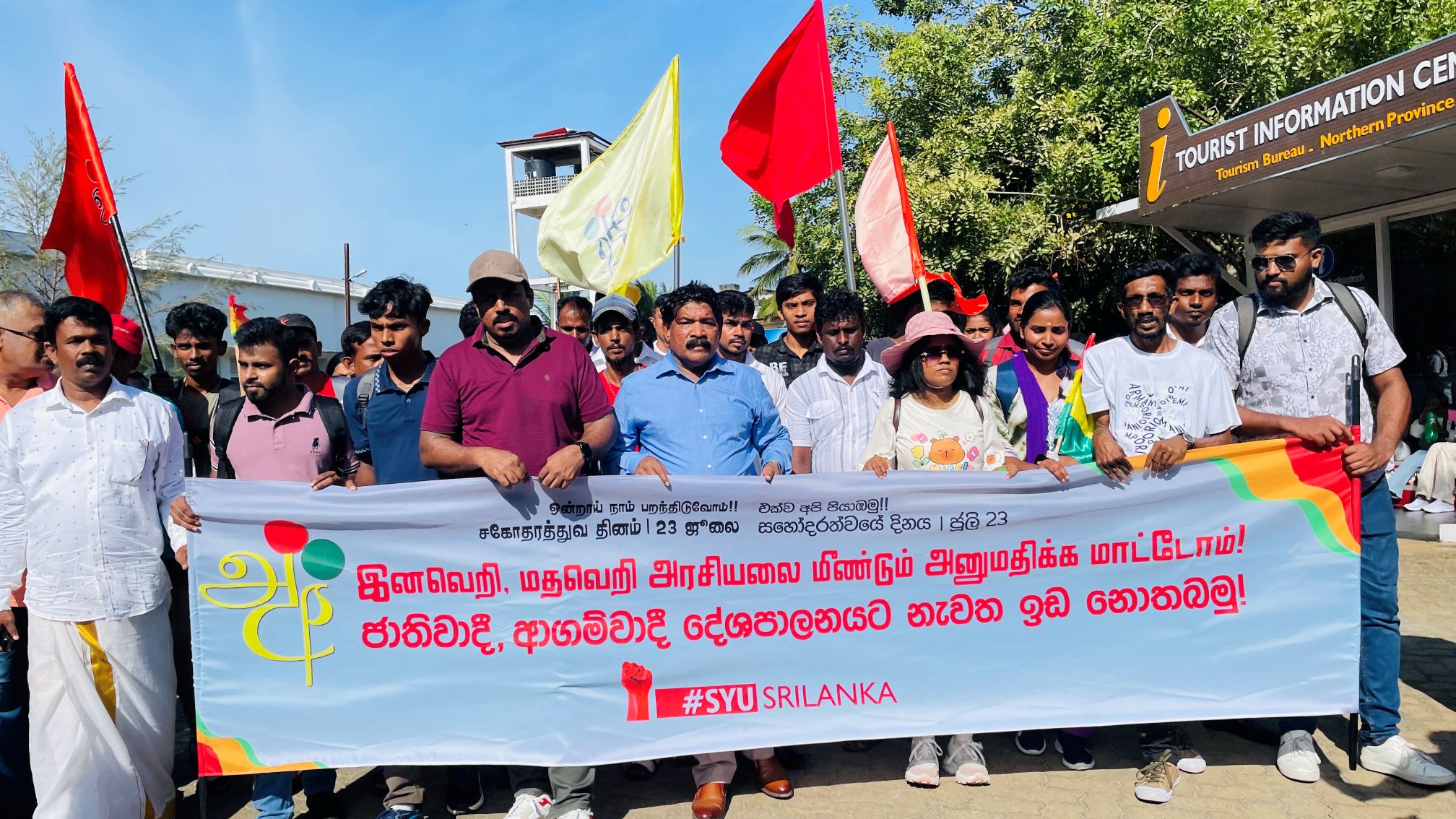
NPP officials in Jaffna this week.
Tamil National People’s Front (TNPF) leader and Member of Parliament Gajendrakumar Ponnambalam delivered a scathing speech in Sri Lanka’s parliament this week, condemning the government for whitewashing the memory of the Black July pogrom and enabling continued land appropriation in the North-East.
Speaking on 23 July, the 42nd anniversary of Black July, Ponnambalam recalled the pogrom in 1983 in which thousands of Tamils were massacred, homes and businesses were destroyed, and families were burned alive. He emphasised that the attacks were “systematically” carried out with the support of the Sri Lankan police, military and government-backed mobs.
“The Tamils in particular — Tamils outside the North and the East, particularly in Colombo — were systematically hunted down. They were hunted down using electoral registers. The police, the military, helped government-backed thugs in hunting down families, burning them alive,” said Ponnambalam.
He went on to criticise attempts by the current government, including its youth wing, to rebrand the day as one of “camaraderie”. This year, the government-backed youth initiative organised events in Jaffna to mark 23 July as a so-called “Brotherhood Day” — a move widely condemned by Tamil politicians and civil society.
“This is not a day for camaraderie,” Ponnambalam declared. “You’re trying to hide history, to change history, to change the meaning of today completely. That is not something that a government that has intentions of wanting to put the record straight, of doing the right thing, facing up to the reality of the past, and make sure the past is not repeated.”
As part of the so-called “Brotherhood Day” efforts, a delegation from the Socialist Youth Union (SYU) travelled from Colombo to Jaffna, where they were greeted by ruling government officials including, Sri Lanka’s Fisheries Minister Ramalingam Chandrasekar.
.jpeg)
At a vigil in Jaffna yesterday, a placard denounces the government's co-called "Brotherhood Day".
Ponnambalam denounced the government’s continued refusal to deliver justice for the victims of 1983 or to officially acknowledge the atrocities as a crime against the Tamil people. “Still, we don't have an official apology,” he stated.
Turning to broader issues of justice and accountability, Ponnambalam noted the hypocrisy of the government in promoting anti-money laundering and anti-terror legislation while continuing to shield perpetrators of state violence.
“In 1983, innocent civilians were massacred. No justice, nothing whatsoever,” he said. “This government also refuses to bring anybody before courts and convict those who are responsible for these heinous crimes.”
He criticised the use of “terrorism” to delegitimise Tamil resistance and invoked the historical experience of the Janatha Vimukthi Peramuna (JVP), whose youth once took up arms against the state.
“I will never call that terrorism, because those are legitimate reasons — legitimate reasons that have to be addressed,” he said. “If they are forced to take up arms because they feel that that is the only way they can have some sort of security... you, of all people, calling that terrorism, and refusing to look at the whole conflict in its proper context to find answers?”
Ponnambalam warned that suppressing Tamil grievances while ignoring the root causes of the conflict would only perpetuate unrest. “No amount of legislation can actually prevent conflict,” he said.
He also highlighted ongoing land grabs in the North, particularly in the Myiliddy area of Valikamam North. Despite initial land releases following international pressure, he revealed that 3,000 acres remain under military occupation and are now at risk of being re-gazetted as a permanent high-security zone.
“Out of these 3,000 acres... almost 75% of the land is not used for military purposes,” he pointed out. “It is used for farming — by the Army, by the Navy, and the Air Force — to bring vegetables to the local market and undercut the local farmer.”
Ponnambalam also drew attention to the destruction of religious and cultural sites within these zones. “Six temples and churches within this 3,000 acres — within the so-called high security zone — have disappeared,” he revealed, calling it a “UNESCO crime”.
Concluding his remarks, the Jaffna MP urged the government to take responsibility for its actions, warning that failure to do so would only entrench cycles of resistance and conflict.
“Nothing you do will ever prevent a people from resisting this absolutely unacceptable conduct by the state.”