
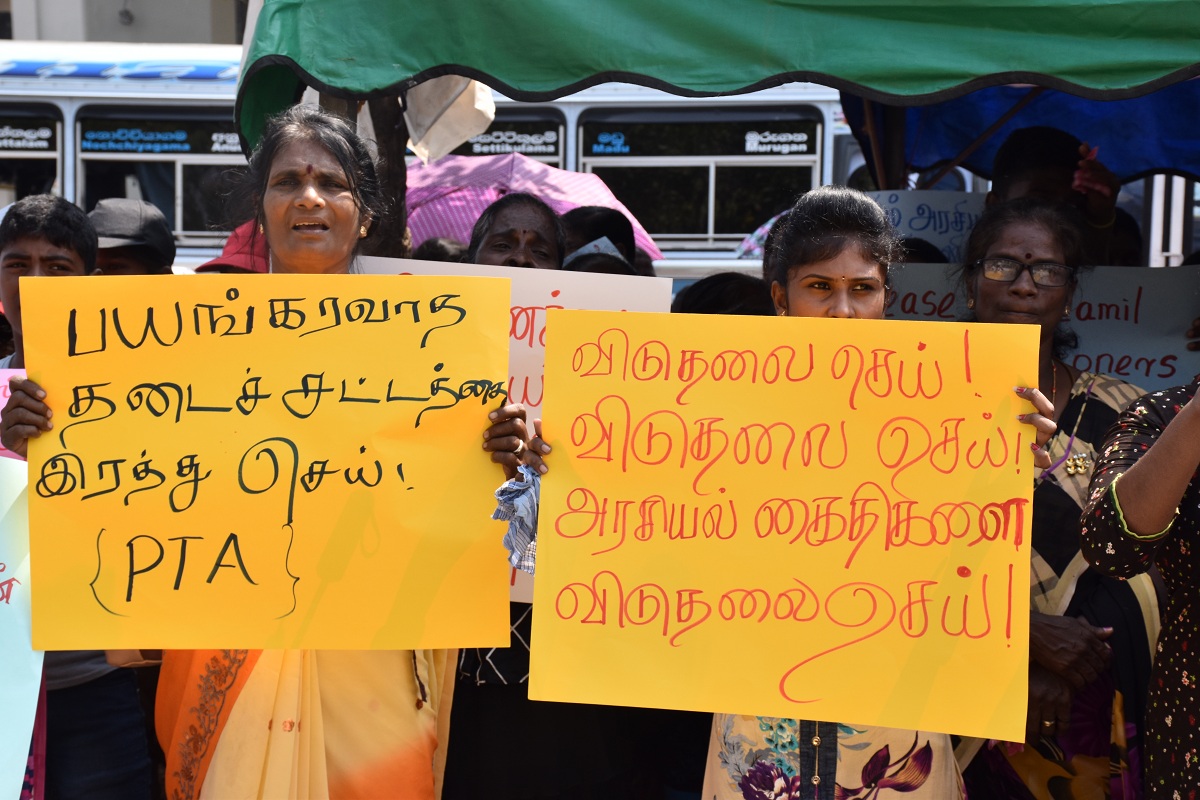
In a joint appeal, over 240 civil society actors, including activists, trade unions, lawyers, clergy, academics, and former detainees, have signed a letter demanding the immediate and unconditional repeal of Sri Lanka’s controversial Prevention of Terrorism Act (PTA).
The letter, addressed to the Minister of Justice, also strongly opposes the government's plans to introduce a new anti-terror law as a replacement. The appeal was issued in response to a newspaper notice published on May 16, which gave the public a mere two weeks to submit feedback on repealing the PTA and drafting new counter-terror legislation. Signatories criticized the short consultation period and questioned the sincerity of the government’s approach.
The letter expresses deep disappointment with the ruling National People’s Power (NPP) government, which had previously pledged to fully repeal the PTA during its election campaign. Now, in power, the NPP appears to be backtracking on that promise by proposing new legislation that many fear could replicate the PTA’s repressive framework.
"The unqualified promise to repeal the draconian PTA by the NPP is being hedged now that the Party is in Government," the statement reads.
Criticism was also directed at the government-appointed committee tasked with reviewing the legislation. The signatories argue that its composition lacks credibility, being dominated by state and military officials with no representation from victims’ families, minority communities, or civil society groups.
Originally enacted in 1979 as a temporary measure, the PTA has remained in force for over four decades. Its use has disproportionately affected Tamils and Muslims, particularly during and after the armed conflict.
The law allows for prolonged detention without trial, the use of confessions extracted under duress or torture, and sweeping powers for the executive - including the ability to ban publications and restrict movement. Rights groups both locally and internationally, including the UN Human Rights Council and Sri Lanka’s own Human Rights Commission, have repeatedly called for its full abolition.
In 2022, the Human Rights Commission of Sri Lanka described the PTA as fundamentally incompatible with the rule of law and urged that terrorism cases be dealt with under the ordinary criminal justice system.
Importantly, the letter argues that no replacement anti-terror law is necessary. It points out that Sri Lanka already has a robust legal framework capable of addressing terrorism threats. This includes at least 15 existing laws and provisions under the Penal Code, as well as specialized agencies such as the Counter Terrorism Investigation Division (CTID), National Intelligence Service, and the Financial Intelligence Unit (FIU) of the Central Bank.
The letter concludes with five core recommendations:
1. Repeal of the Prevention of Terrorism Act No. 49 of 1979 (PTA) immediately, and not attempt delaying tactics through the Committee working on another version. The Government should also impose a moratorium on the application of the PTA, until its repeal.
2. There are at least 15 laws in the existing criminal justice system including Penal Code provisions to address issues relating to 'terrorism'. Therefore, there is currently no necessity for any special law on terrorism.
3. Ensure that NO laws are enacted that empower the police / Executive to restrict the freedom of movement, conducting meetings, ability to congregate, to have a rally or procession, or to make demands by any form of protest. Debate and dissent are essential features of a democracy, and in recent years, numerous oppressive laws have eroded these basic rights. Individuals and peoples pursuit of legitimate aspirations through democratic means should not be infringed upon in any manner by way of terror laws.
4. Take measures to expedite justice to all currently detained under the PTA through political and legal interventions, including Presidential Pardons, withdrawal of charges if no evidence, or if only/primary evidence is through confessions and release of those not charged yet.
5. Ensure reparations by state for those who were detained under PTA and not convicted including acknowledgement, apology, compensation, physical and mental health care and livelihood support. Reparations should also be provided to the families of those who died in custody when detained under the PTA.
The full statement can be found here.