
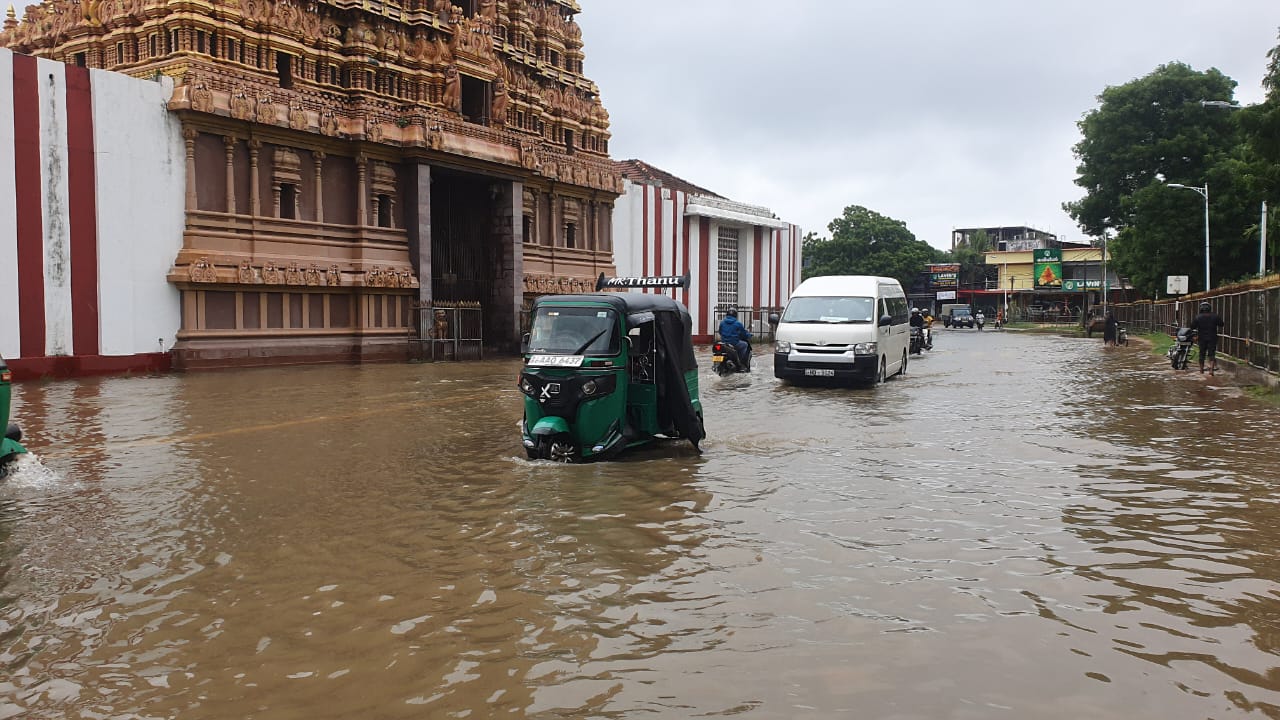
As Cyclone Ditwah battered Sri Lanka this week, Tamil speakers complained of being left without life-saving information, as state institutions issued disaster warnings in Sinhala and English alone.
Social media users across the island reported that crucial updates from government agencies appeared in Sinhala or English, with Tamil often missing entirely.
.jpg)
.jpg)
.jpg)
.jpg)
.jpg)
One user who asked for a translation to Tamil, also received racist abuse.
.jpg)
.jpg)
.jpg)
.jpg)
.jpg)
.jpg)
A brief study published by researcher Sanjana Hattotuwa laid bare the scale of the discrimination. Examining 68 posts published on the Disaster Management Centre (DMC) Facebook page between 25 November and the morning of 29 November, he found that all key information on the homepage banner was in Sinhala only. Of the 68 posts issued during the peak of the storm, just twelve contained Tamil content, and all of these were limited to basic flood notices.
This occurred despite the high proportion of vulnerable Tamil plantation workers living in the affected hill country. Road closures on critical arteries such as Kadugannawa and the Mahiyanganaya hairpin route were explained only in Sinhala, leaving Tamil travellers without essential guidance.
The disparities extended to education and essential services. Even the announcement that examination papers would be airlifted to Jaffna—an overwhelmingly Tamil-speaking region—was issued only in Sinhala. Warnings for the Deduru Oya basin, containing precise discharge rates and the names of threatened divisional secretariats, were never published in Tamil.
Hattotuwa also found that maritime and wind warnings were issued with far greater detail in Sinhala, while Tamil speakers received only vague references to “high risk”.
The discrimination persisted across platforms. The DMC’s official website contains a Tamil-language option, but aside from navigation menus, almost all content remains in Sinhala or English. Detailed situation reports for 25–29 November were published exclusively in Sinhala. Of 34 weather reports uploaded to the site during this period, only one contained Tamil.
The Meteorology Department’s Facebook output followed a similar pattern. Of its 85 posts during the same window, 36 included Tamil text. Yet Hattotuwa found that the most urgent cyclone-related warnings were either delayed by hours or never published in Tamil at all. As the storm intensified between the night of 27 November and the morning of 28 November, Sinhala speakers received multiple detailed updates at 8.26 p.m., 11.19 p.m., 2.02 a.m. and 5.48 a.m. Tamil speakers received none.
He further highlighted long delays for life-threatening hazard alerts. One severe rainfall warning posted in Sinhala at 3.51 p.m. on 25 November did not appear in Tamil until 6.41 p.m., a three-hour gap that could determine whether communities escape rising floodwaters. Several morning forecasts published in Sinhala had no corresponding Tamil version at all.
The report links this crisis to a broader pattern of structural racism within state institutions. Earlier this year, Hattotuwa described how Sri Lankan digital infrastructure routinely excludes Tamil speakers, warning that digitisation built on discriminatory foundations will “encode and amplify” the same biases. The cyclone response, he said, demonstrated this in real time: platforms that should distribute life-saving information instead reproduced linguistic and ethnic hierarchies.
“The architecture of the state,” he concluded, “remains one that cannot bring itself to communicate with Tamil citizens in their language, even when lives are at risk.”