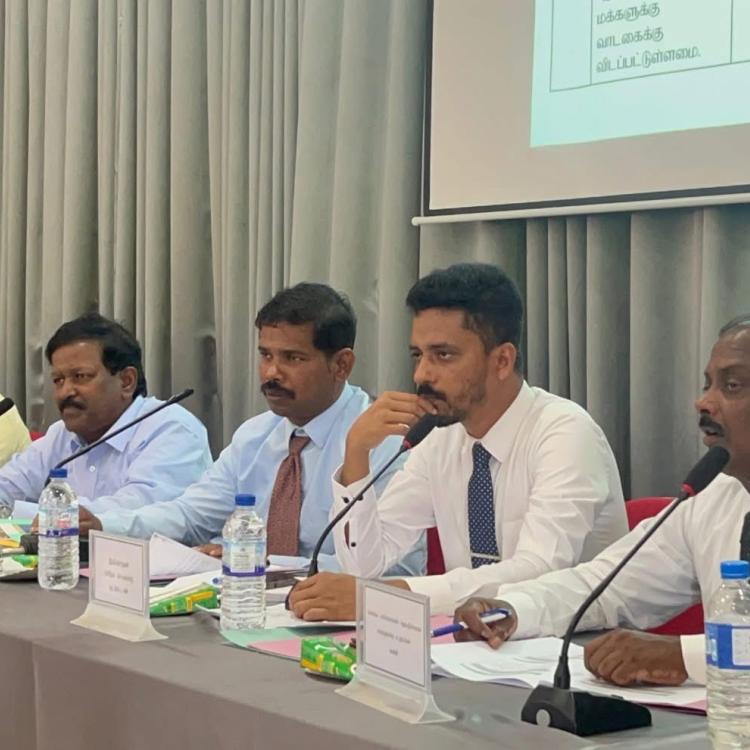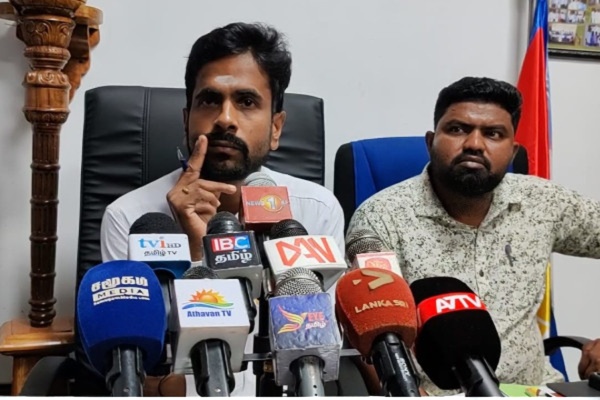
The Mayor of Vavuniya Municipal Council, S. Kandipan, has strongly condemned the suffocating militarisation of the Tamil homeland, declaring that while “camps can be seen in almost every corner of the North,” the South of the island remains entirely free of such entrenched occupation.
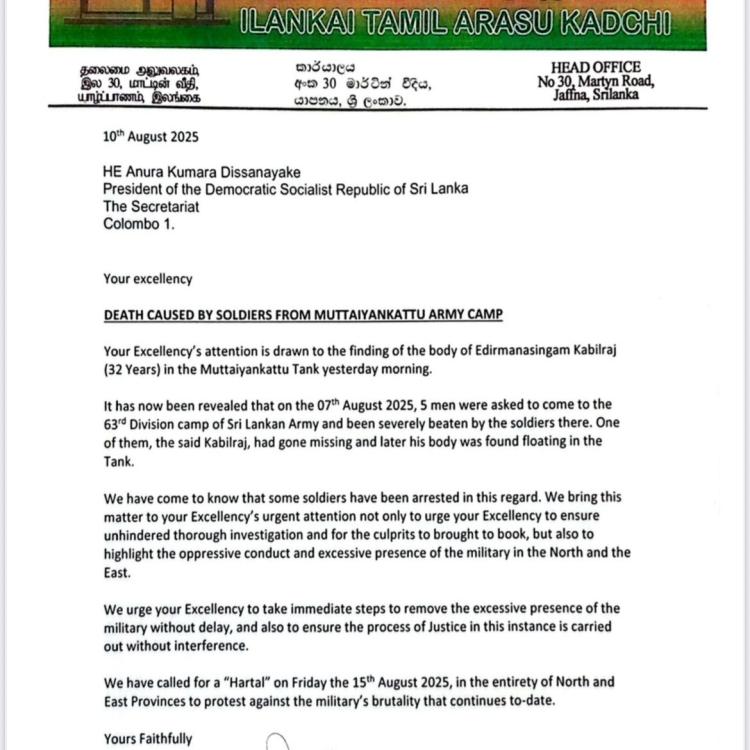
Kandipan was speaking to reporters earlier this week, as he pledged the Council’s full support for the hartal planned across the North-East on Monday. The action, organised by Tamil political parties and community leaders, is being held to protest against the pervasive presence of the Sri Lankan military and its unlawful seizure of civilian land.
The excessive military presence in the North and East must be reduced, he stressed, urging the wider public to support the protest campaign.
The Mayor highlighted the extraordinary disparity between the Tamil homeland and the rest of the island.
Compared to the other seven provinces of the country, the North and East face a disproportionately high Sri Lankan military presence, he said.
The statement echoes long-standing Tamil concerns that the Sri Lankan state has transformed the North-East into a garrisoned zone. The military presence in the Tamil homeland remains one of the densest in the world, with tens of thousands of soldiers still stationed there, despite the armed conflict ending in 2009.
Successive Sri Lankan governments have continued to justify the deployment of troops under the pretext of “national security.” However, as Tamil politicians and rights activists have repeatedly pointed out, no such military build-up exists in the South, where Sinhala communities live free from the daily surveillance, intimidation, and land expropriation that characterise life in the North-East.
Land grabs and dispossession
Kandipan went on to detail how the military continues to expropriate Tamil land for its camps and commercial projects.
In Sahayamathapuram, he revealed, eight acres of land are being seized for an Air Force camp, despite the fact that the village lacks even a playground for its children. Similarly, in Irambaikkulam, no land has been allocated for public use, and even the local cemetery is inadequate. Yet, despite this shortage of basic amenities, Kandipan noted that the military continues to take over land.
“How can land acquisitions of this nature be permitted under such circumstances?” he asked.
For Tamils, this pattern of dispossession is familiar. In Mullaitivu, Kilinochchi, Vavuniya, and across the Tamil homeland, land has been steadily appropriated by the armed forces, often in defiance of court orders and international pressure. Tamil villagers have been displaced to make way for army camps, naval bases, Buddhist temples, and military-run farms and hotels.
In Jaffna, large stretches of fertile land remain under occupation, leaving families unable to return to their homes more than a decade after they were first displaced. In Mullikulam, Mannar, Catholic fisher families have been barred from their lands for years due to the Navy’s continued presence. Meanwhile, the army runs luxury resorts such as the “Thalsevana Holiday Resort” in Kankesanthurai, directly profiting from occupied Tamil land.
Normalisation of militarisation
Kandipan lamented how militarisation has become normalised in the Tamil homeland.
“This has become the norm in the North, where almost every village hosts a military camp—something that does not exist in the South,” he said.
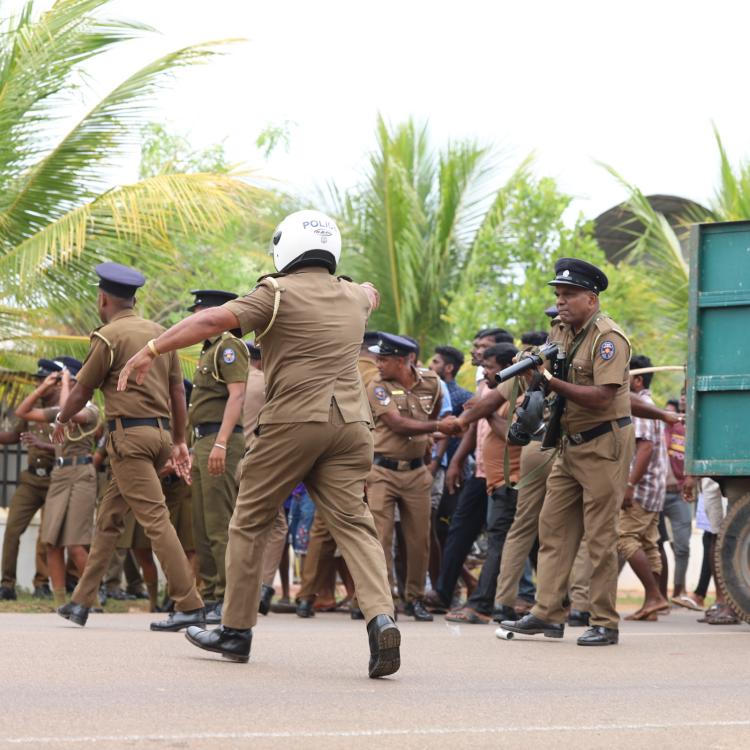
The occupation has a suffocating effect on everyday life. Tamils are regularly subjected to surveillance, intimidation, and harassment, particularly when organising protests or commemorations for those killed in the war. Civil society organisations have documented how military intelligence officers monitor community gatherings, while state security agencies frequently summon activists and journalists for questioning.
The presence of the military also bleeds into the economy. Soldiers have been deployed into farming and fishing sectors, directly competing with Tamil civilians for livelihoods. Reports have shown the army cultivating paddy fields, running cafés, and selling produce at markets in Jaffna and Kilinochchi.
“The military must be completely removed from the North and East,” he said. “They cannot be among the people.”