
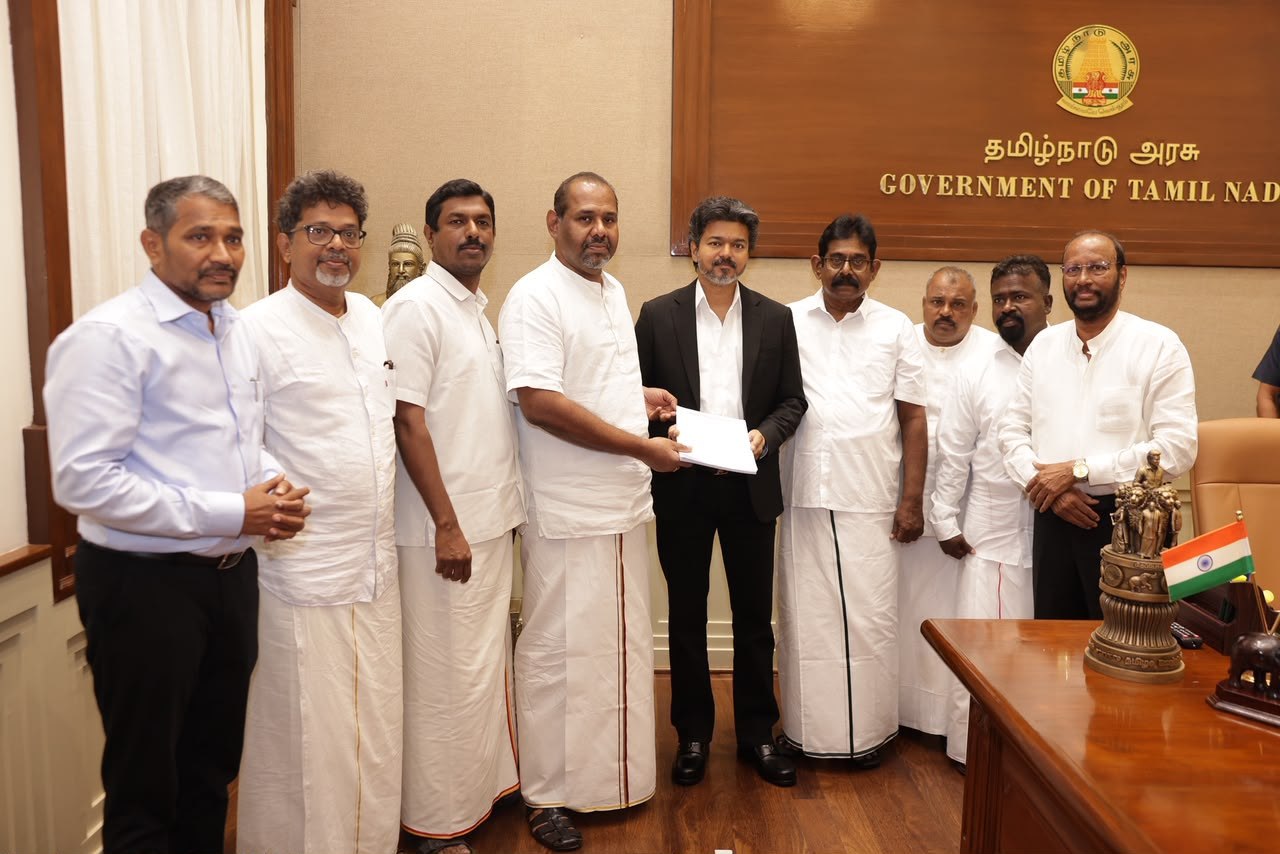
The Tamil National People's Front (TNPF)-led Tamil National Council (TNC) has called for an all-party conference in Tamil Nadu to formulate a united political position on the future of Eelam Tamils, following talks with Tamil Nadu Chief Minister Vijay in Chennai on Friday.
A seven-member delegation led by TNC leader and Sri Lankan parliamentarian Gajendrakumar Ponnambalam met the chief minister at the Tamil Nadu Secretariat, where they handed over a detailed memorandum outlining the alliance's political demands and concerns over Sri Lanka's constitutional direction.
According to Ponnambalam, the discussions covered the political aspirations of Eelam Tamils, the need for an international independent investigation into the genocide of Eelam Tamils, a permanent solution to the dispute involving Indian and Eelam Tamil fishermen, and long-standing issues affecting Eelam Tamil refugees living in India.
Calls for federal constitution
The memorandum states that a lasting political solution can only be achieved through a federal constitutional arrangement that recognises the Tamil nation, its sovereignty and its right to self-determination.
It argues that the distinct identity of the Tamil nation can only be protected through such a constitutional framework, and maintains that historical experience has demonstrated that this cannot be achieved within Sri Lanka's unitary state structure, which it describes as having facilitated structural oppression against Tamils.
"The distinct identity and character of the Tamil nation can only be safeguarded if Sri Lanka's constitutional system is changed to a federal form of governance that recognises the Tamil nation, sovereignty, and the right to self-determination. It is a historical experience that this can never be safeguarded within a unitary system that, from the standpoint of Sinhala-Buddhist Mahavamsa ideology, is carrying out the genocide of the Tamil people.”
The letter urged Tamil Nadu to press the Indian government to oppose any new unitary constitution in Sri Lanka and instead support a constitutional settlement founded on federal principles.
Opposition to unitary-state constitution
The TNC warned against the proposed "Ekya Rajya" (Unitary State) constitution, stating that it would further entrench centralised rule.
The memorandum recalls that former Tamil Nadu Chief Minister M. K. Stalin was previously briefed by the alliance on the dangers posed by the proposed constitution. It further notes that, following those discussions, Stalin later wrote to Indian Prime Minister Narendra Modi, warning of “grave risks” to Tamils from Sri Lanka’s proposed unitary constitution and referring to the Thimphu Principles as the basis for resolving the Tamil national question.
The Thimphu Principles, advanced by Tamil representatives during the 1985 talks facilitated by India, call for recognition of the Eelam Tamils as a distinct nation, acknowledgement of the North-East as the traditional Tamil homeland, recognition of the Tamil nation’s right to self-determination and a political framework that guarantees equality and non-discrimination.
References to the Indo-Lanka Accord
The memorandum also revisited the 1987 Indo-Lanka Accord, stating that the agreement acknowledged the Northern and Eastern Provinces as the traditional areas of habitation of the Tamil people and accepted, in principle, that the merged North-East should receive self-governing powers.
However, the TNC said the Sri Lankan state failed to implement those political objectives and instead introduced the 13th Amendment and the Provincial Council system within the framework of a unitary constitution.
The council argued that the Provincial Council system established under the 13th Amendment cannot provide meaningful political autonomy because it remains subordinate to Sri Lanka’s unitary constitutional structure.
Citing a 1987 Supreme Court ruling on the 13th Amendment, the memorandum argued that sovereignty in a unitary state remains indivisible and rests with the central parliament, while provincial institutions cannot exercise sovereign authority independent of the central government.
It further said the Provincial Council system was deliberately designed to operate under the authority of the central state and could never satisfy Tamil political aspirations.
The memorandum added that the Liberation Tigers of Tamil Eelam (LTTE) and other Tamil nationalist parties rejected the 13th Amendment and other unitary constitutional arrangements, and claimed that Tamil voters have continued to reject such frameworks in elections held since 2009 through their democratic mandate.
Rejection of the 13th Amendment and Provincial Councils
The TNC contends that the Provincial Council system established under the 13th Amendment cannot provide meaningful political autonomy because it remains subordinate to Sri Lanka's unitary constitutional structure.
Citing a 1987 Supreme Court ruling on the 13th Amendment, the memorandum argues that sovereignty in a unitary state remains indivisible and rests with the central parliament, while provincial institutions cannot exercise sovereign authority independent of the central government.
It further argues that the Provincial Council system was deliberately designed to operate under the authority of the central state and therefore could never satisfy Tamil political aspirations. The memorandum adds that the Liberation Tigers of Tamil Eelam (LTTE) and other Tamil nationalist parties rejected the 13th Amendment and other unitary constitutional arrangements, and claims that Tamil voters have continued to reject such frameworks in elections held since 2009 through their mandate.
Appeal to Tamil Nadu
The TNC urged the Tamil Nadu government and the Tamilaga Vettri Kazhagam to use their influence with the Indian Union government to prevent the adoption of a new unitary constitution in Sri Lanka and to support a federal constitutional arrangement recognising the Tamil nation, sovereignty and the right to self-determination.
The memorandum also states that, given India's substantial assistance to Sri Lanka during its economic crisis, New Delhi is in a position to exert meaningful pressure on Colombo to secure a political solution that addresses the aspirations of the Tamil people.
Proposal for an all-party coordination committee
The delegation further proposed the establishment of an all-party coordination committee in Tamil Nadu under the leadership of the chief minister.
According to the memorandum, the body should include not only parties represented in the Tamil Nadu Legislative Assembly, but also political parties that have consistently worked on the Eelam Tamil national question, the welfare of Eelam Tamil refugees and efforts to secure a permanent solution to the India-Sri Lanka fishermen dispute.
The TNC said such a committee should work towards convening an all-party conference to formulate a common political position in Tamil Nadu on the future of Eelam Tamils.
It stated that a unified position would send a strong democratic message to the Indian Union government while also demonstrating to the Sri Lankan state and Sinhala-Buddhist nationalist forces that Eelam Tamils are not isolated and that Tamil Nadu stands with them.
The TNC’s latest appeal follows earlier efforts to engage Vijay after his election victory. In May, the TNC congratulated Vijay and expressed hope that his leadership would strengthen support for the political aspirations of Eelam Tamils. The council later urged Vijay to adopt a resolution in the Tamil Nadu Legislative Assembly reaffirming that the mass atrocities committed against Eelam Tamils constituted genocide and calling for an international criminal investigation.
Meeting with Sri Lankan government representative
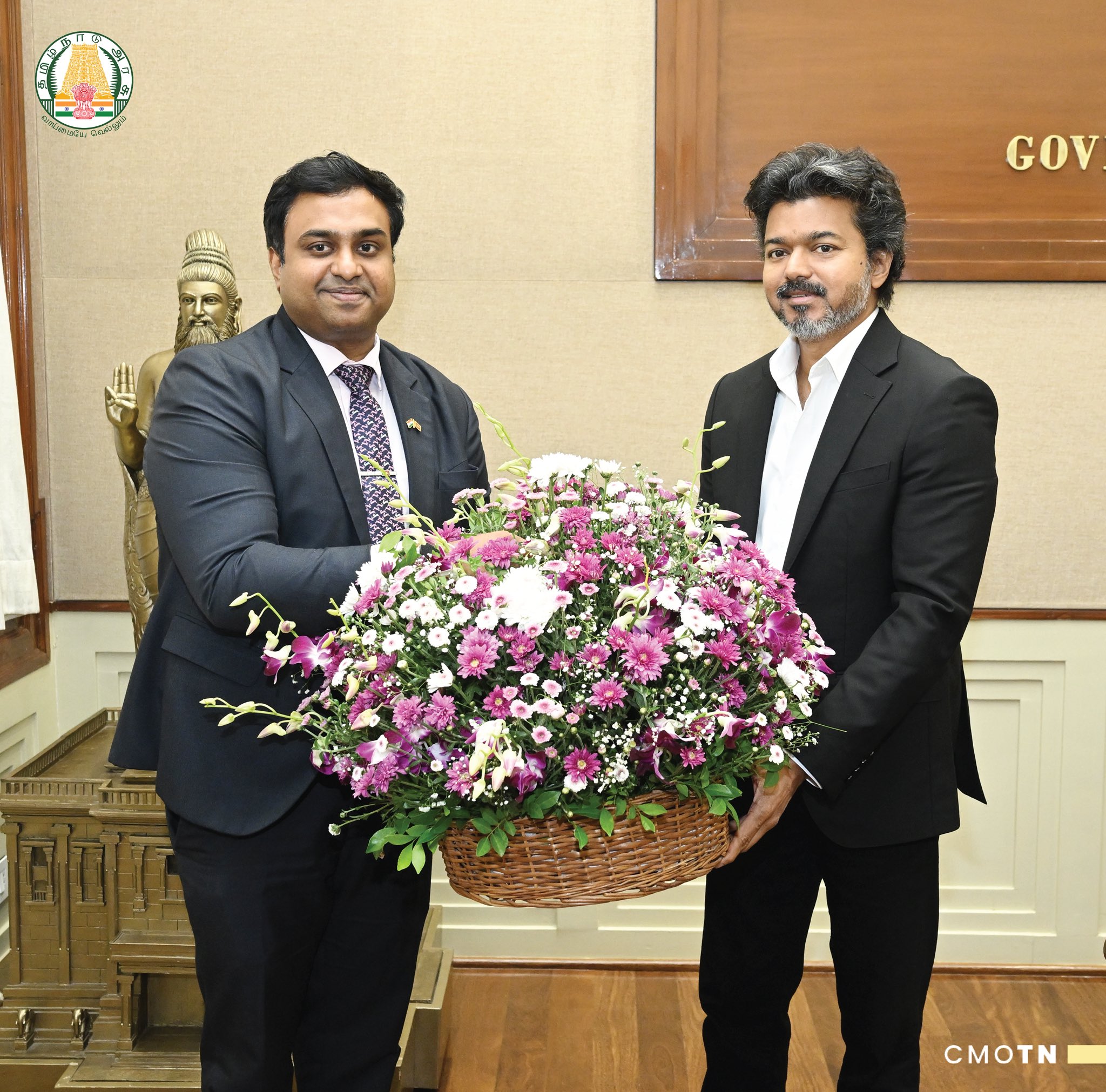
It comes just days after the Deputy High Commissioner of Sri Lanka in Chennai, Dr Ganesanathan Geathiswaran, paid a courtesy call on Vijay at the Secretariat in Chennai on 1 July, marking the first publicly announced meeting between the newly elected chief minister and a representative of the Sri Lankan state.
According to the Sri Lankan Deputy High Commission, Geathiswaran congratulated Vijay on assuming office and conveyed best wishes to the new Tamil Nadu government. The mission stated that the Deputy High Commissioner reaffirmed its commitment to strengthening cooperation and enhancing people-to-people ties between Sri Lanka and Tamil Nadu within the framework of the longstanding bilateral relationship between the two countries.
The meeting took place amid continued scrutiny of Vijay’s position on the Eelam Tamil national question. Since assuming office, the Tamil Nadu chief minister has made only limited public remarks on accountability, justice and the political aspirations of Eelam Tamils.
On Mullivaikkal Remembrance Day this year, Vijay said Tamils should carry the memories of Mullivaikkal in their hearts and pledged support for the rights of Eelam Tamils living across the seas. But his speeches inside and outside the Tamil Nadu Legislative Assembly have not yet outlined a clear political position on international accountability, self-determination or the future of the Tamil homeland.
Vijay has previously raised the issue of Tamil Nadu fishermen arrested by the Sri Lankan Navy during his first official visit to New Delhi, where he met Indian Prime Minister Narendra Modi.
However, he has yet to publicly set out a detailed position on the broader political demands of Eelam Tamils.