
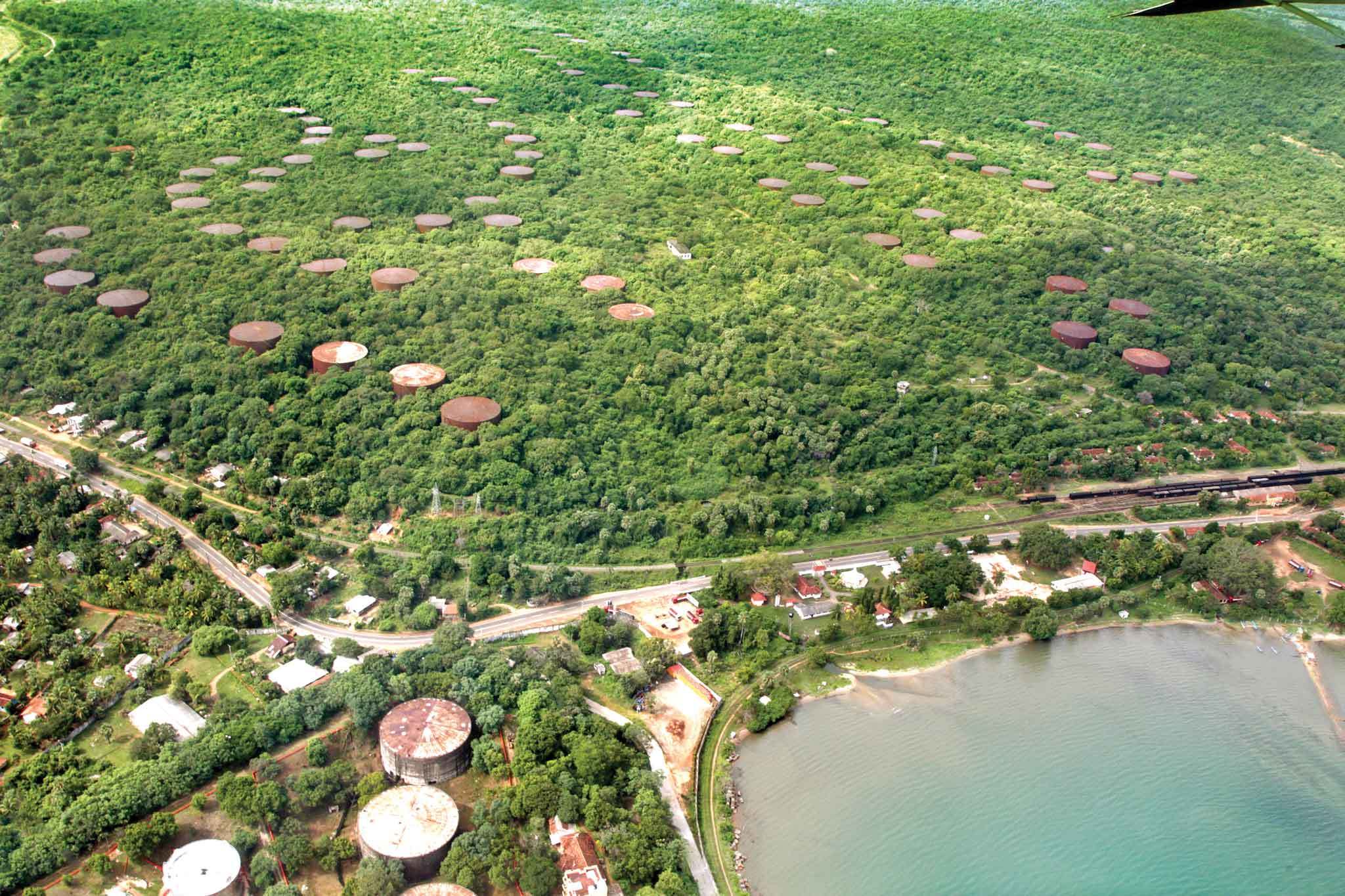
Sri Lanka's Foreign Minister Vijitha Herath has described the redevelopment of the Second World War-era oil tank farms in Trincomalee as the only credible long-term answer to the island’s energy crisis, as the island continues to grapple with fuel shortages triggered by the conflict in West Asia.
"Temporary solutions are not sustainable, we need a long-term strategy to deal with oil storage and distribution given the global energy situation," Herath told The Hindu on 21 March 2026, reiterating remarks he had made to Parliament the previous week. "That is why at the very beginning, our government signed the MoU with India and the UAE."
He was referring to the Memorandum of Agreement signed in April 2025 during Indian Prime Minister Narendra Modi's visit to Colombo, under which India, Sri Lanka, and the United Arab Emirates agreed to develop Trincomalee as a regional energy hub. The deal includes plans to modernise the tank farms and establish new refining and distribution infrastructure. A tripartite meeting has since taken place, and Sri Lanka has submitted a concept note for its partners to respond to.
"There are some technical aspects being addressed by the Energy Ministry. Once that is done, a tender process will be initiated to bring in investors," Herath said, adding that the government was working to "expedite the process."
The push to finally act on Trincomalee comes as Sri Lanka's fuel situation has deteriorated sharply. Although Sri Lanka does not import fuel through the Strait of Hormuz — its sources are India, Malaysia, South Korea and Singapore — the closure of the strait following the United States and Israel's attack on Iran has disrupted global supply.
"When a situation like this erupts…the entire country must face the ramifications. We are facing that same situation today," Herath told Parliament.
Sri Lanka switched to a QR code-based fuel rationing system last week as a precautionary measure, and the government has announced a four-day working week for the public sector to reduce fuel consumption. A new number plate-based rationing scheme also came into effect on 20 March, with vehicles issued fuel on alternating dates according to whether their plate number ends in an odd or even digit.
What are the tank farms?
The renewed urgency around Trincomalee sits against a history of broken deals and deliberate obstruction that stretches back nearly four decades. The site itself is located in the heart of the Tamil homeland. The tank farm, comprising 99 storage tanks each with a capacity of 12,000 kilolitres, was originally constructed in the 1930s to supply the British fleet in the Indian and Pacific Oceans. The Royal Navy remained at Trincomalee after Sri Lanka's independence before being expelled in 1957.
The 1987 Indo-Lanka Accord — the same agreement that promised devolution of land and police powers to a merged North-East province, a promise never honoured — included a commitment to develop the oil tanks as an India-Sri Lanka joint venture. That provision, like most of the Accord's undertakings towards the Tamil nation, lay dormant for decades.
India established a foothold through Lanka IOC, a subsidiary of the Indian Oil Corporation, which was granted control of a small number of tanks following a 2003 agreement.
However, in 2021, under Energy Minister Udaya Gammanpila, Sri Lanka reclaimed those tanks from the IOC, scrapping the deal amid pressure from Sinhala nationalist groups and Ceylon Petroleum Corporation trade unions. "I am proud to announce that the oil tanks the use of which had been denied to us since 2003 will be soon ours," Gammanpila declared at the time.
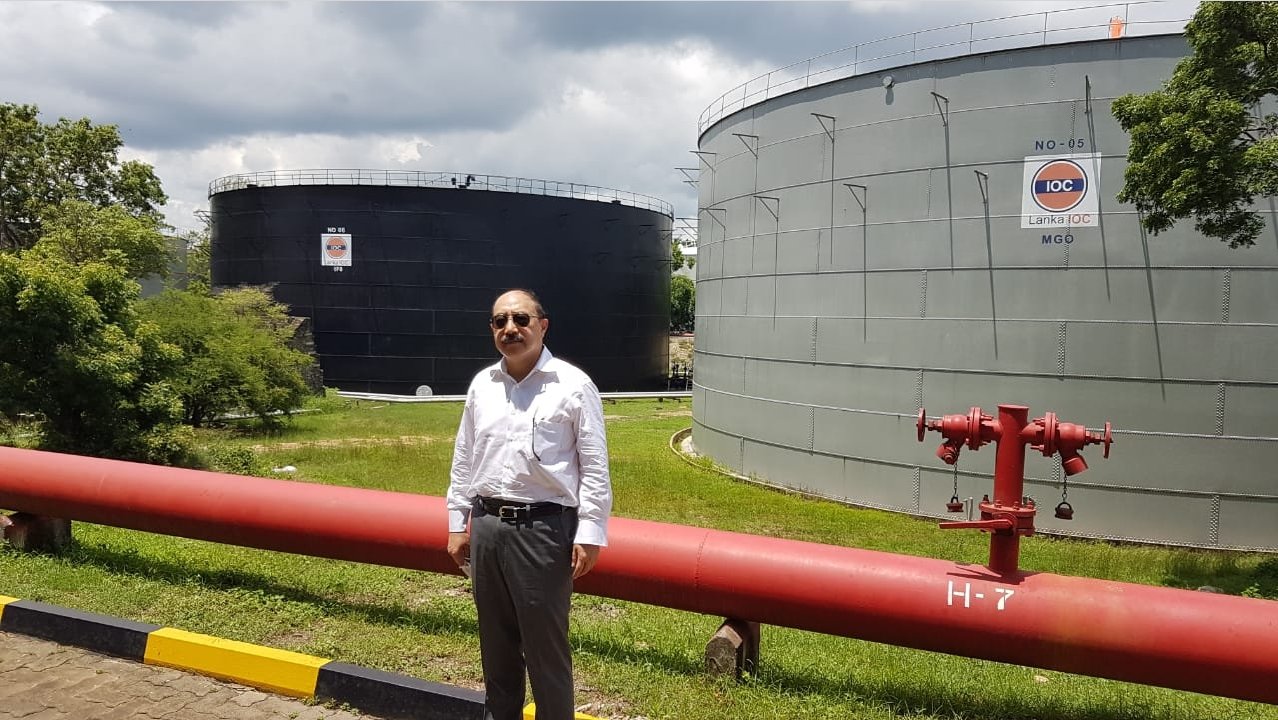
India’s Foreign Secretary Harsh Vardhan Shringla visits the Trincomalee oil tanks in October 2021.
The reversal was short-lived. Sri Lanka's catastrophic economic collapse in 2022 left Colombo with little leverage and forced a return to New Delhi. A new agreement gave the Indian Oil Corporation a 50-year lease over 14 tanks, with an additional 61 tanks assigned to a joint venture between Indian Oil and the Ceylon Petroleum Corporation. Sri Lanka's Energy Minister at the time acknowledged that any commercial activity at the site required IOC and CPC approval.
.jfif)
India’s Finance Minister Nirmala Siharaman visits the Trincomalee oil tanks in October 2023.
India, for its part, had little difficulty extracting the concession, as it had made its economic assistance to Sri Lanka contingent on progress at Trincomalee. India has been working on the development of the North-East, including improving connectivity via air and sea, taking control of the Trincomalee Oil Tank Farm to integrate Sri Lanka into India's national energy system, and plans to invest over $1 billion in two wind energy projects in Mannar.
The current ruling coalition's position on all of this represents a striking turnaround. The Janatha Vimukthi Peramuna, the dominant party within Sri Lankan president Anura Kumara Dissanayake's National People's Power coalition, spent years in fierce opposition to Indian involvement at Trincomalee, framing it as a surrender of a strategic asset to a foreign power. The JVP organised protests, made parliamentary speeches, and cultivated its credentials among Sinhala nationalist voters on precisely this issue. Despite protests and delays, the NPP government has now decided to continue its joint venture with India to develop the Trincomalee Oil Tank Farm, notwithstanding the JVP's history of vehement protests against the agreement.