
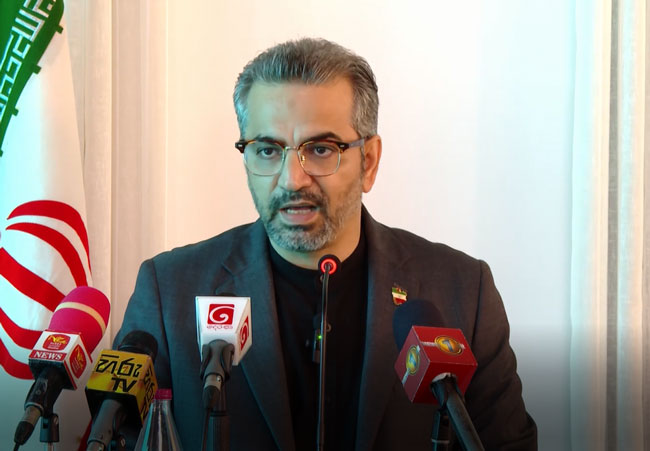
Iran's Ambassador to Sri Lanka, Dr. Alireza Delkhosh, has insisted that the frigate IRIS Dena was in Sri Lankan waters at Colombo's own invitation when it was torpedoed without warning by a United States submarine.
Speaking at a press conference held at the Iranian Embassy in Colombo, the ambassador offered his most detailed account yet of the circumstances surrounding the sinking, which killed 104 people according to Iranian officials and left dozens more injured, in what has become the most dramatic flashpoint of the US-Israeli war on Iran to reach the shores of South Asia.
"Dena was not ready for war. It was not here for war. It was not here for conflict. It was participating in peaceful exercises in India," Delkhosh said. The ship had been returning home following India's International Fleet Review and the multinational MILAN 2026 naval exercises at Visakhapatnam, which involved vessels from over 70 countries, including the United States itself.
The ambassador was emphatic that the vessel's presence near Sri Lanka was not incidental. "They were invited by the Sri Lankan side to come here… they came here upon their invitation. I repeat, invited by the Sri Lankan side," he said, adding that the Sri Lanka Navy Commander had extended the invitation during a meeting in India.
The Iranian Embassy had formally requested a goodwill visit for Dena and two accompanying ships, scheduled to begin on 9 March, days before the ship was sunk.
Delkhosh also alleged that no warning was given before the strike. "They did not receive any alert in advance… they attacked it without any warning," he said. That account is consistent with a statement by a US official, who confirmed that the United States did not provide a warning prior to carrying out the strike. US Defence Secretary Pete Hegseth, speaking at a Pentagon briefing, described the attack as a "quiet death" and confirmed it was the first time a US submarine had sunk an enemy vessel using a torpedo since the Second World War.
The ambassador challenged the characterisation of the Dena as a combat vessel. Many of those on board, he said, were not military personnel in any operational capacity. "Most of the people were not army… they were a music group, a music band," he said. The ship had been part of a cultural as well as naval delegation, with crew members visiting the Taj Mahal, attending a city parade and participating in ceremonial events during their time in India.
"The wounded persons fortunately are good… except two or three of them, the others are in good situation and they don't have any serious problem," he said, adding that Iran was grateful to Sri Lanka for its care of those affected.
He described the principal concern among the surviving sailors as one of separation from their families. "They are good and they are happy, no problem… just their worry is that they are separated from their family and they want to go back as soon as possible," the ambassador said, confirming that negotiations with the Sri Lankan government were under way to facilitate their return.
"We are talking and we are following this issue with the Sri Lankan government and I do hope that we can solve this problem as soon as possible," he added. According to Iranian officials, 251 sailors are currently being held in Sri Lanka, with discussions ongoing for their early release under international maritime conventions.
Earlier this month Reuters reported that an internal United States State Department cable indicated that Washington had urged Colombo not to return either the survivors from the IRIS Dena or the crew of a second Iranian vessel currently in Sri Lankan custody.
The cable, dated Friday, stated that Jayne Howell, the charge d'affaires at the US embassy in Colombo, had emphasised to the Sri Lankan government that neither the crew of the IRIS Bushehr nor the 32 survivors from the Dena should be repatriated. “Sri Lankan authorities should minimize Iranian attempts to use the detainees for propaganda,” the cable stated.
At the press conference, Delkhosh also addressed broader bilateral relations, describing Sri Lanka as a friendly country and reaffirming Iran's commitment to its relationship with Colombo. He stated that the Strait of Hormuz remains open to vessels of friendly countries, including Sri Lanka, and that Iran stood ready to supply the island with essential goods, including oil, should the need arise. "We do not want to see Sri Lanka in trouble, and the people of Sri Lanka are highly esteemed and respected in Iran," he said.
He also confirmed that infrastructure was in place to support foreign nationals inside Iran, including the option of departure through neighbouring countries. "If they wish to return to their countries, we can facilitate their travel through neighboring countries, such as Turkey," he said.
The press conference took place against a backdrop of deepening entanglement for Sri Lanka in a conflict it has taken pains to stay out of. Sri Lanka dispatched two navy vessels and an aircraft to respond to the Dena's distress call on the morning of 4 March, recovering 87 bodies from the sea and rescuing 32 survivors. The following day, a second Iranian vessel, IRIS Bushehr, requested to enter Colombo port after one of its engines failed. Sri Lankan president Anura Kumara Dissanayake subsequently announced that Sri Lanka would intern the ship at Trincomalee under international maritime conventions, and its 208 crew members were transferred to Colombo. A third vessel, IRIS Lavan, with 183 sailors on board, had separately sought refuge at the Indian port of Kochi, where India has since repatriated a significant portion of the crew.