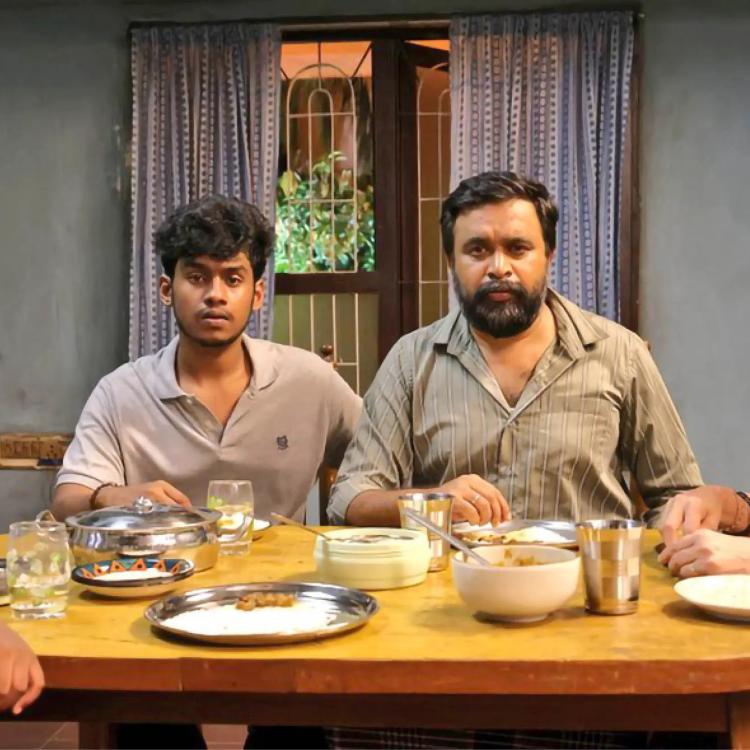
Tamil actor Sasikumar has addressed the criticism surrounding his recent film 'Tourist Family', in an interview with film critic Sudhir Srinivasan, in which he defends speaking up for Eelam Tamils and slammed film censorship in India.
The discussion covered criticisms focusing on the film’s portrayal of Eelam Tamil refugees in India. Sasikumar responds to concerns about whitewashing, censorship, and representation, while also speaking about his upcoming film, 'Freedom', which features Eelam Tamil characters but in a different light.
In the candid conversation, Srinivasan raised questions echoing the key criticisms outlined by others, including in an piece published in the Tamil Guardian: the dilution of the Eelam Tamil dialect, the absence of the phrase “Tamil Eelam”, and the portrayal of refugee life in India as overly simplistic and optimistic. Sasikumar defended the film’s creative direction while acknowledging the deep political and censorship-related challenges of portraying Eelam Tamil stories in Indian cinema.
Sasikumar, known for his rooted portrayals in Tamil Nadu films, plays an Eelam Tamil refugee in Tourist Family who forms a bond with his Indian neighbours. The film, intended as a light-hearted entertainer, drew ire for glossing over the harsh realities faced by tens of thousands of Eelam Tamils still confined to refugee camps in Tamil Nadu. In his interview, Sasikumar maintained that his personal experiences with Eelam Tamil friends during his boarding school days shaped his decision to take on the role and that the film was born out of empathy.
“I have many Eelam Tamil friends,” he said. “This movie shows how I would want to treat that community and encourages others to do the same.”
When asked about his decision to portray Eelam Tamil characters in back-to-back films, he highlighted the linguistic variety within Tamil cinema. He argued that Eelam Tamil deserves equal space within it, stating,
“I’ve done four films in Madras Tamil and ten in Madurai Tamil. Why can’t I do more in Eelam Tamil? Even if it’s the same dialect, there are so many different stories that can be told.”
However, when pressed on why Eelam Tamil wasn’t given the same level of authenticity often afforded to other Tamil dialects, he explained that the accent in Tourist Family was intentionally softened to aid audience comprehension, rather than to compromise its integrity. Nonetheless, critics argue that such choices contribute to a broader pattern of erasing and oversimplifying Eelam Tamil identity within Indian cinema.
Central to Sasikumar’s defence was the issue of censorship. He revealed that initial scripts included scenes depicting the family’s past in Eelam, but these were removed after pushback from India's Central Board of Film Certification (CBFC). Even a shot of his character glancing at a tiger toy, seen as a potential reference to the LTTE, was cut from the final version.
“The film could only be released because the Eelam issue was just a backdrop,” he admitted. “If we want to make progress in what we’re allowed to express, it has to happen gradually. We can’t fling all the doors open at once.”
When asked directly whether there were any restrictions on using the term “Tamil Eelam” in Tourist Family, Sasikumar denied this. Yet, the absence of the term in the film continues to raise questions and has been seen by critics as indicative of Kollywood’s wider hesitation to engage directly with the political identity of Eelam Tamils. This reinforces the perception that Tamil cinema often reduces Eelam Tamil suffering to an aesthetic device that sells tickets, rather than treating it as a serious political or human reality.
Despite the criticism, Sasikumar maintained that the film was ultimately one of hope.
“It gave people the belief that it is possible to be like the supportive neighbourhood shown in the movie,” he said.
While recognising the difficult history of Eelam Tamils, including those who fled abroad, he believed Tourist Family still served a purpose.
“For many Eelam Tamils living overseas, their children are growing up speaking other languages and have largely lost touch with their mother tongue. I have a friend going through this with his daughter. I made this movie for them, too,” he added.
Full interview can be found here.