
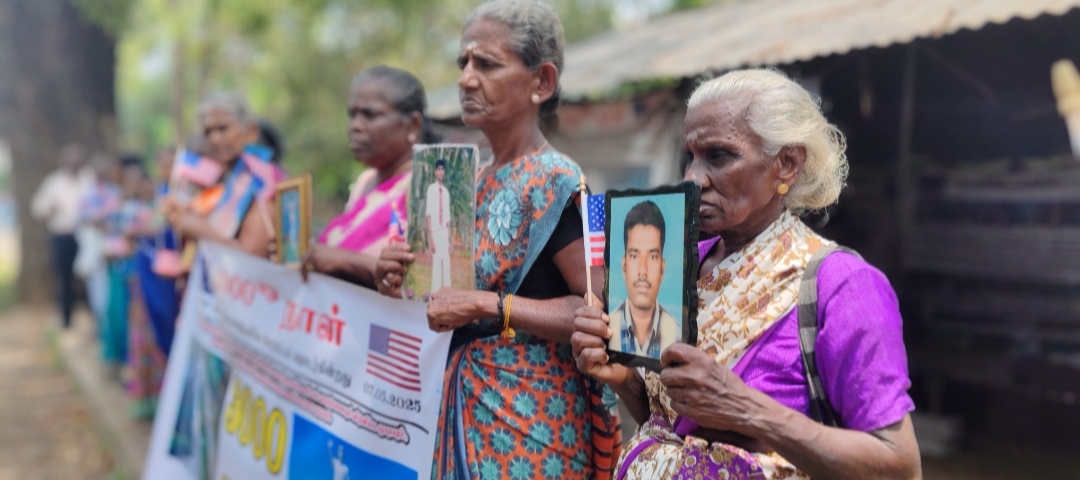
Sri Lankan security forces continue to harass Tamil families of the disappeared and weaponise counterterrorism laws against Tamil activists and journalists, despite promises of reform, Human Rights Watch (HRW) warned this week.
The rights watchdog called on the United Nations Human Rights Council (UNHRC) to renew mandates for evidence collection and monitoring of Sri Lanka.
“President Dissanayake pledged that he would adopt more rights-respecting policies, but very little has changed, particularly for Tamil victims of abuses,” said Meenakshi Ganguly, HRW’s deputy Asia director. “The families of the disappeared continue to face threats, including for engaging with the UN, while prospects for justice in Sri Lanka are as remote as ever.”
Last week, the UN Office of the High Commissioner for Human Rights (OHCHR) reported there had been no progress in accountability for atrocities committed during the armed conflict, with tens of thousands of Tamils remaining unaccounted for. Many were last seen in Sri Lanka military custody.
In June, UN human rights chief Volker Türk visited the Chemmani mass grave near Jaffna, where the remains of over 100 people, including children, have been unearthed. He called for “robust investigations by independent experts with forensic expertise who can bring out the truth.” Yet, as HRW noted, none of Sri Lanka’s mass graves, from Jaffna to Matale, have ever been properly investigated.
HRW documented continued harassment of Tamil families campaigning for justice. One mother of the disappeared said Terrorism Investigation Division (TID) officers interrogated her for three hours about her visits to Geneva to engage with the UN.
“Many mothers [of the disappeared] are mentally affected by the [police] inquiries, monitoring, and intimidation,” she said, adding that Criminal Investigation Department surveillance had increased. “Sometimes they approach our children to get information about us. That is a type of threat.”
Police frequently film memorials, intimidate attendees, and pressure communities not to associate with campaigners. In August, the TID summoned Tamil journalist and human rights defender Kanapathipillai Kumanan for questioning over his reporting on protests and land grabs.
Despite long-standing promises to repeal the notorious Prevention of Terrorism Act (PTA), the law continues to be used disproportionately against minorities. According to the UN, 38 people were arrested under the PTA in 2024 and 49 more in the first four months of 2025.
HRW highlighted the cases of:
• Mohamad Liyaudeen Mohamed Rusdi, detained under the PTA for pasting a sticker opposing Israeli policies. The Human Rights Commission of Sri Lanka found a “total lack of evidence” against him and warned of the PTA’s dangers.
• Mohamed Rifai Suhail, a 21-year-old student, held for nine months without charge for criticising Israel on social media. Police failed to notify the Human Rights Commission, in violation of the law.
HRW urged the Dissanayake administration to announce a moratorium on the PTA, end harassment of victims’ families, and invite international experts to investigate mass graves such as Chemmani. It also called on the UNHRC session in Geneva next month to extend monitoring and evidence-gathering mandates.
“Families of the disappeared in Sri Lanka have been fearless in their campaign for truth and justice, but they face government harassment every step of the way,” Ganguly stressed.
“Foreign governments should press harder for credible investigations of mass graves and the prosecution of those responsible for serious crimes in Sri Lanka, wherever they can be brought to justice.”
Read more HRW here.