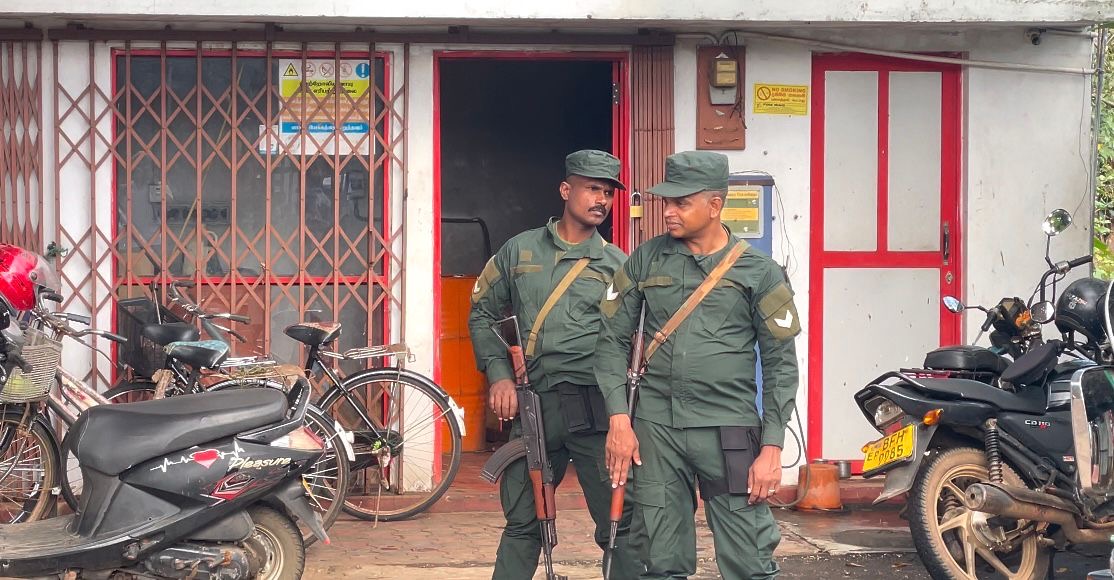
Vanni District Member of Parliament Thurairasa Ravikaran has formally rejected a parliamentary fuel distribution arrangement routed through Sri Lankan military-operated stations, stating that accepting services from the same military structure responsible for the enforced disappearances of thousands of Tamils would be a betrayal of both his political convictions and the community he represents.
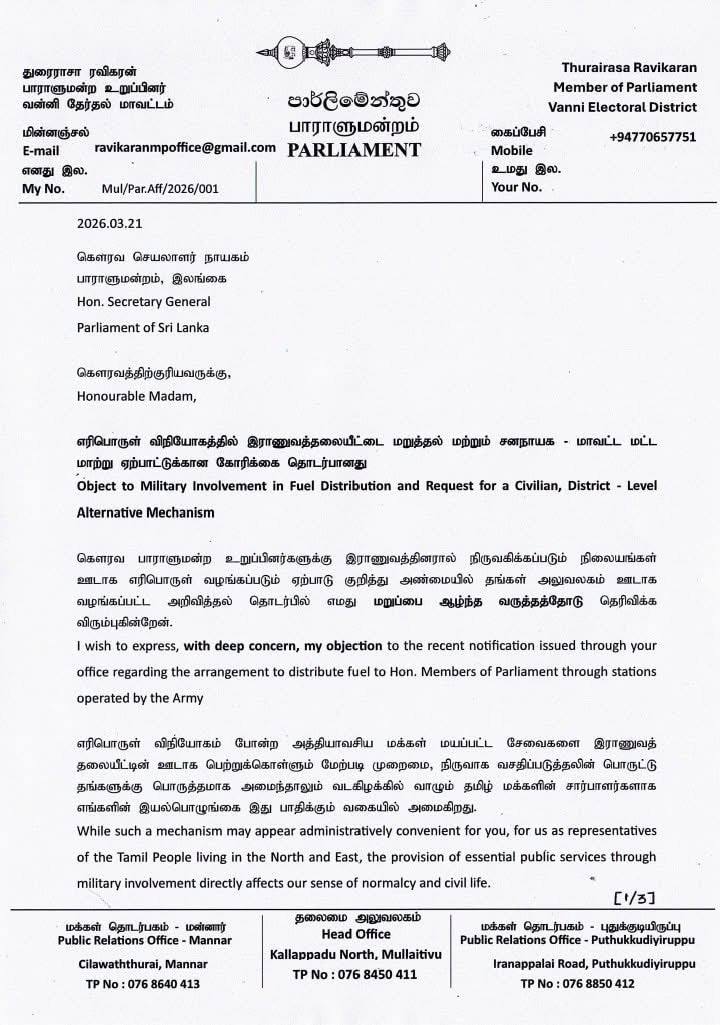
In a letter dated 22 March 2026, addressed to the Secretary General of Parliament and titled "Rejection of Sri Lankan Military Involvement in Fuel Distribution and Request for Democratic and District-Level Alternatives," Ravikaran outlined his refusal and proposed a series of civilian alternatives to the current arrangement.
The letter comes amid a worsening fuel shortage across Sri Lanka, linked to disruption of supply routes through the Strait of Hormuz. In response, a system had been introduced to supply fuel to Members of Parliament through military-run filling stations. Ravikaran declined the arrangement outright.
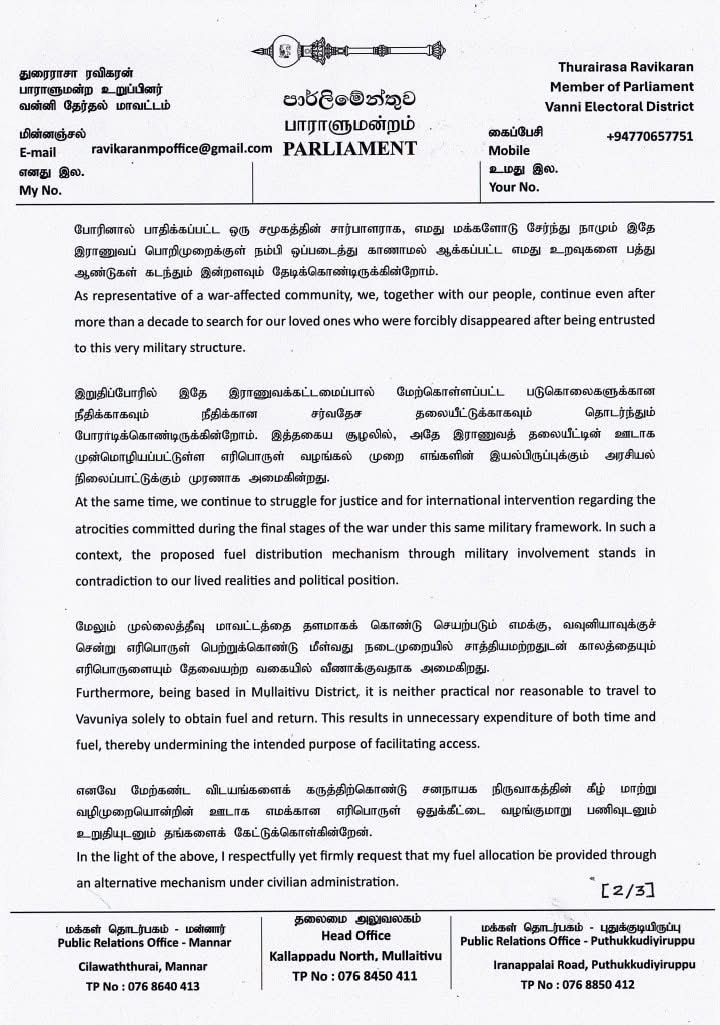
He stated that many Tamil relatives who were handed over to the military during the final phase of the armed conflict remain missing to this day, and that receiving services from the very institution accused of their disappearance was neither politically nor morally tenable. War-affected communities, he argued, should not be compelled to depend on military institutions for essential services.
Ravikaran also raised practical objections, noting that travelling from Mullaitivu to Vavuniya solely to collect fuel was not feasible and resulted in unnecessary time and fuel wastage in its own right.
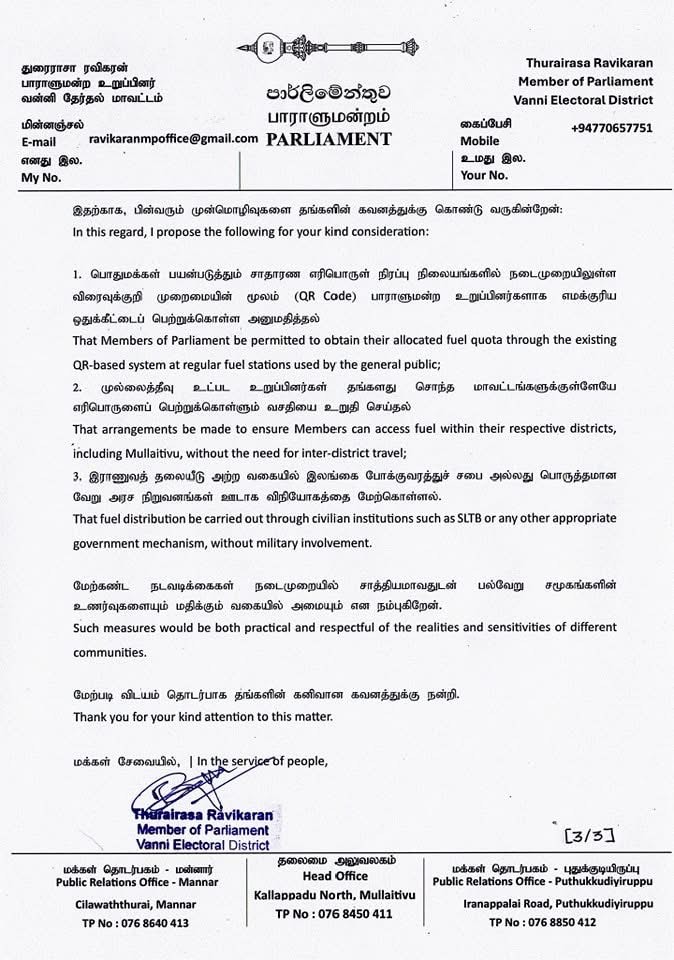
In place of the existing arrangement, the MP proposed three alternatives: access to fuel through the existing QR code system at civilian public stations; provision of fuel within MPs' respective districts; and distribution through civilian bodies such as the Sri Lanka Transport Board, without any military involvement.
His remarks coincide with the introduction of two new fuel distribution measures. In line with the existing QR code system, a number plate-based rationing scheme came into effect on Thursday, under which vehicles with plates ending in 0, 2, 4, 6 and 8 will receive fuel on even-numbered dates, while those ending in 1, 3, 5, 7 and 9 will receive fuel on odd-numbered dates.
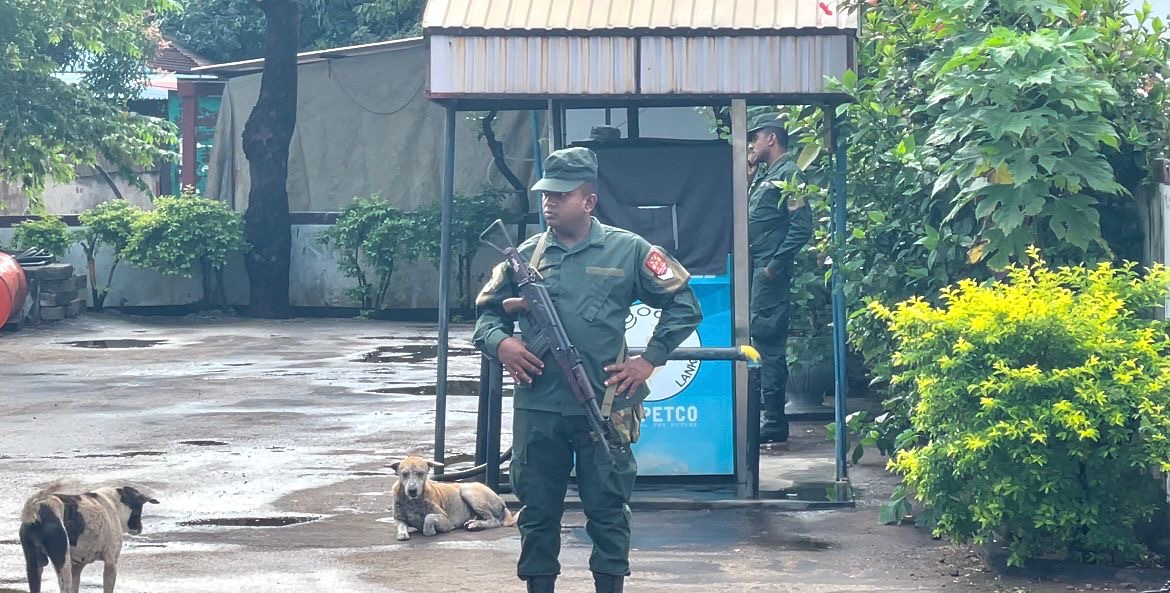
Meanwhile, in Jaffna, fuel filling stations have been placed under heightened security, with the Sri Lankan police, military, and navy all deployed at the pumps.
See the full text of his letter below.