
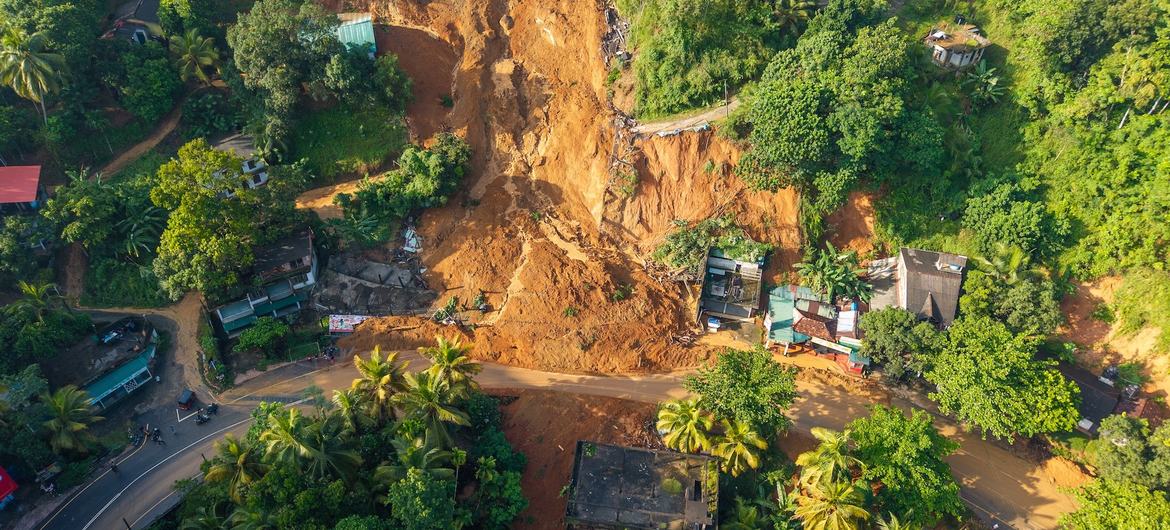
Photograph: Damage from the flooding in Uthuwankanda/UNICEF
Sri Lanka’s tea plantations have been left in ruins after Cyclone Ditwah tore across the island last week, uprooting fully grown crops, destroying entire hamlets and pushing thousands of already vulnerable plantation workers into deeper precarity.
The cyclone, described as the worst to strike the island in a century, has killed at over 600 people and affected more than two million, leaving an already fragile economy in tatters.
Sri Lanka’s highlands, the heart of the country’s tea and vegetable production, suffered the most severe damage. Official figures recorded at least 471 deaths in the region, alongside extensive destruction across hilly estates in Nuwara Eliya, Badulla and Uva, where landslides buried homes and wiped out livelihoods in minutes.
“It is all gone,” said Sundaram Muttupillai, a Tamil plantation worker who has laboured on estates in Thalawakelle since he was 17, told Al Jazeera.
“Now the roads are impassable. We do not have the essentials, nor any hope of overcoming the cyclone’s impact.” He, like many others, has been left without work and without a home.
For the upcountry Tamil plantation communities, who are some of the most marginalised and impoverished on the island, the cyclone has deepened an already acute crisis. “Our homes and livelihoods are gone,” Muttupillai added.
At a government shelter in Badulla, worker Senthilnathan Palansamy said entire hamlets had been buried. “There will not be any work for several months. We will have to snap out of plantation lives and work somewhere else.”
Preliminary estimates suggest a collapse of up to 35 percent in tea output, according to an anonymous member of the presidential cyclone recovery committee. “This would mean the resumption of work for plantation workers will get delayed, making an already vulnerable community more vulnerable,” he warned.
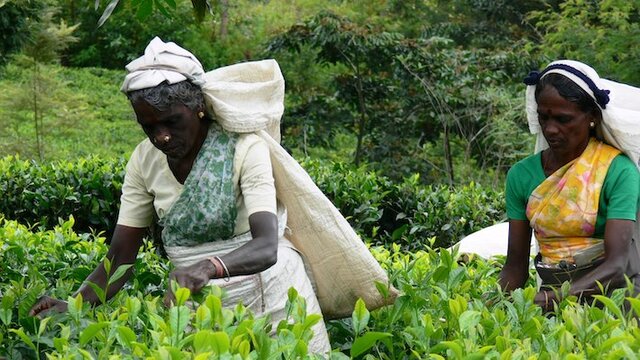
Tea remains Sri Lanka’s second-largest export earner after apparel, bringing in around $1.3bn annually with expectations of $1.5bn this year. The damage has disrupted harvesting, manufacturing, transport and fertiliser distribution. Roads and rail lines have been washed away, complicating the movement of goods across the island.
Sri Lanka’s wider economic situation leaves little capacity to absorb the shock. Still reeling from its worst financial crisis since independence, the country is bound by a US$2.9bn IMF bailout and is burdened with public debt nearing US $100bn, around 99.5 percent of GDP. The government has requested an additional US$200m in IMF relief following the cyclone.
Economists warn of spiralling consequences. Advocata Institute’s chief executive Dhananath Fernando compared the devastation to the 2004 tsunami and predicted a sharp rise in consumer prices. “The cyclone has dealt a heavy blow, and this shock will significantly reduce overall growth, not just our export capacity, but also local consumption,” he said. The likely collapse in tea output could undermine projections for export recovery and force plantation workers into precarious alternative labour. “We cannot afford people to shift from the plantations in search of other options,” Fernando added.
“Destruction to the sector is so vast, and it has dealt a huge blow to an industry that was picking up,” a source from the Tea Exporters Association of Sri Lanka told Al Jazeera. “Rebuilding will require both time and resources.”
Climate analysts have stressed that the scale of devastation underscores Sri Lanka’s vulnerability to extreme weather. “Even if we did not face a disaster of this magnitude, extreme weather should be factored in as part of industry preparedness,” said Omar Rajarathnam of Factum, warning that government planning continues to neglect the risks faced by highland communities.
Despite the scale of destruction documented across the plantations, the Colombo Tea Traders’ Association issued a statement claiming the tea sector was “recovering quickly”, describing damage as largely confined to roads and saying harvesting operations were returning to normal in some areas.
It added that auction schedules had been revised and efforts were underway to repair machinery damaged by flooding along the Kelani River.
The statement was a far cry from the reality on the ground, according to the plantation workers themselves.
.
“The tea plantations are now like wastelands,” Sharmila, a worker from Badulla told Al Jazeera. “The crops are devastated, homes destroyed, and we have lost so many people. I do not know whether we would ever recover.”