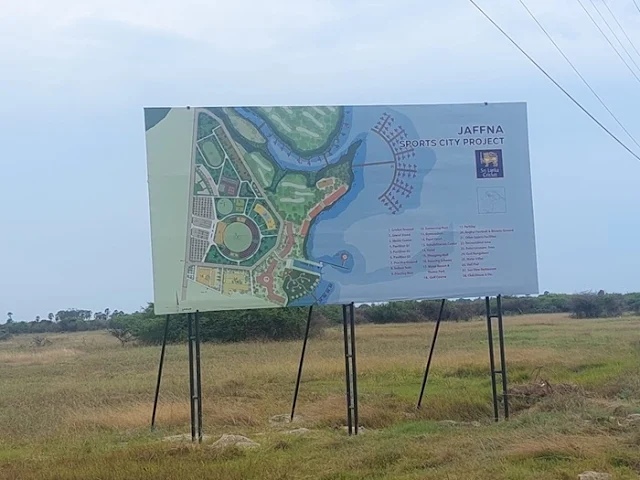
Construction of the Jaffna International Cricket Stadium in Mandaitivu is continuing and progressing according to government plans, despite sustained criticism from environmental organisations over the project’s legality and its potential impact on fragile local ecosystems.
Sri Lanka Cricket (SLC) confirmed that construction work was temporarily halted due to Cyclone Ditwah, which disrupted the project timeline, including a trial match that had been scheduled for 14 January 2026.
“Work has now resumed, and the trial match will be held after the completion of the ICC Men’s T20I Cricket World Cup 2026, co-hosted by Sri Lanka and India,” SLC stated.
The cricket board reiterated its confidence that construction would be completed within the planned timeframe. The international-standard ground is being developed on 48 acres and will include ten centre wickets, with boundary lengths extending up to 80 metres.
SLC has said the stadium forms part of a broader plan to establish a sports city in Jaffna, spanning a total of 138 acres. According to the board, the project is intended to strengthen cricket development in the Northern Province and complement its National Pathway Programme.
However, the Wildlife and Nature Protection Society of Sri Lanka (WNPS) has raised serious objections. In a formal letter sent last week to Anura Kumara Dissanayake, the society warned that construction of the stadium on Mandaitivu Island is unlawful and poses a significant threat to the area’s sensitive ecosystems and surrounding communities.
The WNPS stated that Sri Lanka Cricket has not obtained the legally required approvals under the Coast Conservation and Coastal Resource Management Act prior to commencing construction. Proceeding without these permits, the organisation said, constitutes a clear violation of environmental law.
The society emphasised that it does not oppose the development of a sports facility in Jaffna in principle, but strongly objected to the choice of location and the failure to comply with statutory environmental safeguards. It urged immediate intervention to halt the project in order to prevent irreversible environmental damage.
The dispute adds to wider concerns around large-scale development projects in the Tamil homeland, where local communities and civil society groups have repeatedly accused state-backed initiatives of disregarding environmental protections, consultation processes, and the rights of the people of the North-East.
Read more from the North Eastern Monitor here.