
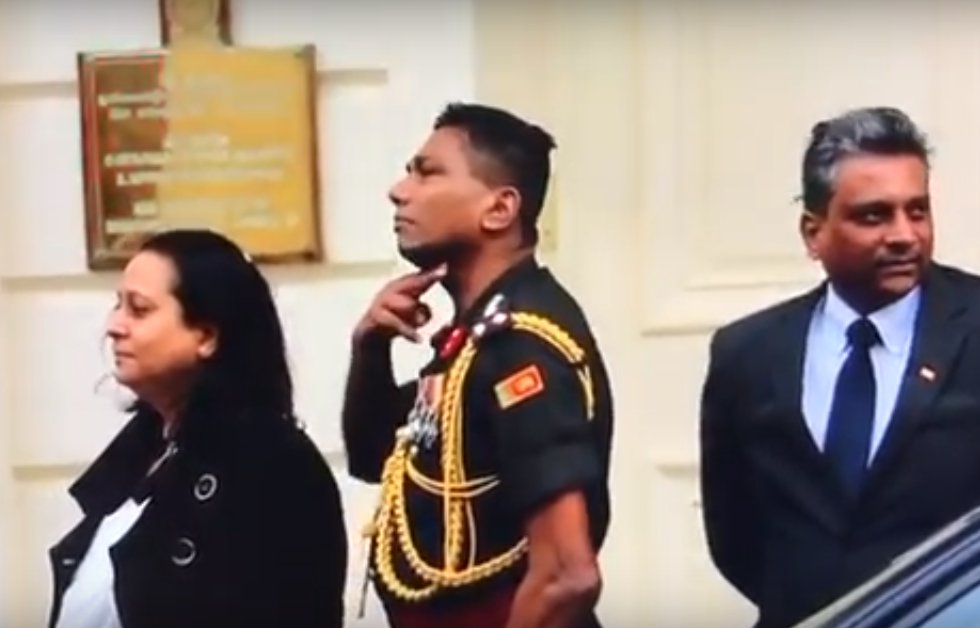
The British High Court has handed their ruling in support of former Sri Lankan defence attaché Brigadier Priyanka Fernando, who has appealed his conviction of breaching section 4A of the Public Order Act by making a cut-throat gesture at peace Tamil demonstrators outside Sri Lanka’s embassy.
In their ruling, Sir Julian Flaux C and Mrs Justice McGowan recognised the criminal behaviour of the Sri Lankan Brigadier, however, upheld his claim of diplomatic immunity.
“We consider that the acts in question in the present case were ones which were performed by the appellant in the exercise of his functions as a member of the mission and thus qua diplomat. They did not somehow lose that quality and become acts performed in a personal capacity merely because they were criminal. They remained acts performed by the appellant in the exercise of his functions as a member of the mission despite their criminality”, they argued.
The judgement further claimed that:
“…the Chief Magistrate was not right to determine that the actions the appellant performed, whilst he was a diplomat, were outside the functions of the mission and therefore not covered by residual immunity when the defendant faced trial. This appeal must be allowed.”
Responding to the decision solicitor Paul Heron, of the Public Interest Law Centre (PILC), who represented the three protesters, decried the judgement.
“We are extremely disappointed by this decision [...] We would not expect a diplomat to be carrying out his official duties by threatening peaceful protesters".
He further added:
“We will be reviewing the case in detail, consulting with our client and considering appeal options.”
Read the court judgement here.
Read PILC's reporting here.