
.jpg)
A Tamil man in Mullaitivu wades out of his flood-hit home.
Sri Lanka’s Disaster Management Centre (DMC) announced on Thursday that the death toll from Cyclone Ditwah has climbed to 479, as the island continues to grapple with damage of up to USD $7 billion.
More than 1.6 million people from 455,405 families have been affected, in what has become one of the most devastating disasters in recent decades, with a further 350 people still missing.
Entire districts, from the North-East to the central highlands, remain submerged or isolated by landslides. According to the DMC, at least 1,289 homes have been completely destroyed and more than 44,500 partially damaged. Large sections of the country’s agricultural heartland have been inundated, compounding an already severe economic crisis.
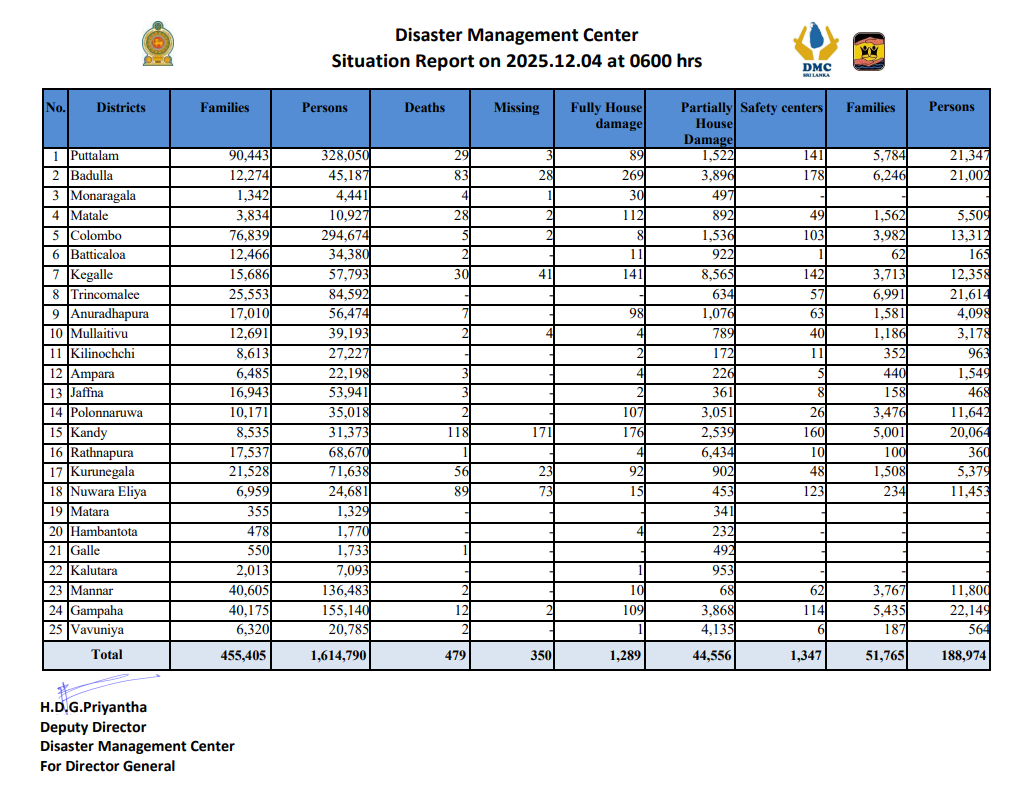
Photograph: Sri Lanka's Disaster Management Centre's situation report
The scale of infrastructure damage is unprecedented. The Commissioner-General of Essential Services reported that 1,777 irrigation tanks, 483 dams, 1,936 canals and 328 agricultural roads have been damaged. The country’s railway network is also in disarray, with fewer than one-third of its 1,000 miles of track still operational.
Prabath Chandrakeerthi, the Commissioner-General of Essential Services, described the devastation as “probably 10 times” greater than the destruction caused by the 2004 Indian Ocean tsunami. While that disaster devastated the island’s coastline, Cyclone Ditwah has torn through nearly every district, overwhelming local authorities and responders.
"Given that all 25 districts are affected, we estimate the cost would be USD 6-7 billion," Chandrakirthi told reporters.
Economists warn that the impact island-wide. The cyclone has disrupted regions responsible for more than 80 per cent of Sri Lanka’s GDP, including the Western Province, home to the country’s core manufacturing, financial and logistics sectors. Preliminary estimates suggest economic losses between Rs. 210 billion and Rs. 320 billion, with the overall damage possibly reaching USD 6–7 billion.
Duminda Hulangamuwa, the senior economic adviser to the president, said talks with international funding agencies had begun, but donors would wait for an official assessment currently being conducted by the World Bank. “It is not going to be easy,” he admitted.
The government’s own figures remain uncertain. Chair of the Committee on Public Finance, Harsha de Silva, said estimates vary widely. “Some say it is $3 billion, while Minister Alawathuwala said $6 billion. It hasn’t been assessed properly,” he said. He urged the government to redirect Rs. 500 billion reserved for retiring treasury bills next year towards emergency relief and compensation.
With thousands still stranded, hundreds more missing, and vast agricultural and economic networks in ruins, Cyclone Ditwah has left Sri Lanka facing a long and painful recovery.