
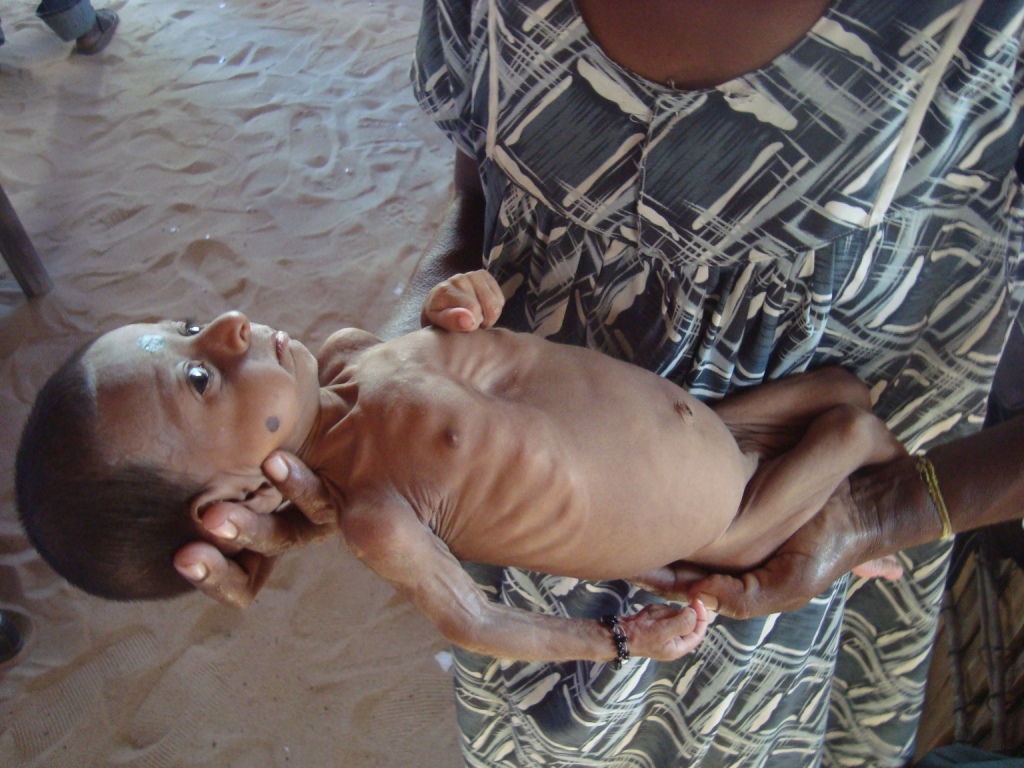
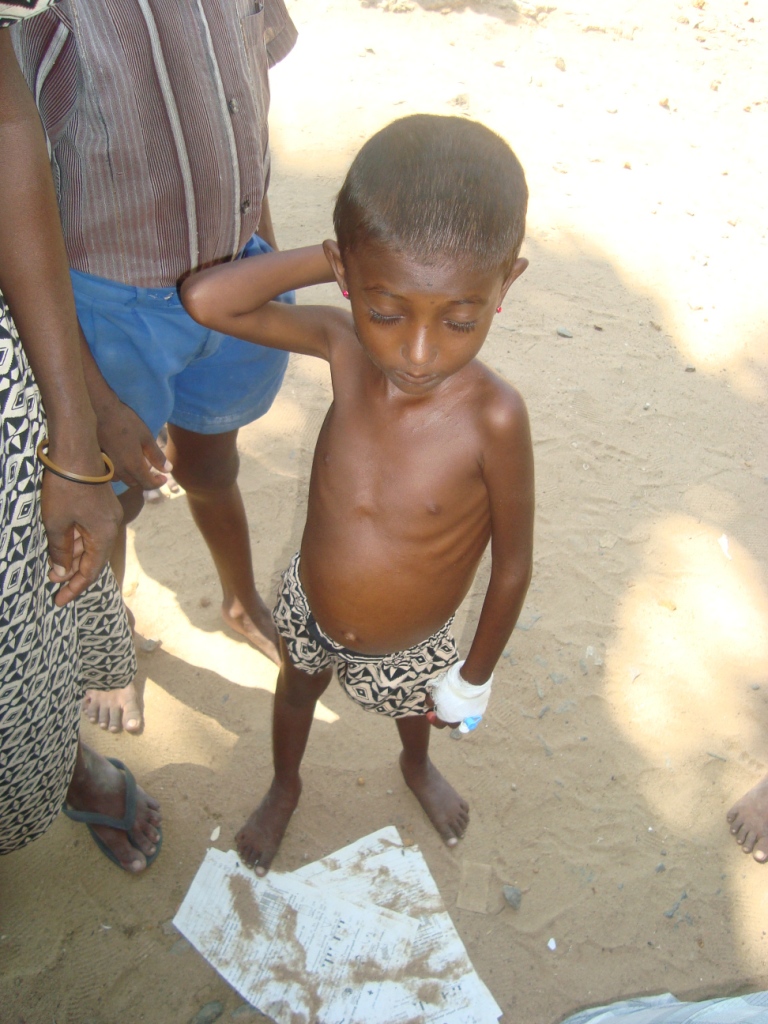
Photographs: Above and below - Tamil children with signs of acute malnourishment, pictured inside the final conflict zone.
As Israel faces global outrage for imposing its siege on Gaza by cutting off food, water, and supplies to 2.3 million Palestinians, observers of Sri Lanka’s ethnic conflict hear chilling echoes.
Several human rights organisations has accused Israel of using starvation of civilians as a method of warfare, which is a crime under international law. This tactic is not unprecedented. Sixteen years earlier, on the far side of Asia, Sri Lanka’s government deployed a nearly identical strategy against Tamils trapped in the Vanni, culminating in the 2009 Mullivaikkal genocide. Today, as Israel’s conduct in Gaza draws comparisons, many fear it is borrowing from Sri Lanka’s playbook of siege, starvation and indiscriminate slaughter.
In the final months of Sri Lanka’s massacres, government forces turned the Vanni region into a death trap sealed by hunger, a lack of medicine and under constant bombardment.
Just as Israeli officials openly vowed to block all essentials to Gaza – “No electricity, no food, no water, no gas – it’s all closed,” declared Defence Minister Yoav Gallant – Sri Lanka too choked off supplies to the LTTE-held Vanni, using deprivation as a weapon. The systematic denial of food, medicine, and clean water to hundreds of thousands of Tamil civilians in 2008–09 was identified as a deliberate strategy by Sri Lankan authorities.
It set the stage for a humanitarian catastrophe that shocked UN officials at the time, even if the world’s response was muted. Now, with Gaza under siege, that familiar playbook of mass civilian suffering is unfolding anew. It is a deadly testament to the impunity enjoyed by those who deployed it earlier.
Strangling the Vanni: A siege by design
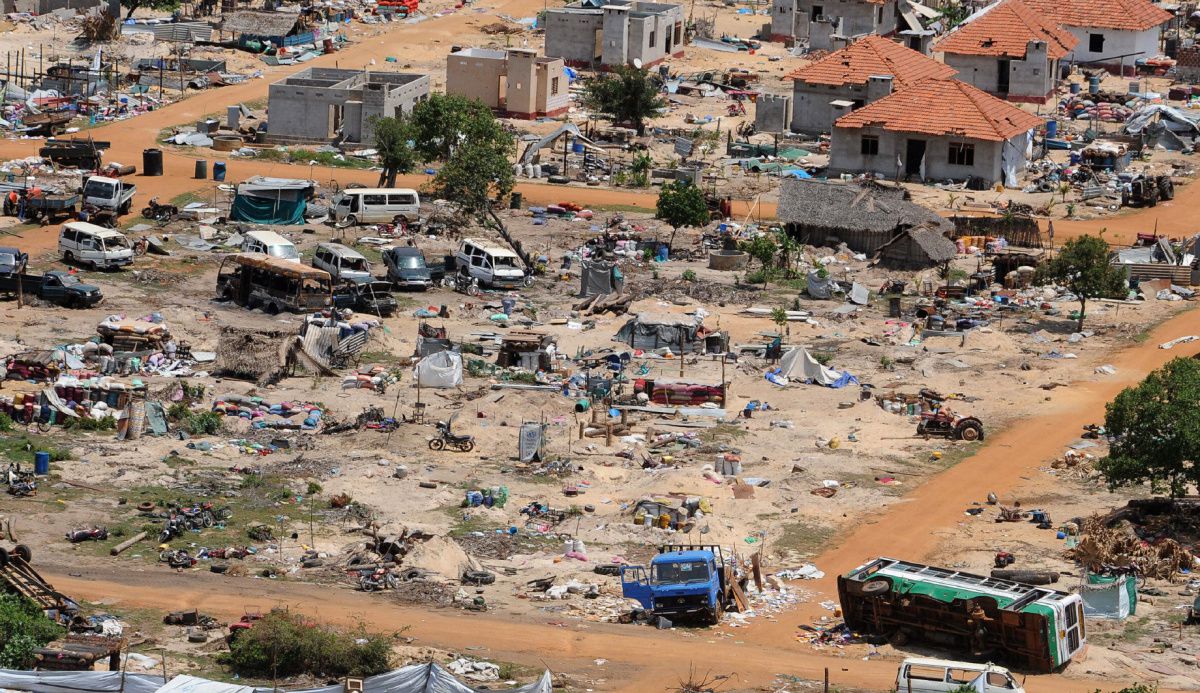
The aftermath of the Mullivaikkal genocide photographed days after it concluded.
Long before the final onslaught at Mullivaikkal, Sri Lanka’s government had prepared the ground by isolating and weakening the Vanni population. In September 2008, as war escalated, the government ordered all United Nations and NGO personnel out of LTTE-controlled areas, removing witnesses and aid workers from the coming storm.
Immediately, a tight siege was imposed, cutting off essential humanitarian aid to the hundreds of thousands of Tamil civilians who were increasingly hemmed into a shrinking war zone. The International Committee of the Red Cross (ICRC), one of the few agencies allowed near the battlefield, struggled even to evacuate the wounded by sea. An ICRC dispatch from May 2009 described the situation in Mullivaikkal as an “unimaginable humanitarian catastrophe”.
From October 2008 onward, food and medical convoys into the Vanni were tightly rationed and often obstructed by the Sri Lankan military. The last World Food Programme relief convoy reached the area on 16 January 2009. After that, the government halted land access, forcing the UN to attempt occasional shipments by sea. Even those were grudging and infrequent. In early February 2009, the UN warned of a growing food crisis in northern Sri Lanka.
The entire population of the Vanni is facing a food crisis, said Emilia Casella of the WFP, noting that 250,000 people were completely dependent on aid – yet no supply convoy had entered since 16 January. “We don’t have any more stocks to distribute,” she warned, and displaced families were already going hungry. Each week that convoys were blocked, the desperation deepened.
Behind closed doors, Sri Lankan officials cynically manipulated the numbers of civilians to justify the meagre aid. In Colombo, authorities insisted that only 70,000 civilians remained in the Vanni, even as UN and local estimates ranged from 200,000 to well over 300,000. This ploy was deliberate: “the Government’s denial of the real numbers buttressed arguments against increasing humanitarian convoys,” an internal UN inquiry later found. In reality, when the fighting ended, around 300,000 people emerged and were sent into internment camps, starkly exposing how badly the government had undercounted and undersupplied the population.
Put plainly, Sri Lanka’s government had been providing rations for a fraction of the Tamils actually at risk. It was a de facto starvation policy.
On the ground, the effects of the siege were soon visible. Food stocks dwindled and prices sky-rocketed in the Vanni enclave. By late 2008, local food production had collapsed: ongoing fighting and army takeovers had forced farmers off their land and even blocked irrigation to fields. With markets empty, basic staples sold at five to ten times the normal price, if they could be found at all. Families survived on scant foraging and ever-smaller rations. Witnesses recall people going hungry for days.
Meanwhile, the Sri Lankan state tightly controlled the official convoys, often allowing only a few hundred tonnes of food when thousands were needed. Between mid-February and mid-May 2009, for example, the total food delivered by sea was a fraction of the minimum survival requirement – literally only a few days’ worth of supplies for the entire trapped population. Every request to send more was met with stonewalling or delays. The result was a slow but systematic strangulation of the enclave.
Shelling the starving: Attacks on food queues
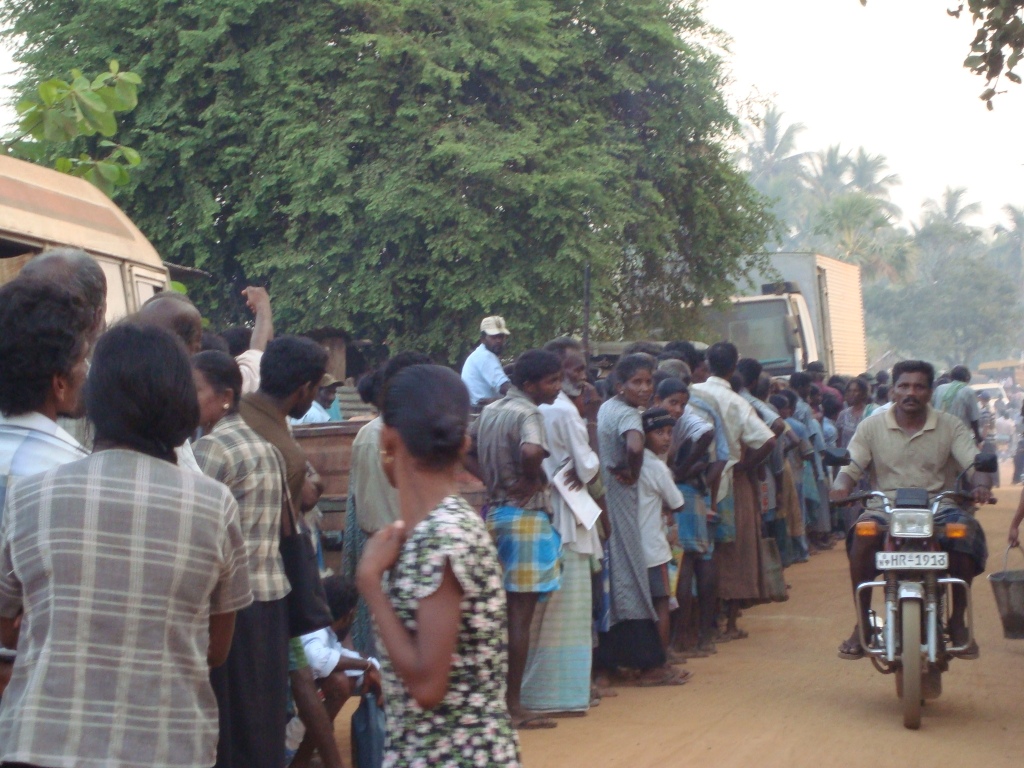
Photograph: People queue for food inside the final conflict zone, pictured May 5th 2009.
Starvation was not only a product of the Sri Lankan strategy. It was actively enforced through violence. In a pattern tragically similar to recent scenes in Gaza, Sri Lankan forces repeatedly attacked civilians as they gathered for food and relief. Artillery batteries that ringed the “No Fire Zones” zeroed in on bread lines and food distribution points, turning moments of hope into carnage. Each time the UN or local relief groups organized a food handout, it seemed the army’s response was to shell the crowds.
One of the earliest such atrocities came on 24 January 2009. Thousands of displaced Tamil civilians – exhausted, hungry, but desperate for rations – had queued up in a field near the Udayarkaddu hospital where food was being distributed. Without warning, shells began raining down.
“People lay on the ground as they heard the incoming fire approaching,” one UN staffer recounted. Five shells exploded in quick succession amid the food queues, killing at least 20 civilians and wounding many more. A witness described the scene as “complete chaos,” recalling that “people who had come to take food were instead carrying away dead bodies”.
This was not an isolated incident. Time after time, Sri Lankan forces struck civilians waiting for food, even when their locations were well known.
On 11 March 2009, for example, a large crowd had lined up at a distribution centre in Valayarmadam to receive rice and lentils. Moments after a surveillance drone was heard buzzing overhead, Sri Lankan artillery repeatedly shelled the queue. “Large numbers subsequently died from the attack, including the witness’s mother,” according to testimony later gathered by the UN.
Two weeks later, on 25 March, a similar horror unfolded. As hundreds of displaced people waited for boiled rice at a community kitchen in Ampalavanpokkanai, army shells were fired on them. One witness said the barrage lasted about 15 minutes and roughly 50 shells pounded the area, killing an untold number of men, women and children. Even aerial spotters were seen overhead during the attack, indicating the army knew exactly what it was targeting.
Then came perhaps the most egregious attack, widely reported for its sheer brutality. On the morning of 8 April 2009, in Pokkanai, hundreds of mothers and children gathered at a makeshift clinic to receive a rare distribution of powdered milk. The precious milk powder had just arrived by ship and been announced over loudspeaker, drawing families who desperately needed nourishment for their babies. The time and location of this distribution had been formally given to the Sri Lankan military by humanitarian agencies. It didn’t matter.
As the crowd queued outside the primary health centre, bombs rained down on them. In an instant, the clinic turned into a slaughterhouse. At least 50 people, including infants and young children, were killed in this single strike. Survivors described shredded bodies and body parts scattered across the ground. The local hospital was overwhelmed by scores of mutilated toddlers, screaming mothers, and “so many women and children dead and injured” that doctors were utterly swamped.
These attacks on food queues were no accident. In each case, evidence indicates the military knew exactly what it was targeting. The UN’s investigation found no LTTE military activity near the distribution sites, and Sri Lankan commanders had been specifically informed of the humanitarian gatherings. Surveillance drones were often overhead, and units like the army’s 58 Division were even monitoring the crowds in real time. In short, the army knew these were civilians – mostly women, children, and the elderly – queuing for food. They shelled them anyway.
The deliberate targeting of civilian food distribution points is a flagrant breach of international humanitarian law, and the UN later concluded there were “reasonable grounds to believe” these attacks were intentional. Such acts, which terrorize and starve civilians, “are strictly prohibited under international humanitarian law and amount to serious violations thereof,” the UN report stated.
‘Everyone was starving’
.jpg)
Photograph: People queue for food inside the final conflict zone, pictured May 5th 2009.
For the survivors in the Vanni, the last months of the genocide were a journey into the heart of hunger and despair. Those not ripped apart by shells faced a slower death by starvation.
Witness testimonies and humanitarian reports from early 2009 describe a population wasting away. A displaced Tamil medic recounted how even small children exhibited signs of severe malnutrition: “One of the children who was 18 months old ... could not stand up or walk and had to be carried all the time. ... They showed signs of muscle wastage in their legs, they had distended stomachs and their ribs were showing through their skin”, she said, describing classic symptoms of prolonged starvation.
Another survivor from Mullivaikkal recalled the all-pervasive hunger: “Everyone was starving. I could see the children were malnourished and the elderly were very weak,” he testified grimly, the images of emaciated toddlers and feeble old men seared into memory.
By the time the guns fell silent in May 2009, the toll of deprivation was unmistakable. UN agencies reported that the civilians coming out of the conflict zone were in ghastly condition – “sick, hungry and suffering from acute malnourishment and dehydration,” in the words of UNHCR spokesman Ron Redmond.
Local health officials reported elderly people dying of starvation even before the conflict ended, simply unable to fend for food during the chaos of displacement. In one striking incident, a magistrate in Vavuniya ordered the release of some starving elderly detainees after “a series of deaths which he attributed to starvation” in the overfilled camp.
The intentional nature of this suffering has since been well documented.
In its OISL investigation, the UN detailed how government officials persistently refused appeals for more food, justified their stance with false statistics, and denied the very reality of starvation on the ground. Even after the genocide, Sri Lankan leaders maintained the fiction that they had sent ample supplies and that “at no point was [a] food shortage raised” by anyone – a claim brazenly contradicted by months of UN warnings and the harrowing condition of the survivors.
To many, this official denial was yet another insult: a refusal to acknowledge the mass suffering that had been inflicted by design.
Impunity and repetition: From Mullivaikkal to Gaza
Sri Lanka’s genocide ended in May 2009 with tens of thousands of Tamil civilians dead on the beaches of Mullivaikkal. Yet, in the aftermath, no one was held accountable. Sri Lankan officials simply denied all wrongdoing, insisting – against all evidence – that “zero civilians” were harmed.
The international community, preoccupied or complicit, took no meaningful action to pursue justice. This international indifference left a dangerous legacy.
In the years that followed, strategists around the globe took note of Sri Lanka’s approach. The Sri Lankan army’s total victory– achieved through siege, indiscriminate shelling and mass civilian casualties – was held up by some as a model of counter-insurgency. Indeed, Israeli military analysts have explicitly referenced the “Sri Lankan model” when discussing how to deal with Hamas. Moshe Elad, a former Israeli security official, wrote on how Sri Lanka demonstrated that “terror groups can be completely defeated through military means” without the constraints of outside scrutiny. Ominously, he noted Sri Lanka did it “without a Supreme Court or B’Tselem” – meaning without legal oversight or human rights watchdogs.
Today, as Israeli forces bombard Gaza and enforce a blockade that United Nations experts liken to collective punishment, the parallels to Sri Lanka are unmistakable.
It follows a now-familiar playbook: the shelling of hospitals, the deliberate denial of humanitarian aid, and the displacement of a civilian population into so-called safe zones only to bomb them indiscriminately.
In Gaza, as in the Vanni, civilians have been herded from one shrinking enclave to another under the banner of “safe zones,” only to find that nowhere is safe. As Krisna Saravanamuttu put it, “Israel borrows the strategy of declaring ‘safe zones’ from Sri Lanka, too... Sri Lanka forced Tamils into smaller areas of land only to bomb those same areas”, just as Gazans have come under renewed attack.
The siege tactics are also mirror images: Sri Lanka cornered the Tamil population and cut off life-saving aid, and Israel has sealed off Gaza, throttling supplies of food, fuel, water and electricity.
The effect and intent is the same: to starve a people into submission. If there is a grim lesson in this repetition, it is that impunity enables atrocity. Sri Lanka’s success in avoiding accountability after 2009 sent a message that has not been lost on other states fighting insurgencies: If you cage in a population and bomb them into the ground while blocking food and medicine, the world may avert its eyes – and you might just get away with it. Israel’s leaders today deny targeting civilians intentionally, just as Sri Lanka’s did, but the humanitarian impact of their siege speaks louder than any official statements. Starvation is being used as a weapon once again, before the eyes of a watchful world. And the world’s response, or lack thereof, is setting a precedent.
The starved and shelled Vanni is a warning to all. Allowing one nation to get away with starving a civilian population invites others to follow suit. We must recognise starvation for what it is: not an unfortunate byproduct of war, but a deliberate tactic of extermination.