
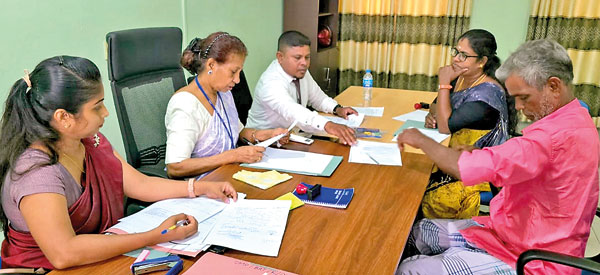
Photograph: Sunday Times.
An investigative team visited the suspected mass grave site at Kurukkalmadam in Batticaloa last week, to plan the next stage of excavations and exhumations amid renewed demands from Tamil families for international oversight.
The team — comprising Judicial Medical Officers (JMO), archaeologists, police Scene of Crime Officers, lawyers for complainants, and officials from the Office on Missing Persons (OMP) — inspected the site under the supervision of Kaluwanchikudy Magistrate J. B. A. Ranjithkumar. A formal investigation plan and budget will be submitted to court on September 18.
The OMP confirmed that the field visit was facilitated after Magistrate Ranjithkumar issued an order last month under Article 12(d) of the OMP Act, which allows applications to begin excavations at suspected mass grave sites.
Families of the disappeared, who believe their relatives may be buried at Kurukkalmadam, were permitted to observe proceedings. Twenty-six families have already submitted affidavits regarding the disappearance of loved ones.
On Friday, the OMP recorded statements from at least 66 families of the disappeared at a special sitting in Batticaloa. However, victims’ relatives and rights groups have long rejected the OMP as a credible body, denouncing it as part of Colombo’s domestic façade to avoid international accountability.
Deputy Minister of National Integration Muneer Mulaffer meanwhile announced that Rs. 2.9 million has been allocated for the excavations, which are scheduled to formally commence next week.
The developments in Batticaloa come as investigations at the Chemmani mass grave site in Jaffna continue. To date, more than 240 skeletal remains — including children — have been identified there, alongside a baby bottle, schoolbag and evidence of execution-style killings. A court in Jaffna is expected to rule on the next stage of Chemmani excavations on September 18.
For decades, Tamils have maintained that Sri Lanka’s institutions cannot be trusted to deliver justice, pointing to a history of cover-ups, intimidation and destroyed evidence in mass grave investigations from Chemmani to Mannar. Despite mounting international concern, Colombo continues to block any foreign forensic or judicial role, insisting that all exhumations and prosecutions will remain under domestic control.